From aerial sightseeing to "sky weddings", China is exploring new and innovative ways to develop its bourgeoning low-altitude economy which features manned or unmanned aviation services at low elevations.
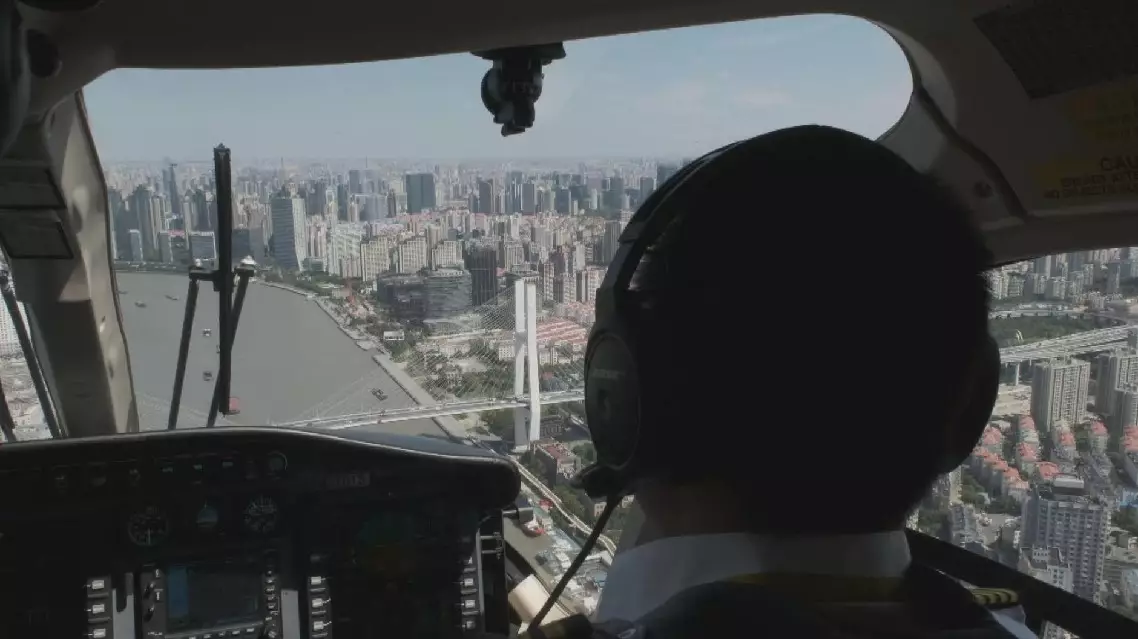
Shanghai launched its first helicopter tour service over the Huangpu River on Tuesday, the first day of the seven-day National Day holiday.
Starting from Xuhui District in downtown Shanghai, to Lujiazui, one of the city’s financial hubs, the round-trip journey is about 24 kilometers, with a flight time of around ten minutes.
"The reservation volume is quite good. Many people book the aerial tour online, and others buy tickets at the airport after seeing our helicopters or hearing their roaring sound from the sky. We receive dozens of customer groups each day," said Cao Xintian, operator of the helicopter tours over the Huangpu River.
During the trip, tourists can not only admire the beautiful scenery of the Huangpu River from the sky, but see many iconic buildings and scenic areas, including the Shanghai Expo Cultural Park, the Bund, and the Oriental Pearl Tower.
"My son has a strong interest in modern transport, including helicopters and high-speed trains. This program allows him to see the changes of Shanghai from a very unique perspective and appreciate the beautiful scenery along the most classic tourist route in Shanghai. I think this helps both his growth and academic study," said a tourist named Zhang Nan.
A group wedding party in Zhongyang County in north China's Shanxi Province for 30 new couples also featured a helicopter tour for the newlyweds.
Flying over the Lvliang Mountains with a bird's-eye view of the county's magnificent landscape will ensure a memorable wedding day for these couples.
The "sky wedding" was sponsored by the Beijing-based Beihang University, a multi-disciplinary and research-oriented university focusing on aeronautical and astronautical engineering, which is exploring ways to develop the low-altitude economy in the country.
The low-altitude economy is an emerging sector in China whose scale is expected to reach 2 trillion yuan (about 285 billion U.S. dollars) by 2030.
Aerial sightseeing, "sky wedding" show China's low-altitude economy taking off
Commemorations honoring Chinese People's Volunteers (CPV) martyrs were held on the banks of the Yalu River in Dandong, Liaoning Province on Tuesday as part of ongoing tributes to those who fought in the War to Resist U.S. Aggression and Aid Korea (1950-1953).
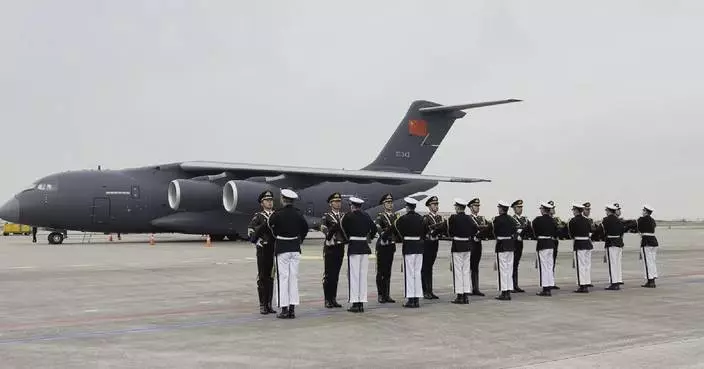
The event was held to mark the return of the remains of 12 CPV martyrs, who were killed in the war, from the Republic of Korea (ROK) on Wednesday.
This will be the 13th such repatriation of CPV remains following the handover agreement between the two countries. Since 2014, the remains of 1,011 soldiers have been returned to China from the ROK, according to China's Ministry of Veterans Affairs.
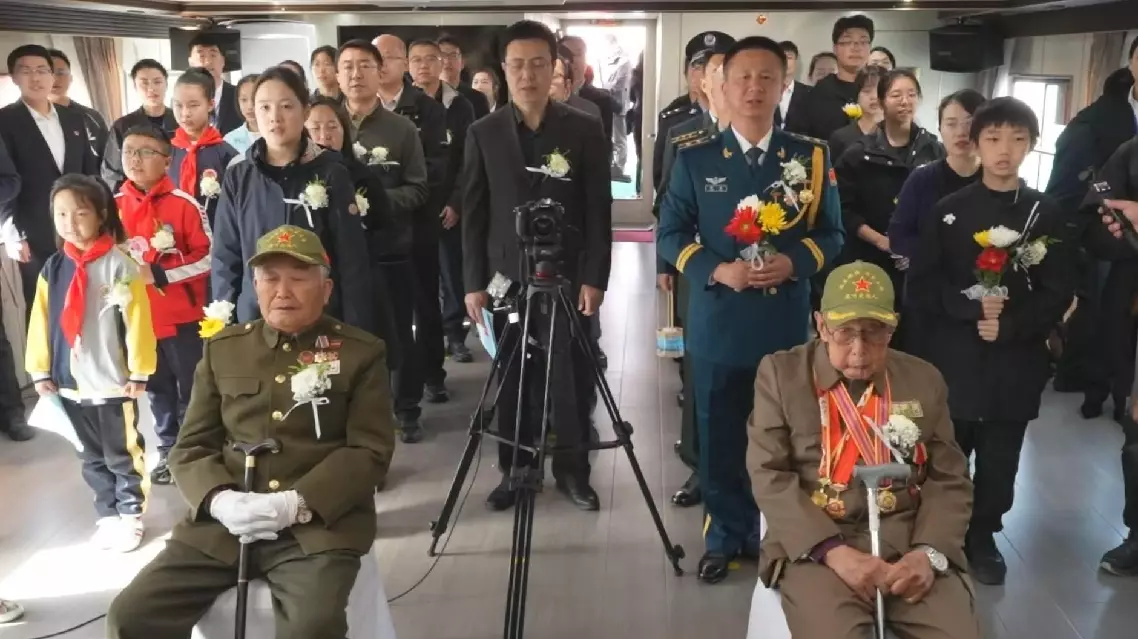
More than 170 representatives, including veteran CPV soldiers, relatives of the martyrs, active-duty personnel, students, and other from various sectors of society, attended the event.
People boarded a ferry which slowly sailed down the Yalu River. Inside the cabin, all present stood in solemn silence as the national anthem of the People's Republic of China was played, and observed a moment of silence in honor of the CPV martyrs.
Then, they walked to the ship's railings one by one and scattered flower petals into the river to pay tribute to the martyrs.
"We, the CPV, went abroad to fight to defend our motherland, the people, and our good life and to resist U.S. imperialist aggression against the Democratic People's Republic of Korea (DPRK). I hope that our young comrades and students today will study hard and make contributions to our motherland," said Hu Changzhe, a CPV veteran.
"I feel deeply moved as these veteran soldiers are heroes who once fought for our country. Now, standing by the Yalu River, looking back on their past and remembering their comrades, they must be deeply touched," said Hong Jialu, a student at a branch of Liaoning Province Shiyan High School.
At the event, 10 student representatives from primary and middle schools read aloud a letter to express their reverence and remembrance for the heroic martyrs through their sincere words and heartfelt recitation.
The Korean War broke out in June 1950, eight months after the People's Republic of China was founded. At the request of the Democratic People's Republic of Korea (DPRK), China sent 2.9 million CPV soldiers to assist the DPRK during the war, of whom more than 360,000 were killed or injured.
Commemorations held to pay tribute to CPV heroes in northeast China