Skip to Content Facebook Feature Image

Beijing Central Axis embodies Chinese rites, order, and philosophy in capital city planning

China

China

China

Beijing Central Axis embodies Chinese rites, order, and philosophy in capital city planning

2024-10-04 22:39 Last Updated At:10-05 03:27

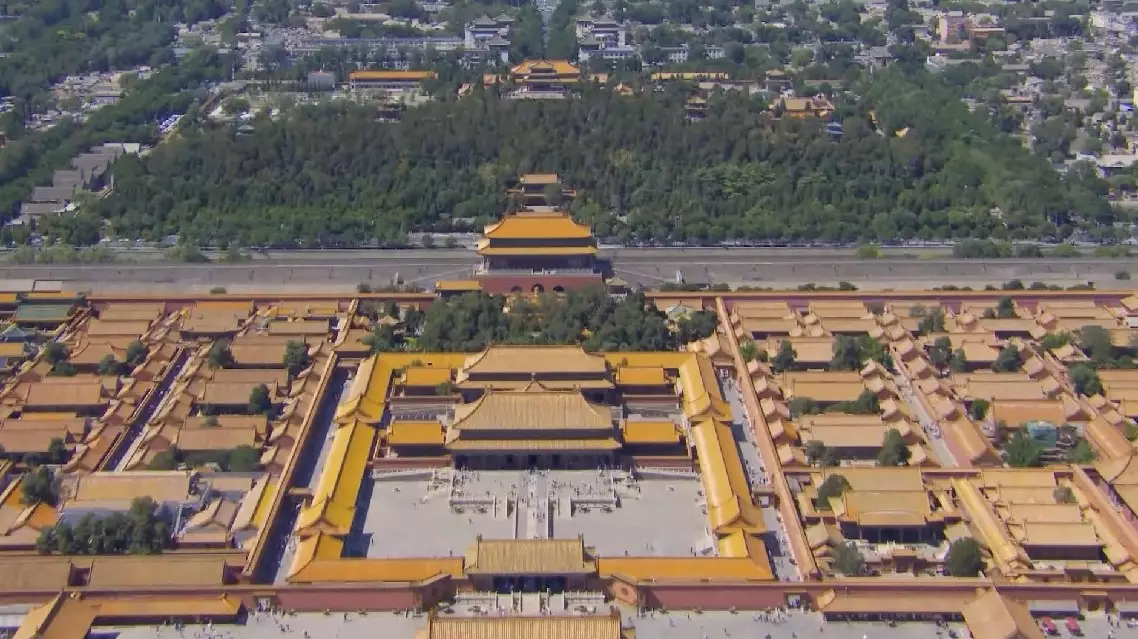
With its unique axis and symmetrical layout, the Beijing Central Axis vividly embodies China's millennium-old capital city planning traditions, which emphasize rites, order, and the philosophical ideals of equilibrium and harmony, cultural preservation specialists said.

The Beijing Central Axis, stretching 7.8 kilometers, begins at the Bell and Drum Towers in northern Beijing and extends southward through the Forbidden City and Tian'anmen, reaching Yongdingmen (Gate of Perpetual Peace). The Imperial Ancestral Temple (Taimiao) and the Temple of Heaven are located on the eastern and western sides of the axis, respectively.

The principles of the urban layout include defining the north-south axis and establishing a "center" that reflects Confucian ideas. These principles aim to promote neutrality and harmony in society through symmetry and balance in the city's design.

Originating in the Yuan Dynasty (1271-1368) and further developed during the Ming Dynasty (1368-1644) and Qing Dynasty (1644-1912), the Axis has remained the foundation of Beijing's urban layout to this day, said Lyu Zhou, director of the National Heritage Center at Tsinghua University.

"The Beijing Central Axis is a whole. It has experienced 700 years of continuous development and has been the foundation of the layout of Beijing. It reflects our understanding of what a nation should be, how to construct its order, and the order of people's lives. So, when we talk about the Beijing Central Axis, I think the most important aspect is that it serves as a prime example showcasing the ideal order of the Chinese capital," said Lyu.

Due to its significant historical importance, the Axis was added to the World Heritage List in July by the United Nations Educational, Scientific and Cultural Organization (UNESCO).

UNESCO posted that Beijing Central Axis is an exceptionally well-preserved example of an urban ensemble. It added that the World Heritage site was developed based on "an ancient urban planning theory founded in Confucian principles" and has "a ritual dimension encompassing city planning, politics, and governance."

"The Beijing Central Axis is the physical representation of traditional values, architectural designs, and philosophical thoughts of ancient China. It showcases the diverse unity of the Chinese nation and is a masterpiece of the ideal order of the Chinese capital. Its inclusion in the World Heritage List addresses the absence of an urban layout originating from Oriental civilizations," said Guan Qiang, deputy director of China's State Administration of Cultural Heritage.

The symmetrical design embodied in the Axis, first found in Kaogongji, or Book of Diverse Crafts, written in the Eastern Zhou Dynasty (770-256 B.C.), has a 3,000-year history, said Lyu, adding that the idea has been influencing China ever since.

"The ideas embodied in Beijing Central Axis, as found in Kaogongji, have 3,000 years of history. Over the 3,000 years, the Chinese people's understanding of urban construction and what a city and a state should be like has been showcased in the symmetrical urban pattern," said Lyu.
Beijing Central Axis embodies Chinese rites, order, and philosophy in capital city planning
Beijing Central Axis embodies Chinese rites, order, and philosophy in capital city planning

The Iranian government is focusing on public concerns and maintaining stable supplies of essential goods amid recent protests, Iranian President Masoud Pezeshkian said in a televised interview on Sunday.

In the city of Karaj, northwest of the capital Tehran, daily life has largely continued as normal. A video filmed by a local resident on Sunday shows food stores open and grocery shelves fully stocked.

"This is the block near my home, and there are some food stores here. Daily life continues here. Last night we did not see many protests in Karaj. Right now the city is very safe. This is a grocery store close to my home. All the food is available; nothing is in shortage. Here are noodles and different types of beans. Here are dairy products, cheese, and yogurt. I also checked other grocery stores and didn't see any shortages. Everything is available," said local resident Ali Reza.

Iranian officials have described recent disturbances as acts orchestrated by the "enemy," including some carried out by well-trained and armed "terrorists." The incidents have caused casualties among security personnel and civilians, as well as property damage.

The Secretary of Iran's Supreme National Security Council Ali Larijani has directed authorities to severely punish the "terrorists."

Meanwhile, Iran's police chief Ahmad-Reza Radan said on Sunday that the police had raised alert levels and arrested several leaders of the troublemakers during the operations on Saturday.

President Pezeshkian noted in the interview that the normal demands of the Iranian people are reasonable and justified, but they must realize that triggering riots and carrying out terrorist acts are the enemy's attempts to undermine the country. He urged the public to remain vigilant.

Also on Sunday, Iranian Parliament Speaker Mohammad Baqer Qalibaf warned that Tehran would regard U.S. and Israeli bases and facilities in the Middle East as "legitimate targets" if Washington takes military action against Iran. His remarks followed media reports saying U.S. President Donald Trump is "seriously considering authorizing a strike" against Iran.

Iranian state media reported that at least 109 members of Iran's security forces have been killed in clashes since the protests began 14 days ago. Meanwhile, human rights groups based outside the country said the number of protesters killed has exceeded 200, though the figure could not be independently verified.

The protests initially erupted over a sharp depreciation of the rial and sweeping subsidy reforms. Iranian authorities have blamed the unrest on foreign-linked agents and sanctions imposed by the United States.

Iranian president says government focusing on ensuring supplies amid protests

Iranian president says government focusing on ensuring supplies amid protests

Recommended Articles