NEW YORK (AP) — Humanity is hitting the upper limit of life expectancy, according to a new study.
Advances in medical technology and genetic research — not to mention larger numbers of people making it to age 100 — are not translating into marked jumps in lifespan overall, according to researchers who found shrinking longevity increases in countries with the longest-living populations.
“We have to recognize there's a limit” and perhaps reassess assumptions about when people should retire and how much money they'll need to live out their lives, said S. Jay Olshansky, a University of Illinois-Chicago researcher who was lead author of the study published Monday by the journal Nature Aging.
Mark Hayward, a University of Texas researcher not involved in the study, called it “a valuable addition to the mortality literature.”
"We are reaching a plateau" in life expectancy, he agreed. It's always possible some breakthrough could push survival to greater heights, “but we don't have that now,” Hayward said.
Life expectancy is an estimate of the average number of years a baby born in a given year might expect to live, assuming death rates at that time hold constant. It is one of the world's most important health measures, but it is also imperfect: It is a snapshot estimate that cannot account for deadly pandemics, miracle cures or other unforeseen developments that might kill or save millions of people.
In the new research, Olshansky and his research partners tracked life expectancy estimates for the years 1990 to 2019, drawn from a database administered by the Max Planck Institute for Demographic Research. The researchers focused on eight of the places in the world where people live the longest — Australia, France, Hong Kong, Italy, Japan, South Korea, Spain and Switzerland.
The U.S. doesn’t even rank in the top 40. But is also was included “because we live here" and because of past, bold estimates that life expectancy in the U.S. might surge dramatically in this century, Olshansky said.
Women continue to live longer than men and life expectancy improvements are still occurring — but at a slowing pace, the researchers found. In 1990, the average amount of improvement was about 2 1/2 years per decade. In the 2010s, it was 1 1/2 years — and almost zero in the U.S.
The U.S. is more problematic because it is harder hit by a range of issues that kill people even before they hit old age, including drug overdoses, shootings, obesity and inequities that make it hard for some people to get sufficient medical care.
But in one calculation, the researchers estimated what would happen in all nine places if all deaths before age 50 were eliminated. The increase at best was still only 1 1/2 years, Olshansky said.
Eileen Crimmins, a University of Southern California gerontology expert, said in an email that she agrees with the study’s findings. She added: “For me personally, the most important issue is the dismal and declining relative position of the United States.”
The study suggests that there's a limit to how long most people live, and we've about hit it, Olshansky said.
“We're squeezing less and less life out of these life-extending technologies. And the reason is, aging gets in the way,” he said.
It may seem common to hear of a person living to 100 — former U.S. President Jimmy Carter hit that milestone last week. In 2019, a little over 2% of Americans made it to 100, compared with about 5% in Japan and 9% in Hong Kong, Olshansky said.
It’s likely that the ranks of centenarians will grow in the decades ahead, experts say, but that's because of population growth. The percentage of people hitting 100 will remain limited, likely with fewer than 15% of women and 5% of men making it that long in most countries, Olshansky said.
The Associated Press Health and Science Department receives support from the Howard Hughes Medical Institute’s Science and Educational Media Group. The AP is solely responsible for all content.

FILE- Emma Morano holds a cake with candles marking 117 years on the day of her birthday, Nov. 29, 2016, in Verbania, Italy. (AP Photo/Antonio Calanni)
WASHINGTON (AP) — President Donald Trump's photo portrait display at the Smithsonian's National Portrait Gallery has had references to his two impeachments removed, the latest apparent change at the collection of museums he has accused of bias as he asserts his influence over how official presentations document U.S. history.
The wall text, which summarized Trump's first presidency and noted his 2024 comeback victory, was part of the museum's “American Presidents” exhibition. The description had been placed alongside a photograph of Trump taken during his first term. Now, a different photo appears without any accompanying text block, though the text was available online. Trump was the only president whose display in the gallery, as seen Sunday, did not include any extended text.
The White House did not say whether it sought any changes. Nor did a Smithsonian statement in response to Associated Press questions. But Trump ordered in August that Smithsonian officials review all exhibits before the nation celebrates the 250th anniversary of the Declaration of Independence on July 4. The Republican administration said the effort would “ensure alignment with the president’s directive to celebrate American exceptionalism, remove divisive or partisan narratives, and restore confidence in our shared cultural institutions.”
Trump's original “portrait label," as the Smithsonian calls it, notes Trump's Supreme Court nominations and his administration's development of COVID-19 vaccines. That section concludes: “Impeached twice, on charges of abuse of power and incitement of insurrection after supporters attacked the U.S. Capitol on January 6, 2021, he was acquitted by the Senate in both trials.”
Then the text continues: “After losing to Joe Biden in 2020, Trump mounted a historic comeback in the 2024 election. He is the only president aside from Grover Cleveland (1837– 1908) to have won a nonconsecutive second term.”
Asked about the display, White House spokesman Davis Ingle celebrated the new photograph, which shows Trump, brow furrowed, leaning over his Oval Office desk. Ingle said it ensures Trump's “unmatched aura ... will be felt throughout the halls of the National Portrait Gallery.”
The portrait was taken by White House photographer Daniel Torok, who is credited in the display that includes medallions noting Trump is the 45th and 47th president. Similar numerical medallions appear alongside other presidents' painted portraits that also include the more extended biographical summaries such as what had been part of Trump's display.
Sitting presidents are represented by photographs until their official paintings are commissioned and completed.
Ingle did not answer questions about whether Trump or a White House aide, on his behalf, asked for anything related to the portrait label.
The gallery said in a statement that it had previously rotated two photographs of Trump from its collection before putting up Torok's work.
“The museum is beginning its planned update of the America’s Presidents gallery which will undergo a larger refresh this Spring,” the gallery statement said. “For some new exhibitions and displays, the museum has been exploring quotes or tombstone labels, which provide only general information, such as the artist’s name.”
For now, references to Presidents Andrew Johnson and Bill Clinton being impeached in 1868 and 1998, respectively, remain as part of their portrait labels, as does President Richard Nixon's 1974 resignation as a result of the Watergate scandal.
And, the gallery statement noted, “The history of Presidential impeachments continues to be represented in our museums, including the National Museum of American History.”
Trump has made clear his intentions to shape how the federal government documents U.S. history and culture. He has offered an especially harsh assessment of how the Smithsonian and other museums have featured chattel slavery as a seminal variable in the nation's development but also taken steps to reshape how he and his contemporary rivals are depicted.
In the months before his order for a Smithsonian review, he fired the head archivist of the National Archives and said he was firing the National Portrait Gallery's director, Kim Sajet, as part of his overhaul. Sajet maintained the backing of the Smithsonian's governing board, but she ultimately resigned.
At the White House, Trump has designed a notably partisan and subjective “Presidential Walk of Fame” featuring gilded photographs of himself and his predecessors — with the exception of Biden, who is represented by an autopen — along with plaques describing their presidencies.
The White House said at the time that Trump himself was a primary author of the plaques. Notably, Trump's two plaques praise the 45th and 47th president as a historically successful figure while those under Biden's autopen stand-in describe the 46th executive as “by far, the worst President in American History” who “brought our Nation to the brink of destruction.”
Barrow reported from Atlanta.
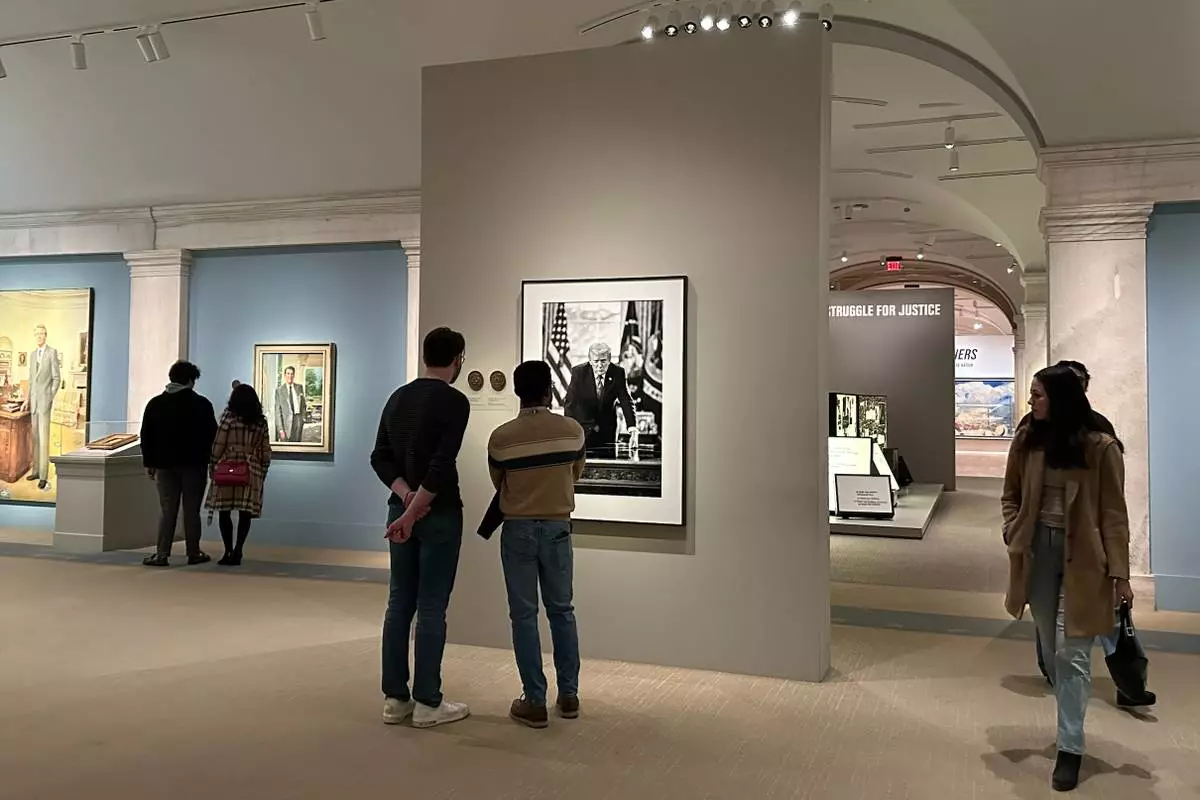
A photograph of President Donald Trump and a short plaque next to it are on display at the Smithsonian's National Portrait Gallery's "American Presidents" exhibit on Sunday, Jan. 11, 2026 in Washington. (AP Photo/Anna Johnson)
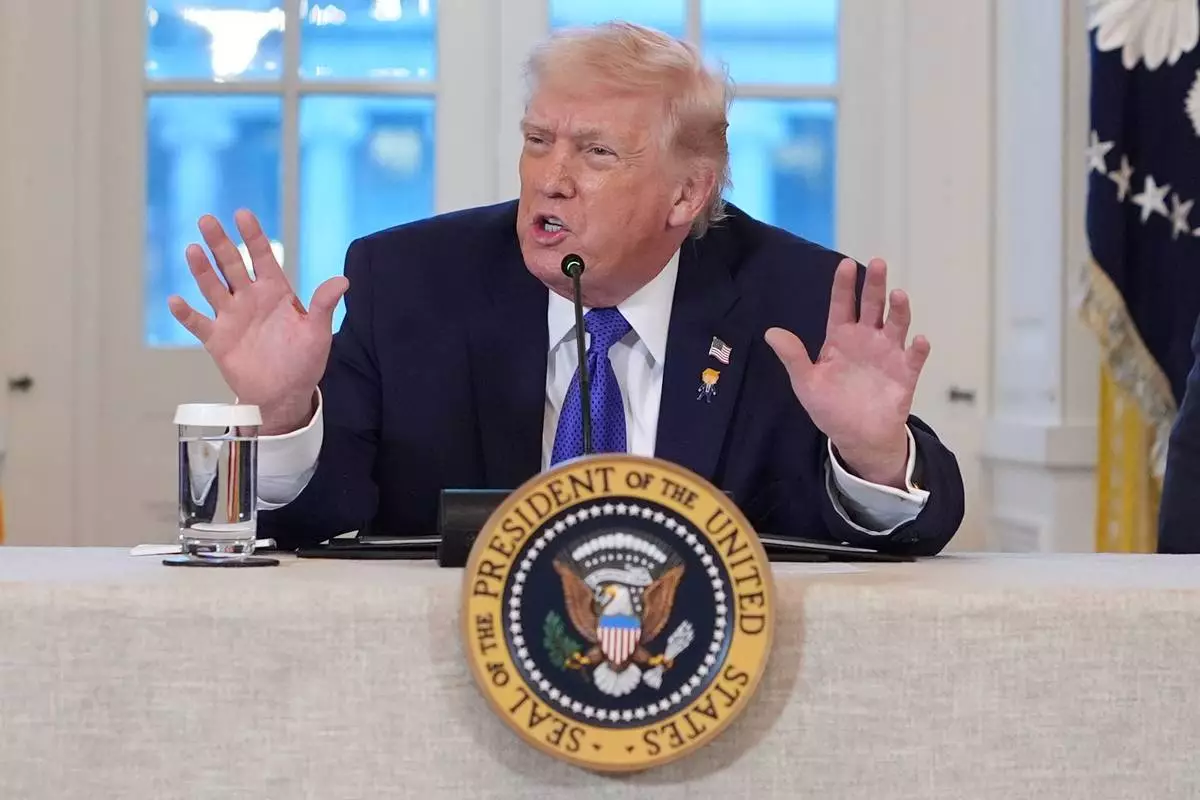
President Donald Trump speaks during a meeting with oil executives in the East Room of the White House, Friday, Jan. 9, 2026, in Washington. (AP Photo/Evan Vucci)