Skip to Content Facebook Feature Image

China's largest jewelry market sees surge in sales due to rising gold prices

China

China

China

China's largest jewelry market sees surge in sales due to rising gold prices

2024-10-09 21:36 Last Updated At:22:07

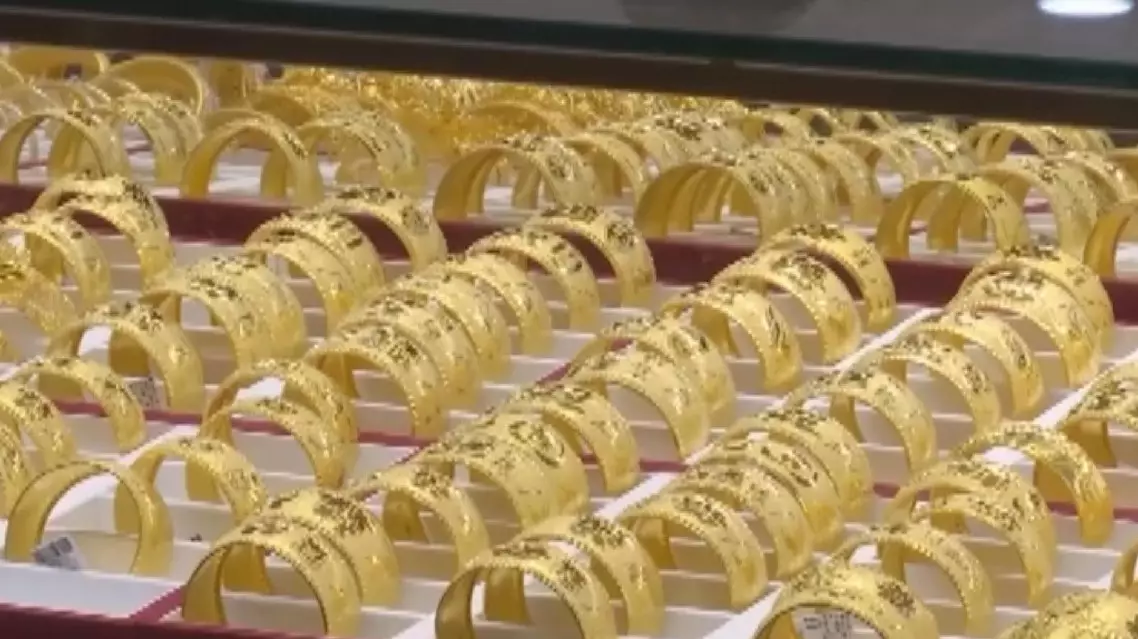
Rising gold prices continue to prompt many consumers to buy gold accessories at the Shuibei Market, China's largest gold jewelry manufacturing and trading hub based in Shenzhen City of south China's economic powerhouse of Guangdong.

Although the week-long National Day holiday ended on Monday, there are still a large number of customers coming to buy gold jewelry at the Shuibei area.

Besides the fashion identity, young Chinese consumers choose gold jewelry also for investment reasons.

"I personally prefer buying gold jewelry. If I have money saved up, I would buy it because gold tends to hold its value well," said a local resident.

In China, gold jewelry is traditionally part of the betrothal gift given by the groom's family to the bride. Therefore, wedding gold has been selling exceptionally well in this Shenzhen market.

"At present, the gold jewelry products that sell well include items like these bangles, particularly dragon and phoenix bangles, phoenix hairpins, as well as gold pig necklaces displayed on this wall," said a gold dealer.

Moreover, the gold recycling market is also booming. Rising prices have made many gold holders choose to sell their assets for profit making at gold recycling shops.

"Last year around this time, I bought gold. It's been almost a year, I must have made a profit. I bought it for over 400 yuan (about 56.6 U.S. dollars) per gram before. Now, the current recycling price is over 500 yuan (about 70.75 U.S. dollars) per gram. The recycling price is 588 yuan (about 83.2 U.S. dollars) per gram of gold," said another resident.
China's largest jewelry market sees surge in sales due to rising gold prices

China's largest jewelry market sees surge in sales due to rising gold prices
Hong Kong's representatives at this year's "two sessions" set out to submit a number of motions and put forward proposals aimed at benefiting the special administrative region and enhancing its synergy with the country’s development.

The "two sessions" are the annual meetings of China's top legislature, the National People's Congress (NPC), and the top political advisory body, the National Committee of the Chinese People's Political Consultative Conference (CPPCC). Both bodies serve a five-year term and hold a plenary session each year, generally in March.

The fourth session of the 14th NPC kicked off on Thursday, while the fourth session of the 14th National Committee of the CPPCC convened on Wednesday.

Iris Wong Ping-fan, an NPC deputy from the Hong Kong Special Administrative Region, plans to submit a motion on the coordinated development of the Guangdong-Hong Kong-Macao Greater Bay Area and the new positioning of Hong Kong in the 15th Five-Year Plan (2026-2030).

"Hong Kong will also develop its own five-year plan, which will align with the broader development goals of our country and will actively achieve synergy with issues concerning Hong Kong in the development goals of our country. Therefore, in the future, it will become increasingly clear that Hong Kong's development is deeply intertwined with that of our country, forming a community of common destiny," said Wong.

Charles Ng Wang-Wai, a CPPCC National Committee member, will highlight the crucial role of artificial intelligence in talent development in his proposal.

"We all know that artificial intelligence is an unstoppable trend. To effectively develop AI, we must focus on education, especially the training of primary and secondary school teachers. That is to say, we need to consider how to improve the skills of these teachers so they can better educate the next generation," said Ng.

Other representatives are suggesting that Hong Kong capitalize on its unique advantages to achieve win-win outcomes with the mainland.

"Hong Kong boasts a high-level international management and service system for medical technology, which provides a solid foundation for developing medical tourism. Both Hong Kong and major mainland cities are well-equipped to offer medical services to patients from Belt and Road countries," said Dennis Lam Shun-chiu, an NPC deputy.

"During the 15th Five-Year Plan period, Hong Kong will leverage its inherent advantages. Many mainland enterprises are looking to Hong Kong as a platform to better expand overseas, and with Hong Kong's excellent professional services and a strong financial platform, we hope to assist these enterprises," said Judith Yu, a CPPCC National Committee member.

Hong Kong representatives on further cooperation with mainland at two sessions

Hong Kong representatives on further cooperation with mainland at two sessions

Recommended Articles