Skip to Content Facebook Feature Image

China to adopt countermeasures against US military companies, senior executives for arms sales to Taiwan

China

China

China

China to adopt countermeasures against US military companies, senior executives for arms sales to Taiwan

2024-10-10 21:15 Last Updated At:21:37

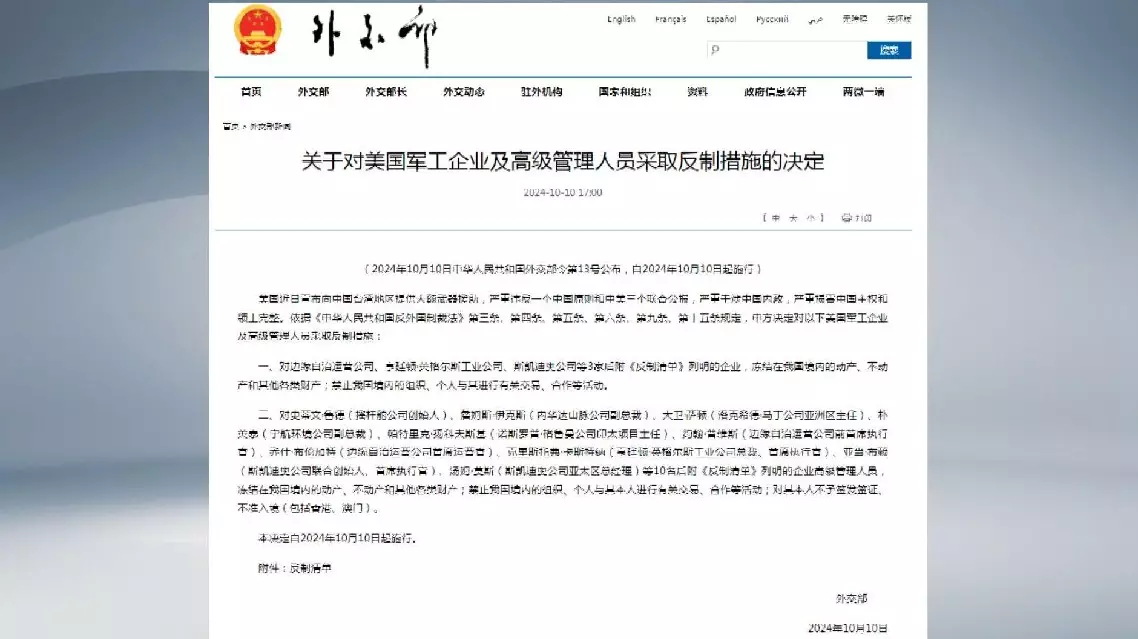
China has decided to adopt countermeasures against three U.S. military companies and 10 senior executives for arms sales to China's Taiwan region, according to a decision published on the Chinese Foreign Ministry's official website on Thursday.

The decision said that the United States recently has once again announced arms sales plans to the Taiwan region, which has seriously violated the one-China principle and the three China-U.S. joint communiques, interfered in China's internal affairs and undermined China's sovereignty and territorial integrity.

Pursuant to Articles 3, 4, 5, 6, 9 and 15 of China's Anti-Foreign Sanctions Law, China has decided to take countermeasures against the following enterprises and executives:

For the three enterprises concerned, namely the Edge Autonomy Operations LLC, Huntington Ingalls Industries Inc. and Skydio Inc., their movable, immovable and all other types of property in China will be frozen.

Organizations and individuals in China will be prohibited from engaging in transactions, cooperation or other activities with any of the three enterprises.

For the 10 senior executives, i.e., Steven Roger Rudder, Founder, Stick Rudder Enterprises LLC; James William Ickes II, Vice President, Sierra Nevada Corporation; David Keith Sutton, Asia Director, Lockheed Martin; Yeong-Tae Pak, Vice President, AeroVironment; Patrick Edward Jankowski, Indo-Pacific Project Director, Northrop Grumman; John Purvis, Former CEO, Edge Autonomy Operations LLC; Josh Brungardt, Chief Operating Officer, Edge Autonomy Operations LLC; Christopher Douglas Kastner, President and CEO, Huntington Ingalls Industries; Adam Bry, Co-Founder and CEO, Skydio Inc.; and Tom Moss, General Manager, Skydio Inc.:

Their movable and immovable properties, and other kinds of assets within China will be frozen.

All organizations and individuals within China will be prohibited from engaging in transaction, cooperation and other activities with any of them.

They will also be denied visas or entry into China (including Hong Kong and Macao).

This decision will come into force from Oct 10, 2024.

The three China-U.S. Joint Communiqués, namely the 1972 communiqué (the Shanghai communiqué), the 1979 communiqué on the establishment of diplomatic relations, and the 1982 communiqué, provide a crucial basis for the development of China-U.S. relations.

In particular, the August 17, 1982 communiqué focuses on a step-by-step approach with the ultimate aim of resolving the issue of U.S. arms sales to Taiwan. The United States declared that its arms sales to Taiwan would not exceed, either in qualitative or in quantitative terms, the level of those supplied in the years since the establishment of diplomatic relations between the United States and China, and that it intended to reduce gradually its sales of arms to Taiwan, leading over a period of time to a final resolution.

In all three communiqués the United States emphasize its acceptance of the one-China principle, which provides political basis for healthy development of China-U.S. relations.
China to adopt countermeasures against US military companies, senior executives for arms sales to Taiwan
China to adopt countermeasures against US military companies, senior executives for arms sales to Taiwan
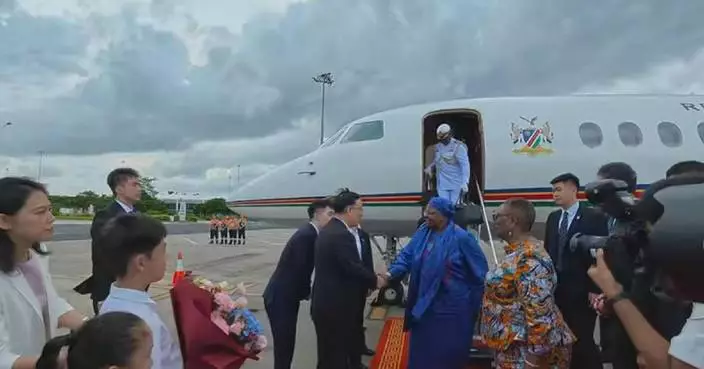
The Iranian government is focusing on public concerns and maintaining stable supplies of essential goods amid recent protests, Iranian President Masoud Pezeshkian said in a televised interview on Sunday.

In the city of Karaj, northwest of the capital Tehran, daily life has largely continued as normal. A video filmed by a local resident on Sunday shows food stores open and grocery shelves fully stocked.

"This is the block near my home, and there are some food stores here. Daily life continues here. Last night we did not see many protests in Karaj. Right now the city is very safe. This is a grocery store close to my home. All the food is available; nothing is in shortage. Here are noodles and different types of beans. Here are dairy products, cheese, and yogurt. I also checked other grocery stores and didn't see any shortages. Everything is available," said local resident Ali Reza.

Iranian officials have described recent disturbances as acts orchestrated by the "enemy," including some carried out by well-trained and armed "terrorists." The incidents have caused casualties among security personnel and civilians, as well as property damage.

The Secretary of Iran's Supreme National Security Council Ali Larijani has directed authorities to severely punish the "terrorists."

Meanwhile, Iran's police chief Ahmad-Reza Radan said on Sunday that the police had raised alert levels and arrested several leaders of the troublemakers during the operations on Saturday.

President Pezeshkian noted in the interview that the normal demands of the Iranian people are reasonable and justified, but they must realize that triggering riots and carrying out terrorist acts are the enemy's attempts to undermine the country. He urged the public to remain vigilant.

Also on Sunday, Iranian Parliament Speaker Mohammad Baqer Qalibaf warned that Tehran would regard U.S. and Israeli bases and facilities in the Middle East as "legitimate targets" if Washington takes military action against Iran. His remarks followed media reports saying U.S. President Donald Trump is "seriously considering authorizing a strike" against Iran.

Iranian state media reported that at least 109 members of Iran's security forces have been killed in clashes since the protests began 14 days ago. Meanwhile, human rights groups based outside the country said the number of protesters killed has exceeded 200, though the figure could not be independently verified.

The protests initially erupted over a sharp depreciation of the rial and sweeping subsidy reforms. Iranian authorities have blamed the unrest on foreign-linked agents and sanctions imposed by the United States.

Iranian president says government focusing on ensuring supplies amid protests

Iranian president says government focusing on ensuring supplies amid protests

Recommended Articles