Chinese Premier Li Qiang attended the 27th China-ASEAN Summit in Vientiane, Laos on Thursday, announcing substantial conclusion of Version 3.0 China-ASEAN Free Trade Area (FTA) upgrade negotiations while calling for deepening cooperation in his opening remarks.
The summit was attended by leaders of ASEAN countries, Prime Minister Xanana Gusmao of Timor-Leste as ASEAN observer state, and Secretary-General of ASEAN Kao Kim Hourn. Li said that over the past year, new achievements have been made in building a China-ASEAN community with a shared future, which has delivered benefits to the people of both sides.
Noting that insufficient global aggregate demand are becoming more prominent, Li said market has become the scarcest resource in the current economic development.
Li pointed out that market resources are the most prominent advantage of China and ASEAN, two of the most promising markets in the world, and strengthening market connectivity is an important part for further cooperation.
Li said the Version 3.0 China-ASEAN Free Trade Area (FTA) upgrade negotiations have achieved substantial conclusion, which provides an institutional guarantee for the two sides to jointly build a hyperscale market.
China would like to do more with ASEAN for the development of the market based on joint contribution and shared benefits, so as to create stronger and more lasting development impetus for both sides, as well as provide more solid support for the common prosperity of the region and the world at large.
Li said that China-ASEAN relations have gone beyond the bilateral scope and have great significance and far-reaching influence in Asia and the world. As Chinese President Xi Jinping has said that China will continue to follow the principle of amity, sincerity, mutual benefit and inclusiveness, and work with other countries in the region to build an Asian homeland.
China is ready to work with ASEAN to build a three-dimensional connectivity network, expand cooperation in emerging industries and deepen people-to-people exchanges, so as to take the China-ASEAN comprehensive strategic partnership to a new height, and create an even better future for Asia, the premier said. Leaders of the participating ASEAN countries welcomed the substantive conclusion of Version 3.0 ASEAN-China FTA upgrade negotiations, and would like to take this opportunity with China to push for deeper synergy between the Belt and Road Initiative and their respective development strategies, deepen cooperation in the fields such as trade, investment and digital economy.
They will work for the success of the China-ASEAN Year of People-to-People Exchanges and jointly contribute to regional peace, stability and prosperity.
The meeting adopted some outcome documents, including the Joint Statement between China and ASEAN on Substantively Concluding Upgrade Negotiations on Version 3.0 China-ASEAN Free Trade Area.
Li Qiang is attending the 27th China-ASEAN Summit, the 27th ASEAN Plus Three Summit and the 19th East Asia Summit to be held in Vientiane, Laos from Oct 9 to 12, and pay an official visit to Laos.
Li's visit is at the invitation of Prime Minister Sonexay Siphandone of the Lao People's Democratic Republic.
Li will also pay an official visit to Vietnam from Oct 12 to 14, at the invitation of Prime Minister Pham Minh Chinh of Vietnam.
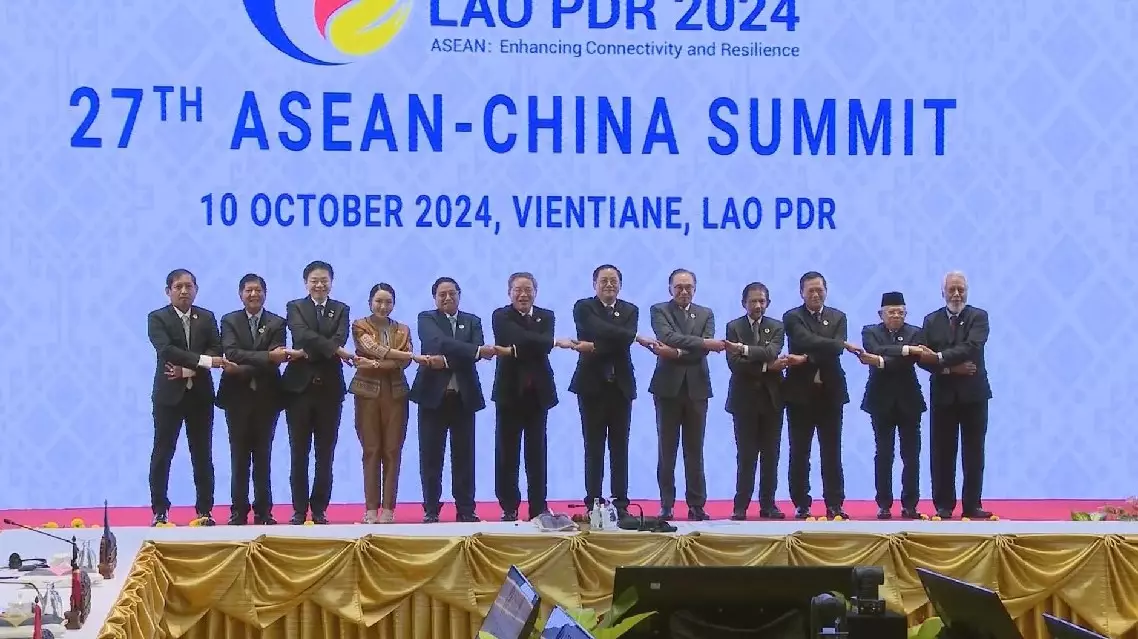
Chinese premier attends 27th China-ASEAN Summit