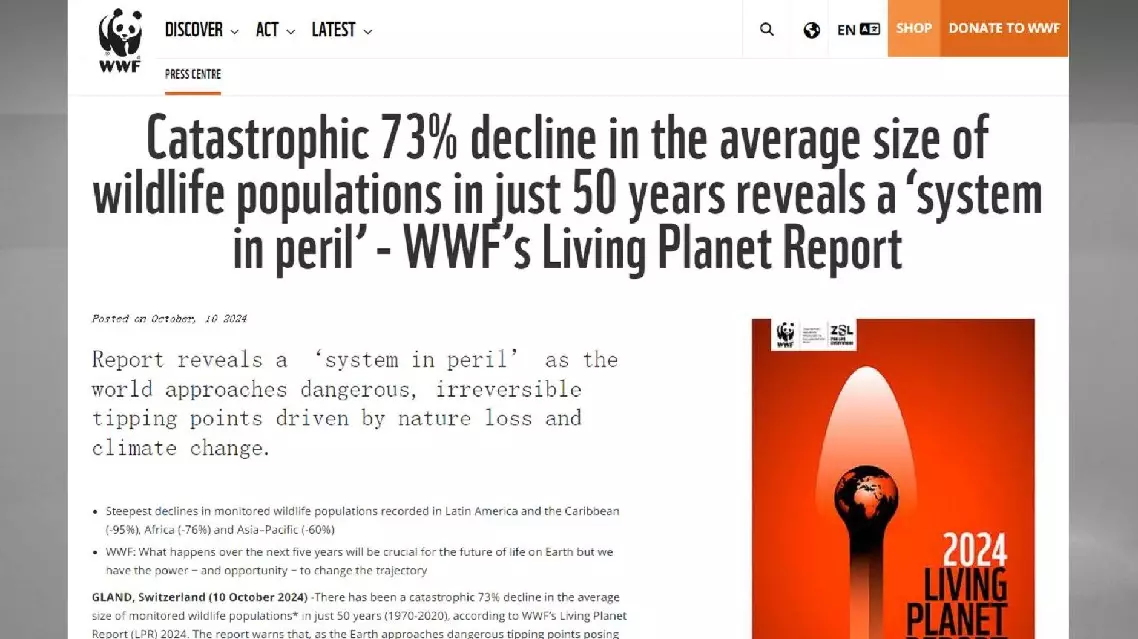
A catastrophic 73 percent decline has been spotted in the average size of monitored wildlife populations in 50 years from 1970 to 2020, said a World Wild Fund for Nature (WWF) report released on Thursday.
According to the Living Planet Report 2024, which runs statistical analysis of more than 5,000 species of birds, mammals, amphibians, reptiles and fish, populations of various wildlife are decreasing sharply from elephants in tropical forests to hawksbill turtles off the Great Barrier Reef.
The steepest declines in monitored wildlife populations were recorded in Latin America and the Caribbean, Africa and the Asia-Pacific region, by 95, 76 and 60 percent respectively.
Habitat loss and degradation, driven primarily by the human food system, is the most reported threat to wildlife populations around the world, followed by over-exploitation, invasive species, disease, climate change and pollution.
Mike Barrett, the report's lead author and WWF chief scientific adviser, said that the human beings, particularly through the way of producing and consuming food, are increasingly damaging natural habitat.
The report warns that the reducing natural resources and climate change are driving the world to an irreversible tipping points.
The catastrophic consequences of losing some of the most precious ecosystems around the world, such as the Amazon rainforest and coral reefs, would be felt by people and nature around the world.
Some populations have stabilized or increased due to effective conservation efforts over the past few years. However isolated successes are not enough, the report noted.
Wildlife population plummets 73 percent in 50 years: WWF report
China's vast market and the diversity of consumer tastes, coupled with its rich talent pool and its innovative approach to creating new products, make the country a key part of PepsiCo’s future plans, according to Ramon Laguarta, the U.S. food and beverage giant’s CEO.
In an interview with China Global Television Network, Laguarta described the scale of PepsiCo’s operations now, 45 years after the company first came to China.
"We were pioneers in China in a way from western companies. We started 45 years ago as a pioneer. Now we build scale, we're very scale in China, we have 10 factories in food, over 50 factories in beverages. We work with 70 plus farmers across the country. And we have about 170,000 people that are part of our ecosystem. So we know China well, all our talent is Chinese and we know how talented they are and how much they can help us. But now the next phase of growth for us is through innovation, creating new markets and leveraging China not only as a kind of a consumption market, but as a creation market, a creation for the rest of PepsiCo," he said.
Laguarta outlined PepsiCo’s growth plans in the country and detailed how its staff there were driving the company’s innovation and transformation globally.
"China is a growth opportunity for us, but it's a growth opportunity that comes with innovation and transformation. So, it plays a very important role also in how we can define the future of PepsiCo both from the portfolio and technology. It's a very important hub for talent, as well. So, our people in China are bright, hardworking, and they are learning outside of China. So, we see China as a place to grow our talent and then bring it to the rest of the world," he said.
"We have clearly insight is a core competence of the company and understanding Chinese consumers, not only young consumers because they're a big source of growth, but what we call silver consumers, let's say 50-year-old plus consumers. That's a very important part of the growth as we see them. So they both require different needs in terms of nutrition, but also experience, value for money. So these are very good groups. We have a broad portfolio because the consumer in China likes variety, and for us to participate in consumers’ lives from the morning to the evening, we need to have multiple solutions. So that's why we have this variety of brands," he added.

Diverse consumer tastes, top talent, innovation make China key to PepsiCo future: CEO