Skip to Content Facebook Feature Image

The drownings of 2 Navy SEALs were preventable, military investigation finds

News

The drownings of 2 Navy SEALs were preventable, military investigation finds
News

News

The drownings of 2 Navy SEALs were preventable, military investigation finds

2024-10-11 12:04 Last Updated At:10-12 13:11

WASHINGTON (AP) — Two U.S. Navy SEALs drowned as they tried to climb aboard a ship carrying illicit Iranian-made weapons to Yemen because of glaring training failures and a lack of understanding about what to do after falling into deep, turbulent waters, according to a military investigation into the January deaths.

The review concluded that the drownings of Chief Special Warfare Operator Christopher J. Chambers and Navy Special Warfare Operator 1st Class Nathan Gage Ingram could have been prevented. But both sank quickly in the high seas off the coast of Somalia, weighed down by heavy equipment they were carrying and not knowing or disregarding concerns that their flotation devices could not compensate for the additional weight. Both were lost at sea.

The highly critical and heavily redacted report — written by a Navy officer from outside Naval Special Warfare Command, which oversees the SEALs — concluded there were “deficiencies, gaps and inconsistencies” in training, policies, tactics and procedures as well as “conflicting guidance” on when and how to use emergency flotation devices and extra buoyancy material that could have kept them alive.

The Associated Press obtained the report upon request before its public release.

The mission's goal was to intercept weapons headed to the Iranian-backed Houthis in Yemen, who have been launching missile and drone attacks against commercial and U.S. Navy ships in the Red Sea and Gulf of Aden since the Israel-Hamas war in Gaza began a year ago. U.S. retaliatory strikes have so far not deterred their assaults.

Chambers and Ingram, members of SEAL Team 3, died during a nighttime mission to board an unflagged ship in the Arabian Sea. Their names were redacted in the report, but officials have confirmed Chambers slipped and fell as he was climbing onto the ship's deck and Ingram jumped in to try to save him.

“Encumbered by the weight of each individual's gear, neither their physical capability nor emergency supplemental flotations devices, if activated, were sufficient to keep them at the surface,” Rear Adm. Michael DeVore wrote in the report.

The report said Chambers was “intermittently” at the surface for 26 seconds after his fall and Ingram was at the surface for about 32 seconds.

“The entire tragic event elapsed in just 47 seconds and two NSW warriors were lost to the sea,” DeVore wrote, referring to Naval Special Warfare Command.

Flotation equipment that was properly maintained, working well and used correctly would have been able to keep them afloat until they were rescued, the report said. Other team members told investigators that while they knew the importance of their tactical flotation system — which includes two inflatable floats that attach to a belt and foam inserts that can be added — few had ever operated one in training and there is little instruction on how to wear it.

The report said the team was operating in 6- to 8-foot seas, and while the vessel they were boarding was rolling in the waves, the conditions were well within their abilities.

As time went on, however, the rolling increased, and Chambers tried to board by jumping from his combat craft's engine compartment to the top rail of the ship they were boarding, the report said. Some of the commandos used an attachable ladder, but because of the waves, others jumped to the top rail, which they said was within reach but slippery.

Chambers' hands slipped off the rail, and he fell 9 feet into the water. Based on video of the mission, he was able to grab the lower rung of the ladder, but when he turned to try to get back to the combat craft, he was swept under by a wave.

Eleven seconds after he fell, Ingram jumped in. For at least 10 seconds, video shows they were above water intermittently and at times were able to grab a ladder extension that was submerged. But both were knocked about by waves. The last sighting of Chambers was about 26 seconds after he fell.

At one point, Ingram tried to climb back on the ladder but was overcome by a wave. He appeared to try to deploy his flotation device, but within two seconds, an unattached water wing was seen about a foot away from him. He also seemed to try to remove some of his equipment, but he slipped underwater and was not seen again. The sea depth was about 12,000 feet.

Both were wearing body armor, and Ingram also was carrying radio equipment that added as much as 40 more pounds. Each of the inflatable floats can lift a minimum of 40 pounds in seawater, the report said.

It said members of the SEAL team expressed “shock and disbelief” that Chambers, their strongest swimmer, could not stay at the surface. The report concluded that the conflicting and meager guidance on the flotation devices may have left it to individuals to configure their buoyancy needs, potentially leading to mistakes.

While SEALs routinely conduct pre-mission “buddy checks” to review each other’s gear, it said Ingram's flotation equipment may have been incorrectly attached and a more thorough buddy exam could have discovered that.

SEAL team members also told investigators that adding the foam inserts makes the flotation device more bulky and it becomes more difficult to climb or crawl.

The report said SEAL Team 3 members began prompt and appropriate man-overboard procedures “within seconds,” and there were two helicopters and two drones overhead providing surveillance, light and video for the mission.

After 10 days, the search was called off because of the water depth and low probability of finding the two.

“The Navy respects the sanctity of human remains and recognized the sea as a fit and final resting place,” the report said.

Chambers, 37, of Maryland, enlisted in the Navy in 2012 and graduated from SEAL training in 2014. Ingram, 27, of Texas, enlisted in 2019 and graduated from SEAL training in 2021.

In response to the investigation, Naval Special Warfare Command said changes are already being made to training and guidance. It said the command is considering developing a force-wide policy to address water safety during maritime operations and is setting standard procedures for buoyancy requirements.

Other changes would refine man-overboard procedures, pre-mission checks and maintenance of flotation devices. It also said it's looking into “fail safe” buoyancy equipment and plans to review safety processes.

Rear Adm. Keith Davids, who headed the command at the time of the mission, said it would learn from the tragic deaths and “doggedly pursue" recommended changes. Davids left the job in August in a routine change of command and is in the process of retiring.

The report recommends that Ingram receive a commendation for heroism for giving his life while trying to save his teammate. That recommendation is under review. Both were posthumously promoted one rank.

According to a separate Defense Intelligence Agency report, the Jan. 11 mission seized Iranian “propulsion, guidance systems and warheads” for medium-range ballistic missiles and antiship cruise missiles destined for the Houthis.
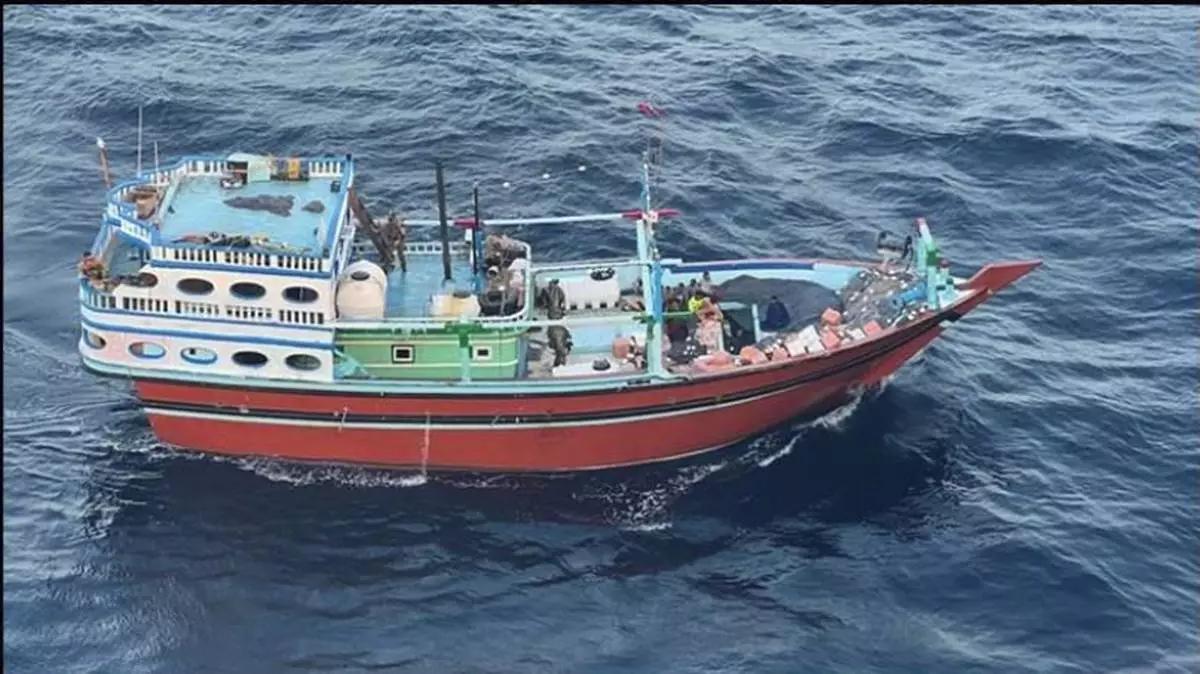
FILE - This image released by U.S. Central Command shows what it is described as the vessel in the Arabian Sea that carried Iranian-made missile components bound for Yemen's Houthi. (U.S. Central Command via AP, File)
FILE - This image released by U.S. Central Command shows what it is described as the vessel in the Arabian Sea that carried Iranian-made missile components bound for Yemen's Houthi. (U.S. Central Command via AP, File)

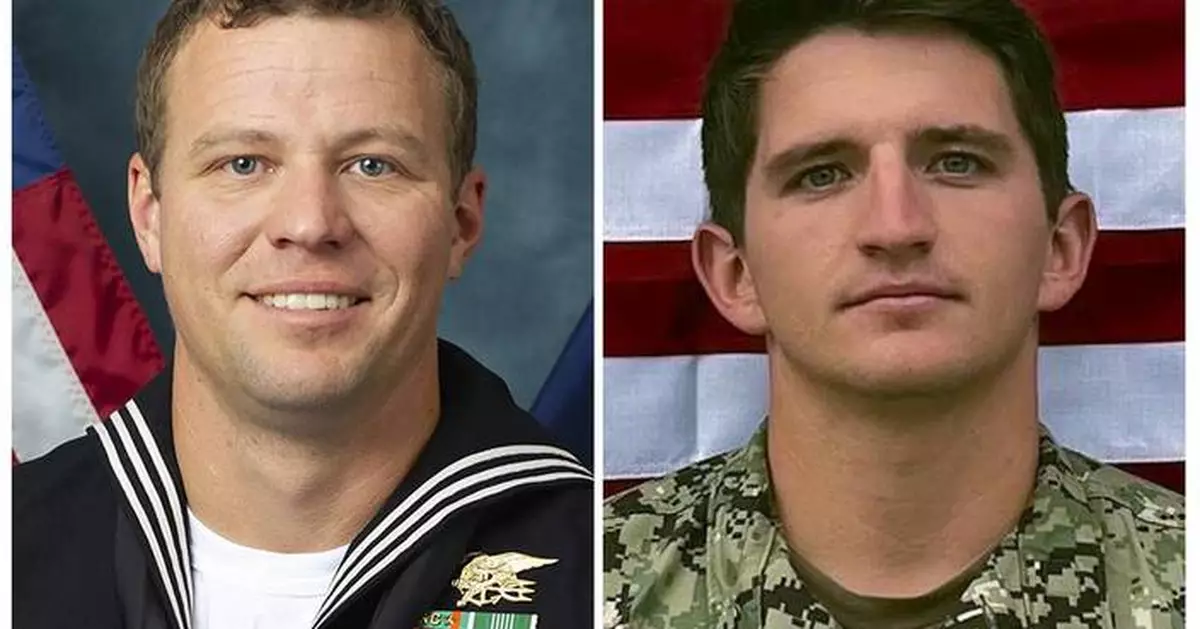
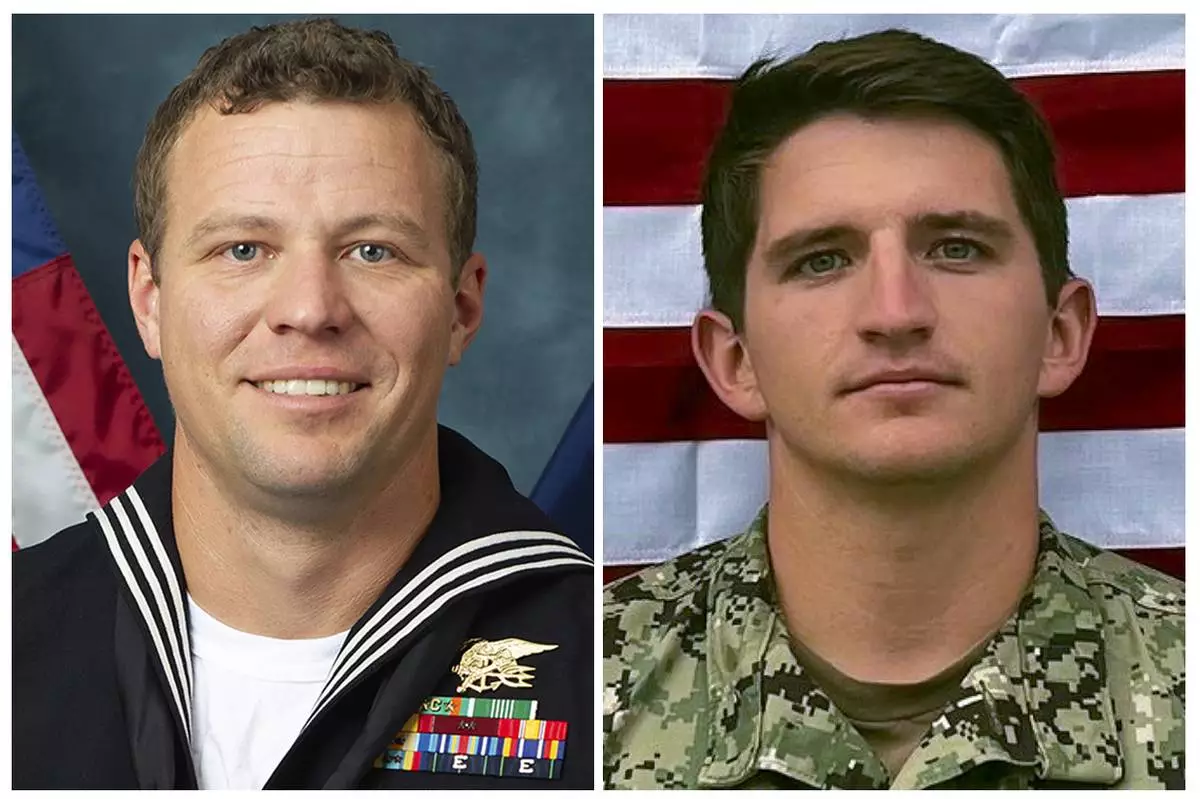
FILE - This combo image, provided by the Department of Defense, shows Navy Special Warfare Operator 1st Class Christopher J. Chambers, left, and Navy Special Warfare Operator 2nd Class Nathan Gage Ingram, right. Chambers and Ingram died while boarding an unflagged ship carrying illicit Iranian-made weapons to Yemen, Jan. 11, 2024, in the Arabian Sea. (Department of Defense via AP, File)


FILE - This combo image, provided by the Department of Defense, shows Navy Special Warfare Operator 1st Class Christopher J. Chambers, left, and Navy Special Warfare Operator 2nd Class Nathan Gage Ingram, right. Chambers and Ingram died while boarding an unflagged ship carrying illicit Iranian-made weapons to Yemen, Jan. 11, 2024, in the Arabian Sea. (Department of Defense via AP, File)

WASHINGTON (AP) — Defense Secretary Pete Hegseth on Monday spoke to widening concerns that the U.S.-Israeli strikes in Iran could spiral into a protracted regional conflict by declaring, “This is not Iraq. This is not endless.”

Hegseth, along with Air Force Gen. Dan Caine, chairman of the Joint Chiefs of Staff, held the Trump administration's first news briefing since Saturday's strikes. President Donald Trump, while he’s conducted a few phone interviews with individual reporters, has not taken questions on camera and only released two videos since the operation began.

Hegseth said the operation had a “clear, devastating, decisive mission” to “destroy the missile threat” from Iran, destroy its navy and “no nukes.”

“No stupid rules of engagement, no nation building quagmire, no democracy building exercise, no politically correct wars. We fight to win, and we don’t waste time or lives,” Hegseth said.

Asked if there are currently boots on the ground in Iran, Hegseth said, “No, but we’re not going to go into the exercise of what we will or will not do.”

He said it was “foolishness” to expect U.S. officials to say publicly “here’s exactly how far we’ll go.”

He also suggested the U.S. was not seeking to change the Iraninan regime with the killing of Iranian Supreme Leader Ayatollah Ali Khamenei,

“This is not a so-called regime change war, but the regime sure did change and the world is better off for it,” Hegseth said.

The briefing comes as the conflict has intensified into a wider war in the region. Iran and its allied armed groups have launched missiles at Israel, Arab states and U.S. military targets in the Middle East.

Four American troops have been killed in action. Trump on Sunday predicted there would be more U.S. casualties.

Caine on Monday said the U.S. expected to have additional losses.

“We grieve with you, and we will never forget you,” he said of the family members of those killed.

The latest sign of the escalating upheaval came when U.S. ally Kuwait “mistakenly shot down” three American fighter jets during a combat mission as Iranian aircraft, ballistic missiles and drones were attacking. U.S. Central Command said all six pilots ejected safely from the American F-15E Strike Eagles and were in stable condition.

U.S. officials have not offered any exit plan or offered signs that the conflict would end anytime soon, and the Khamenei cast doubt on the future of the Islamic Republic and hurtled the region into broader instability.

In laying out a case for the strikes, Hegseth pointed to the Iranian regime as having started the conflict from its inception, declaring that for 47 years it has "waged a savage, one-sided war against America.”

“Their war on Americans has become our retribution against their Ayatolloah and his death cult,” he said.

He did not point to any threat of an imminent nuclear threat from Iran, and he said again that last summer’s strikes by the U.S. and Israel “obliterated their nuclear program to rubble.”

Instead, Hegseth pointed to threats from other weaponry such as ballistic missiles and drones that justified the operation.

“Iran was building powerful missiles and drones to create a conventional shield for their nuclear blackmail ambitions,” Hegseth said.

He said that during negotiations with U.S. officials leading up to the attack, Iranian officials were “stalling."

“The former regime had every chance to make a peaceful and sensible deal. But Tehran was not negotiating," Hegseth said.

Trump, in an interview Sunday with The New York Times, said the assault could last “four to five weeks.”

Hegseth dismissed questions about the time frame and said, “President Trump has all the latitude in the world to talk about how long it may or may not take. Four weeks, two weeks, six weeks. It could move up. It could move back.”

The Republican president said the U.S. and Israel had struck hundreds of targets already. That included Israel and the U.S. bombing Iranian missile sites and targeted its navy, claiming to have destroyed its headquarters and multiple warships.

Caine said that, as with the operation that dropped massive bunker-buster bombs on Iranian nuclear facilities last year, Epic Fury also utilized B-2 stealth bombers, which the chairman said made a 37-hour round trip.

Caine several times referenced the use of cyber technologies in the strikes, which he said had “effectively disrupted communications and sensor networks,” leaving “the adversary without the ability to coordinate or respond effectively.”

Without giving specifics, Caine said the U.S. military “delivered synchronized and layered effects designed to disrupt, degrade, deny and destroy Iran’s ability to conduct and sustained combat operations on the U.S. side.”

The Iranian Red Crescent Society said at least 555 people have been killed in Iran so far by the U.S.-Israeli campaign. Eleven people have been killed in Israel and 31 in Lebanon, according to authorities there.

The news conference came hours before Secretary of State Marco Rubio was slated to brief congressional leadership on Monday.

Rubio, Hegseth, Caine and CIA Director John Ratcliffe were also set to brief the full membership of Congress on Tuesday.

In a private briefing on Sunday, Trump administration officials told congressional staff that U.S. intelligence did not suggest Iran was preparing to launch a preemptive strike against the U.S., three people familiar with the briefings said.

The administration officials instead acknowledged there was a more general threat in the region from Iran’s missiles and proxy forces, two of the people said. The third person, however, said the administration emphasized that Iran’s missiles and proxy forces posed an imminent threat to U.S. personnel and allies in the region.

The information conveyed to the congressional staff contrasts with the message from Trump, who said the objective of the mission was to eliminate “imminent threats from the Iranian regime.”

Senior Trump administration officials, who like others were not authorized to comment publicly and spoke on the condition of anonymity, had told reporters Saturday that there were indicators that the Iranians could launch a preemptive attack.

Associated Press writers Meg Kinnard in Charleston, S.C., Bill Barrow in Atlanta, David Klepper and Ben Finley in Washington and Farnoush Amiri in New York contributed to this report.

Gen. Dan Caine, chairman of the Joint Chiefs of Staff, greets Sen. Chris Coons, D-Del., before President Donald Trump delivers the State of the Union address to a joint session of Congress in the House chamber at the U.S. Capitol in Washington, Tuesday, Feb. 24, 2026. (Kenny Holston/The New York Times via AP, Pool)

Gen. Dan Caine, chairman of the Joint Chiefs of Staff, greets Sen. Chris Coons, D-Del., before President Donald Trump delivers the State of the Union address to a joint session of Congress in the House chamber at the U.S. Capitol in Washington, Tuesday, Feb. 24, 2026. (Kenny Holston/The New York Times via AP, Pool)

Recommended Articles