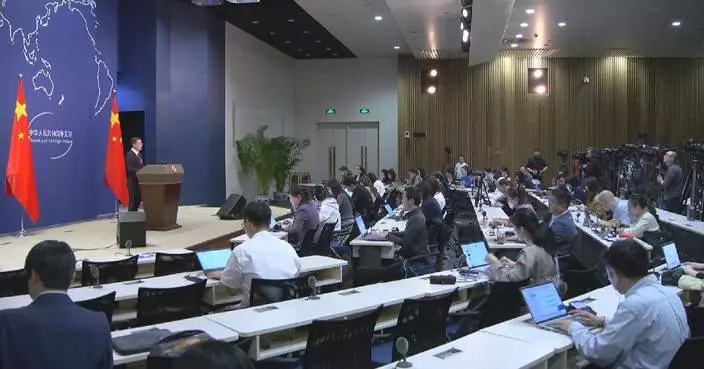
Chinese Premier Li Qiang attended the 19th East Asia Summit in Vientiane, Laos, on Friday.
Li said currently, the world is in a period of turbulence and transformation, and global economic recovery lacks steam.
Noting that this year marks the 70th anniversary of the Five Principles of Peaceful Coexistence, Li said in this turbulent world, "peaceful coexistence" is even more valuable. Equality, mutual respect, mutual benefit and common stability are of great significance to Asia's rapid development, and efforts should be made to draw wisdom from the five principles in safeguarding international fairness and justice.
Even today, the five principles are still not outdated. On the contrary, as simple and ever-lasting great truths, they are of value for the times and relevance in today's world even more.
China is willing to work with all parties to further promote the Five Principles of Peaceful Coexistence, focus on building a community with a shared future for mankind, and further build consensus, deepen mutual trust and strengthen cooperation, so as to jointly create a brighter future for the region and the world, Li said.
First, all parties should uphold peace and tranquility. They should continue to support an open and inclusive regional architecture with ASEAN at the center, and follow the path of regional security governance featuring extensive consultation, joint contribution and shared benefits. They should be highly vigilant and resolutely stop actions that undermine regional stability and increase the risk of conflict, Li said.
Second, all parties should pursue mutual benefit and win-win results. China is ready to work with all parties to actively implement the Global Development Initiative (GDI) proposed by Chinese President Xi Jinping, give full play to their respective complementary strengths, increase input in green transformation, digital economy and other areas needed by countries in the region, and better achieve inclusive development that benefits all, Li said.
Third, all parties should firmly promote opening and cooperation. They should fully implement the Regional Comprehensive Economic Partnership (RCEP) in a high-quality manner, speed up the building of the Free Trade Area of the Asia-Pacific, advance regional economic integration, and avoid turning economic and trade issues into political and security issues, he said.
He said that regional development and prosperity cannot be achieved without peace and stability in the South China Sea, adding that the Chinese side has always been committed to abiding by international law, including the United Nations Convention on the Law of the Sea, and following the Declaration on the Conduct of Parties in the South China Sea.
China has always persisted in resolving differences with the countries concerned through dialogue and consultation and on actively carrying out practical cooperation at sea, Li said.
At present, China and ASEAN countries are actively promoting the consultation on the Code of Conduct in the South China Sea, and striving for its early conclusion, he said.
Relevant countries outside the region should respect and support China's joint efforts with regional countries to maintain peace and stability in the South China Sea and play a constructive role in regional peace and stability, Li said.
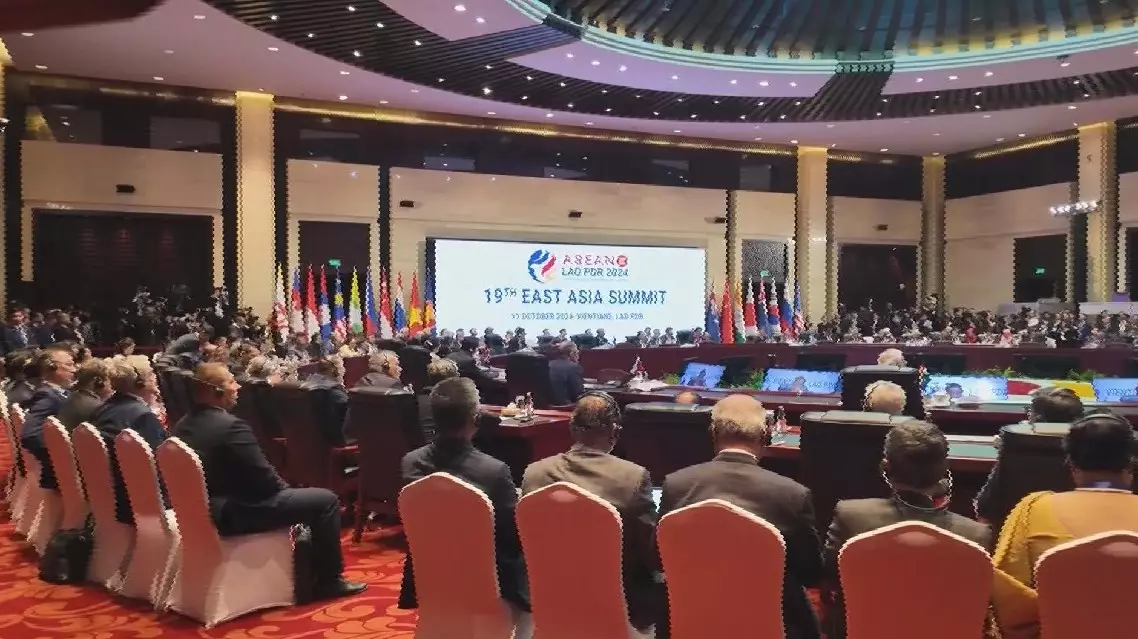
Chinese premier attends 19th East Asia Summit
Chinese premier attends 19th East Asia Summit
The continuing conflict between Israel and Lebanon has not only displaced people from their homes, but also pushed farmers off the land they depend on in the south of the country, as an estimated 80 percent have stopped working due to damaged fields, unsafe roads, and fears of contamination.
Despite Israel and Lebanon agreeing last Thursday to a three-week extension of an original 10-day ceasefire deal which began between in mid-April, deadly Israeli strikes have continued to hit southern parts of Lebanon, resulting in numerous deaths and widespread damage.
Controversy has also arisen over the Israeli military's efforts to extend the territories it occupies in southern Lebanon as part of what it terms as a "security buffer zone" along the border.
Lebanese residents have been warned against returning to their homes within this area, with Israel announcing that anyone who approaches this so-called "Yellow Line" will be considered a threat.
However, in spite of these difficulties, some farmers in the southern city of Tyre are trying to keep their connection to the soil alive.
A group of women have been bravely planting on borrowed land, because their own is now too dangerous to reach. Here, there are growing herbs such as basil, sage, rosemary, mint and thyme in neat rows.
For displaced local farmer Zainab, who hails from the border town of Naqoura, this field is not home, but it is where she has found a way to keep going amid times of crisis.
"I was displaced from my own land. I'm a farmer. I used to farm my land in Naqoura, so I started farming here, too. As you know, most of us from the south are farmers. Agriculture is the main thing we do," she said.
Across southern Lebanon, roughly 80 percent of local farmers have stopped working either because they are unable to reach their land or they fear it is no longer safe.
More than 17,000 farmers have been affected, with their fields damaged by shelling, fires, bulldozing, and contamination.
Officials have condemned the Israeli attacks on the region which have put the livelihood of ordinary people at risk and have cost some innocent civilian their lives.
"Under the recent acts of aggression, there was difficulty for the farmers to get to their lands. Most of the times they would even be targeted. I know some farms owners who hired workers to harvest the crops -- as a result, unfortunately, some of them were killed," said Alwan Charafeddine, the Deputy Mayor of Tyre City.
Agriculture is a key part of the Lebanese economy, but also the backbone of daily life in the south of the country. The region produces staples like olives, citrus, tobacco and vegetables, and when farmers are forced off their land, the consequences are felt across the country.
"I left the land. I left the crops I had planted, which, according to the season, were cabbage, cauliflower, fava beans and peas. More than leaving the land, I left my whole life behind, and now I'm here," said Zainab.
"After the targeting of the bridge that connected Tyre with Sidon, it became hard to get many of the supplies we used to get through there, which has caused the prices of agricultural products to rise," said the deputy mayor.
But amid these hard times, a glimmer of hope remains. On land belonging to local authorities, the Seeds of Tyre project is giving displaced women work, a source of income, and an outlet which allows them to pass on their skills.
Using donated seeds of aromatic herbs, they are producing basil and rose water and orange blossom, generating a small economy which is taking root in the middle of a much larger loss.
For Zainab, working the soil here offers some stability at a time of conflict, with this temporary field helping farmers tick over as they wait for safe access to their own land.
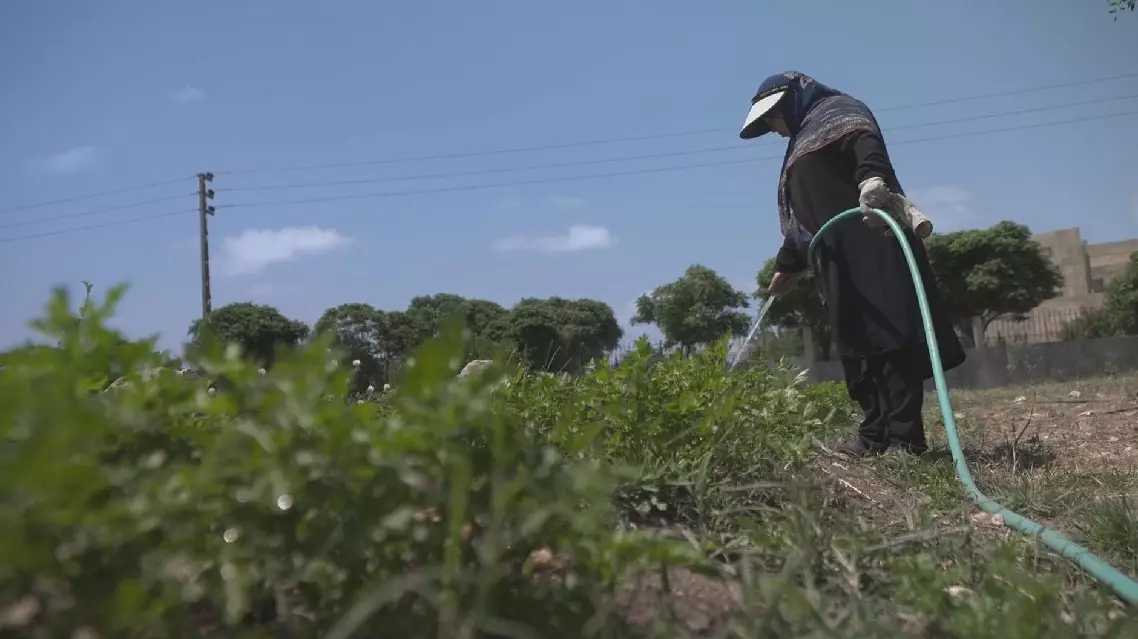
Farmers turn to temporary fields as swathes of land destroyed in southern Lebanon