China's automobile industry has shown steady growth in 2024, with vehicle production and sales rising consistently during the first nine months of the year, according to data released by the China Association of Automobile Manufacturers (CAAM) on Saturday.
During the January-September period, the country's auto production reached approximately 21.47 million units, up 1.9 percent year on year.
Auto sales totaled 21.57 million units, marking a 2.4 percent increase from the same period last year. Notably, both production and sales of new energy vehicles (NEVs) surpassed 8.3 million units, with year-on-year growth exceeding 30 percent in both categories, according to CAAM's data.
CAAM stated that within the structure of automobile production and sales, NEVs now account for nearly 40 percent of total vehicle sales.
China's passenger vehicle market has been gradually picking up, with retail sales growing stronger in the third quarter of this year, thanks to government policies encouraging vehicle trade-ins and manufacturers launching new models during "Golden September and Silver October", a peak period for car sales, said Chen Shihua, deputy secretary-general of the Association.
In August, China increased the financial stimulus to encourage consumers to scrap their old vehicles and buy new ones. Subsidies for trade-ins of new-energy passenger vehicles have doubled from 10,000 yuan (about 1,414 U.S. dollars) to 20,000 yuan, while those for trade-ins of fuel passenger vehicles have been lifted from 7,000 yuan to 15,000 yuan.
At the same time, the export of finished vehicles has also seen steady growth. In the first three quarters, China's automobile exports reached 4.312 million units, a 27.3 percent year-on-year increase. Among them, exports of NEVs totaled 928,000 units, up 12.5 percent year on year.
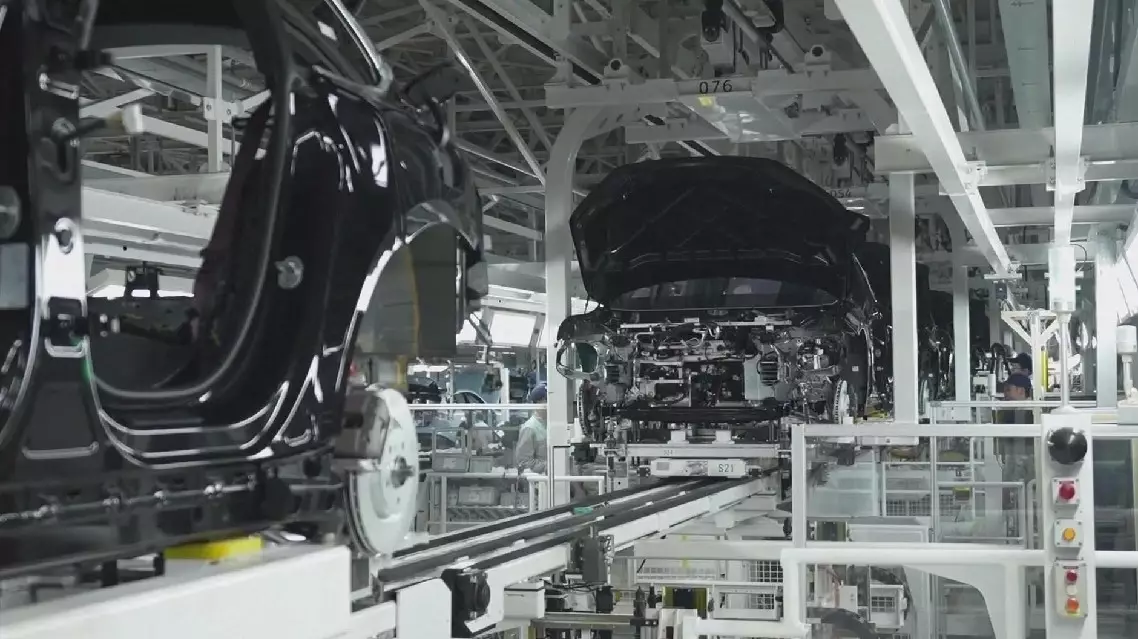
China's auto sector shows strong growth momentum in first nine months

Officials and business leaders from both China and the United States gathered in Berkeley, California on Friday to discuss the future of trade and investment between China and the San Francisco Bay Area, with many hoping to overcome the recent strain brought by the Trump administration's tariffs.
The China Council for the Promotion of International Trade hosted a business breakfast exchange meeting on Friday morning, with the council's chairman Ren Hongbin sending out a clear message of the vast economic potential which is there to be tapped into.
"The Chinese economy is very much innovation driven. And the strategic emerging industries, such as new energy, new materials, low carbon, aerospace, bio-pharmacy and the low-altitude economy, will generate a trillion-yuan level or even larger markets. So, I think that will provide enormous opportunities and room for China and U.S. companies to cooperate," said Ren.
He further stressed the China International Supply Chain Expo in Beijing as an example of an event where San Francisco Bay Area companies like NVIDIA and Apple were active participants and direct beneficiaries.
Meanwhile, Chinese Consul General in San Francisco Zhang Jianmin said that against the backdrop of a global economic slowdown, greater cooperation in the innovation sector is now more important than ever.
"The [San Francisco] Bay Area is home to many of the world's top tech companies and offers a sound innovation ecosystem. China has a super big market, rich application scenarios and a complete industrial supporting system. There exists tremendous potential for both sides to have more mutually beneficial cooperation by tapping into their complementary strengths," said Zhang.
Attendees did voice concerns over how the Trump administration's tariffs are impacting business.
With China accounting for nearly 30 percent of the Port of Oakland's total trade volume, the port's executive director Kristi McKenney stressed the need for greater stability and certainty.
"The tariffs in many cases were never actually implemented or were changed before they were implemented. So those linkages are a bit more challenging. I think the bigger issue will be certainty in the economy. And if there's lack of certainty, if we see economic difficulty, then you're going to see job losses," said McKenney.
Oakland's Mayor Barbara Lee said that it is very much business as usual, despite the recent difficulties.
"While we understand the challenges of tariffs, the exports and imports are still continuing, and our port is still a large containerized port doing business with China. And we're going to strengthen that relationship. We may have our differences on issues, on policies, but we here in Oakland understand that we're a global city and we believe the trade brings friendships, brings understanding, and also brings economic benefits to both countries," she said.
Chinese, US officials, business leaders meet in California to deepen mutual understanding