 |
- This year's World Food Day theme, 'Right to Foods for a Better Life and a Better Future', emphasizes the need for global access to food, with refrigeration playing a vital yet often overlooked role.
- The Right to Refrigeration report reveals that lack of reliable refrigeration is a major challenge, contributing to food spoilage and impacting millions, particularly in underdeveloped regions.
- Refrigeration systems account for over 17% of global electricity use and 8% of carbon emissions, stressing the need for a transition to more sustainable, energy-efficient solutions.
- The report calls for collaboration between public and private sectors to develop affordable refrigeration technologies, enforce international agreements, and reduce environmental impact.
ISTANBUL, Oct. 15, 2024 /PRNewswire/ -- Beko, a global leader in home appliances, released a report which looks at the key role of refrigeration in improving access to food worldwide. Developed by academics from the University of Birmingham specialized in cold economy and sustainable cooling, the report, Without Access to Fundamental Services: The Right to Refrigeration finds that access to reliable refrigeration remains a critical challenge, especially in underdeveloped regions, where millions face food spoilage due to a lack of reliable refrigeration.
World Food Day, an international day commemorating the founding of the United Nations Food and Agriculture Organization (FAO), highlights the urgent need for global action against hunger and food insecurity. Taking place on October 16, this year's theme is 'Right to Foods for a Better Life and a Better Future', emphasizing the importance of ensuring global access to food, where refrigeration plays a critical role, however, which is often overlooked.
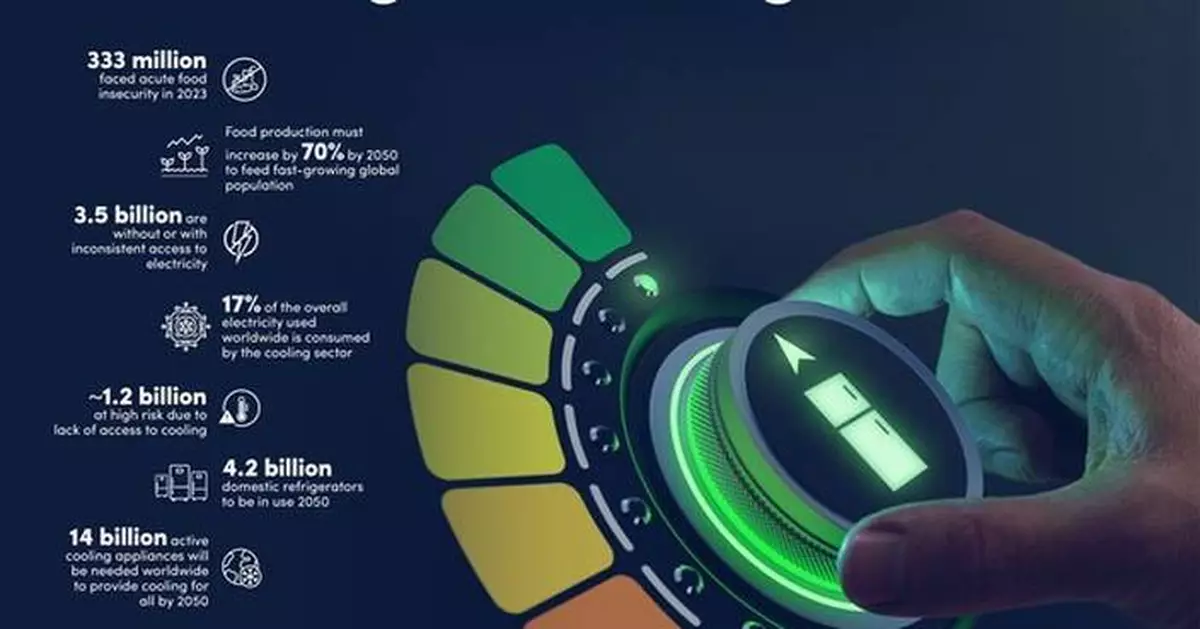
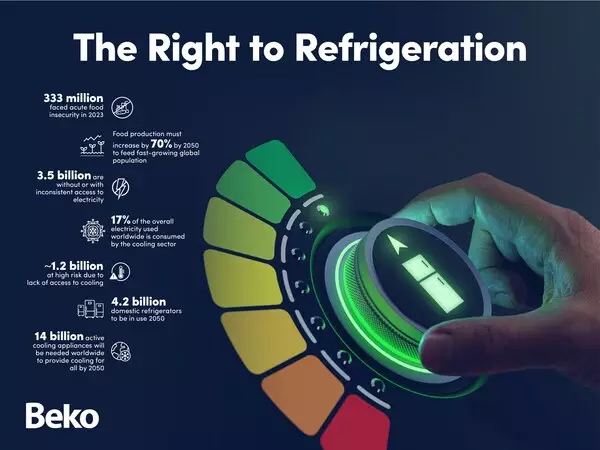
According to Beko's report, in 2023, 333 million people experienced acute food insecurity, a worrying increase of more than 200,000 people when compared to pre-pandemic levels. Currently, over 1.2 billion rural and urban poor populations are considered high risk due to lack of access to cooling solutions. This problem is further exacerbated by the rapid growth of the world's population where, according to the United Nations FAO, food production should increase 70% by 2050 to meet global demand. According to the authors of the study, lack of effective refrigeration contributes to the loss of 526 tonnes of food produced annually, enough to feed one billion people.
Refrigeration and its impact to climate change
The study finds that current refrigeration systems have a significant impact on the environment. The cooling sector accounts for over 17% of global electricity consumption and for 8% of global carbon emissions, which is more than three times the global carbon emissions of the aviation industry. Furthermore, inefficient technologies have been proved to contribute to climate change. According to the study, globally, 1.9 billion refrigeration units were in use in 2022, with 165 million sold that year. These figures are expected to rise, reaching 2.5 billion units by 2030 and 3.8 billion by 2050. However, to fulfill the refrigeration needs of the entire global population by 2050, 4.2 billion domestic refrigerators would be required.
In this context, transitioning to energy-efficient, low-impact refrigeration is extremely important to be able to address both food insecurity and the environmental challenges posed by global refrigeration. The study concludes that solving these interconnected issues will require a genuine collaboration between the public and private sectors. On one hand, the private sector should focus on developing affordable, energy-efficient refrigeration solutions, lobbying for stricter sector regulations, and building consumer trust. However, policymakers should also work on developing and enforcing international agreements, creating National Cooling Action Plans, and setting up environmentally friendly disposal solutions for outdated refrigeration units.
"Refrigeration is not just a convenience; it is essential in today's world for combating food insecurity," said Hakan Bulgurlu, CEO of Beko, "By addressing the refrigeration gap, we can significantly reduce food waste and improve food availability for communities in need. Our commitment to innovative, sustainable technologies ensures we reduce environmental impact while providing these much-needed solutions."
ABOUT BEKO 
Beko is an international home appliance company with 55,000 employees worldwide and global operations through its subsidiaries in 58 countries and 46 production facilities in 14 countries (i.e. Türkiye, UK, Italy, Romania, Slovakia, Poland, South Africa, Russia, Pakistan, India, Bangladesh, Thailand, China and Egypt). Beko has 22 brands owned or used with a limited license (Arçelik, Beko, Whirlpool*, Grundig, Hotpoint, Arctic, Ariston*, Leisure, Indesit, Blomberg, Defy, Dawlance, Hitachi*, Voltas Beko, Singer*, ElektraBregenz, Flavel, Bauknecht, Privileg, Altus, Ignis, Polar). Beko became the largest white goods company in Europe with its market share (based on volumes) and reached a consolidated turnover of 8 billion Euros in 2023. Beko's 31 R&D and Design Centers & Offices across the globe are home to over 2,300 researchers and hold more than 3,500 international registered patent applications to date. For the 5th consecutive year, the highest score in the DHP Household Durables industry (based on the results dated 27 October 2023) in the Dow Jones Sustainability Index of the S&P Global Corporate Sustainability Assessment was achieved.** Beko's vision is 'Respecting the World, Respected Worldwide.' 
 www.bekocorporate.com  
*Licensee limited to certain jurisdictions.  
**The data presented belongs to Arçelik A.Åž., a parent company of Beko. 
- This year's World Food Day theme, 'Right to Foods for a Better Life and a Better Future', emphasizes the need for global access to food, with refrigeration playing a vital yet often overlooked role.
- The Right to Refrigeration report reveals that lack of reliable refrigeration is a major challenge, contributing to food spoilage and impacting millions, particularly in underdeveloped regions.
- Refrigeration systems account for over 17% of global electricity use and 8% of carbon emissions, stressing the need for a transition to more sustainable, energy-efficient solutions.
- The report calls for collaboration between public and private sectors to develop affordable refrigeration technologies, enforce international agreements, and reduce environmental impact.
ISTANBUL, Oct. 15, 2024 /PRNewswire/ -- Beko, a global leader in home appliances, released a report which looks at the key role of refrigeration in improving access to food worldwide. Developed by academics from the University of Birmingham specialized in cold economy and sustainable cooling, the report, Without Access to Fundamental Services: The Right to Refrigeration finds that access to reliable refrigeration remains a critical challenge, especially in underdeveloped regions, where millions face food spoilage due to a lack of reliable refrigeration.
World Food Day, an international day commemorating the founding of the United Nations Food and Agriculture Organization (FAO), highlights the urgent need for global action against hunger and food insecurity. Taking place on October 16, this year's theme is 'Right to Foods for a Better Life and a Better Future', emphasizing the importance of ensuring global access to food, where refrigeration plays a critical role, however, which is often overlooked.
According to Beko's report, in 2023, 333 million people experienced acute food insecurity, a worrying increase of more than 200,000 people when compared to pre-pandemic levels. Currently, over 1.2 billion rural and urban poor populations are considered high risk due to lack of access to cooling solutions. This problem is further exacerbated by the rapid growth of the world's population where, according to the United Nations FAO, food production should increase 70% by 2050 to meet global demand. According to the authors of the study, lack of effective refrigeration contributes to the loss of 526 tonnes of food produced annually, enough to feed one billion people.
Refrigeration and its impact to climate change
The study finds that current refrigeration systems have a significant impact on the environment. The cooling sector accounts for over 17% of global electricity consumption and for 8% of global carbon emissions, which is more than three times the global carbon emissions of the aviation industry. Furthermore, inefficient technologies have been proved to contribute to climate change. According to the study, globally, 1.9 billion refrigeration units were in use in 2022, with 165 million sold that year. These figures are expected to rise, reaching 2.5 billion units by 2030 and 3.8 billion by 2050. However, to fulfill the refrigeration needs of the entire global population by 2050, 4.2 billion domestic refrigerators would be required.
In this context, transitioning to energy-efficient, low-impact refrigeration is extremely important to be able to address both food insecurity and the environmental challenges posed by global refrigeration. The study concludes that solving these interconnected issues will require a genuine collaboration between the public and private sectors. On one hand, the private sector should focus on developing affordable, energy-efficient refrigeration solutions, lobbying for stricter sector regulations, and building consumer trust. However, policymakers should also work on developing and enforcing international agreements, creating National Cooling Action Plans, and setting up environmentally friendly disposal solutions for outdated refrigeration units.
"Refrigeration is not just a convenience; it is essential in today's world for combating food insecurity," said Hakan Bulgurlu, CEO of Beko, "By addressing the refrigeration gap, we can significantly reduce food waste and improve food availability for communities in need. Our commitment to innovative, sustainable technologies ensures we reduce environmental impact while providing these much-needed solutions."
ABOUT BEKO 
Beko is an international home appliance company with 55,000 employees worldwide and global operations through its subsidiaries in 58 countries and 46 production facilities in 14 countries (i.e. Türkiye, UK, Italy, Romania, Slovakia, Poland, South Africa, Russia, Pakistan, India, Bangladesh, Thailand, China and Egypt). Beko has 22 brands owned or used with a limited license (Arçelik, Beko, Whirlpool*, Grundig, Hotpoint, Arctic, Ariston*, Leisure, Indesit, Blomberg, Defy, Dawlance, Hitachi*, Voltas Beko, Singer*, ElektraBregenz, Flavel, Bauknecht, Privileg, Altus, Ignis, Polar). Beko became the largest white goods company in Europe with its market share (based on volumes) and reached a consolidated turnover of 8 billion Euros in 2023. Beko's 31 R&D and Design Centers & Offices across the globe are home to over 2,300 researchers and hold more than 3,500 international registered patent applications to date. For the 5th consecutive year, the highest score in the DHP Household Durables industry (based on the results dated 27 October 2023) in the Dow Jones Sustainability Index of the S&P Global Corporate Sustainability Assessment was achieved.** Beko's vision is 'Respecting the World, Respected Worldwide.' 
 www.bekocorporate.com  
*Licensee limited to certain jurisdictions.  
**The data presented belongs to Arçelik A.Åž., a parent company of Beko. 
** The press release content is from PR Newswire. Bastille Post is not involved in its creation. **
Beko Report Highlights the Role of Refrigeration in World Food Day's 2024 Vision of Securing The Right to Foods
Beko Report Highlights the Role of Refrigeration in World Food Day's 2024 Vision of Securing The Right to Foods
At Anker Day 2026, Anker Innovations marks its 15th anniversary by unveiling THUS™ - ANKER's first neural-net Compute-in-Memory AI audio chip - and a new generation of products across soundcore and eufy.
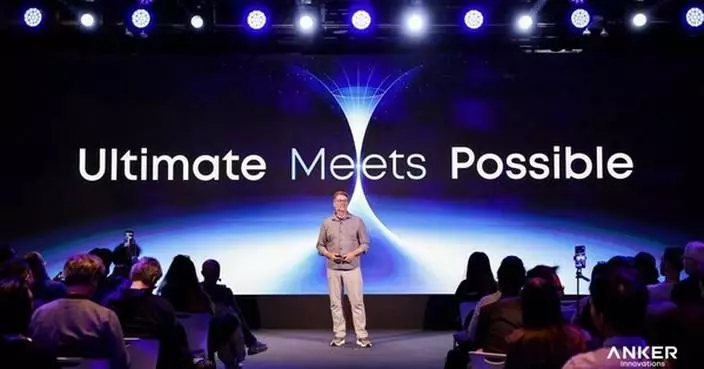
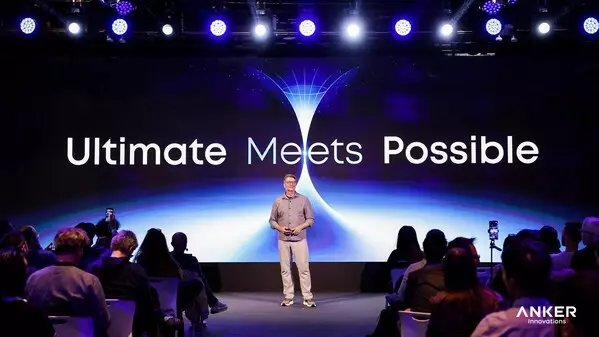
NEW YORK and Bellevue, Wash., May 22, 2026 /PRNewswire/ -- Anker Innovations is hosting Anker Day 2026: Where Ultimate Meets Possible, its annual brand event to showcase the newest product launches and technology break-throughs across its portfolio. Where Ultimate Meets Possible will bring together media, retail buyers and key influencers for an exclusive look at what's next in consumer electronics, spanning premium audio, home energy and the smart home appliances.
Where Ultimate Meets Possible will be held at STORIED in New York City, an invite-only experience featuring keynote presentations, hands-on product demonstrations and a deep dive into the company's latest innovations.
Anker Day 2026 debuted innovations across three brands: soundcore's Liberty 5 Pro and Pro Max — the first earbuds powered by Anker's new THUS™ AI chip — alongside VibeOS AI platform and Nebula SpaceFlow; Anker SOLIX's S2000, the world's longest-lasting 2kWh home backup power station; and eufy's EdgeAgent™, a local AI home security agent, plus new baby care products.
Started With Power
Anker was founded in 2011 and released its first product in the following year: a 4,500mAh ultra-slim power bank. It was a modest beginning, but behind it was an engineering conviction that would shape everything that followed. If technology is going to make a meaningful difference in people's lives, it has to be built to the highest possible standard.
2012 - The Beginning
Anker's first product: a 4,500mAh ultra-slim power bank - the start of a commitment to putting well-engineered, reliable power in people's hands.
2013 - PowerIQ™
Introduced PowerIQ™, enabling fast-charging compatibility across both iOS and Android - setting the standard for universal charging intelligence.
2018 - GaN from Aerospace
An early adopter of Gallium Nitride (GaN) from aerospace applications for consumer charging - delivering a 40% size reduction without sacrificing output.
2019 - World's Smallest 18W Charger
Delivered the world's smallest 18W charger at the time - proving that ultimate performance and ultra-compact form are not a trade-off.
2022 - GaNPrime™
Pioneered high-power multi-port chargers with dynamic power distribution - intelligently allocating power across multiple devices simultaneously.
2023 - 240W Wall Charger
Delivered the industry's highest-power 240W wall charger at the time - meeting the demands of the most power-hungry professional setups.
2024 - InstaCord™ & UltraDura™
In 2024, InstaCord™ became Anker's most advanced retractable‑cable technology and UltraDura™ achieved industry‑leading durability.
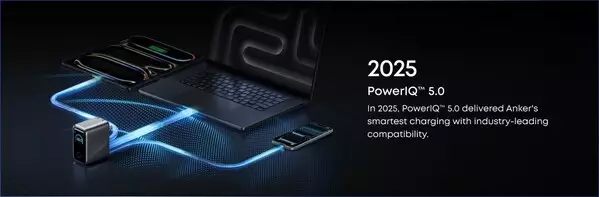
2025 - GaNPrime™ 2.0 • PowerIQ™ 5.0 • AnkerSense™ View • TurboBoost™
GaNPrime™ 2.0 (most advanced fast charging), PowerIQ™ 5.0 (smartest compatibility), AnkerSense™ View (intelligent display technology), and TurboBoost™ for ultra-fast power bank recharging. The pursuit never stops.
Fifteen years. Eight technology generations. Every breakthrough driven by one and only promise: seeking the ultimate innovation, not as an end in itself, but because technology built to its highest standard is how we put the possibilities people want in their lives within reach. Technology in service of people. That is what this pursuit has always meant.
Today's Milestone: Anker Thus™
For 80 years, chip design has followed the same logic established by John von Neumann in 1945: separate the processor from memory, and shuttle data between them one instruction at a time. For eight decades across mainframes, desktops, and data centers, this model worked. AI breaks that assumption. A neural network draws on millions of learned parameters all at once - and in a wearable device, moving that data between memory and processor consumes more than 90 percent of chip power, leaving almost nothing for actual computation.
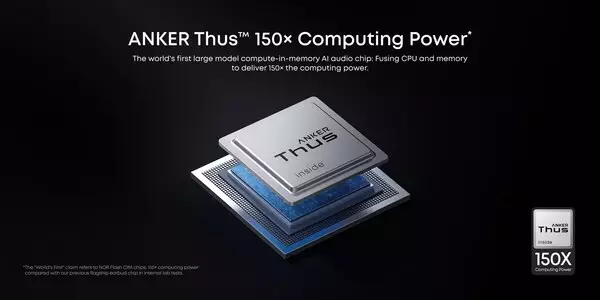
THUS™ applies a different principle: embed computation directly inside NOR Flash memory cells, where the model already lives. The model parameters never have to move. The energy previously consumed by data movement is redirected entirely to computation.
The first THUS™ AI chip debuts in earbuds, delivering up to 150 times more AI computing power on the environmental noise cancellation task than Anker's previous-generation flagship earphones.
Clear Calls - the chip's first disclosed feature - runs a large neural network entirely on-device, anchored by eight MEMS microphones and two bone conduction sensors, for a significantly clear call in any environment. Additional AI-powered features including Signature Sound and Voice Control debuted at Anker Day.
"Every AI chip built until now stores the model on one side and does the computation on the other. To think, the device has to carry all those parameters across, many times per second, every single inference. THUS™ puts the computation where the model already lives. The model never has to move again."
- Steven Yang, Founder and CEO, Anker Innovations
THUS™ takes inspiration from "Thus have I heard", a Buddhist phrase that reflects direct transmission - knowledge conveyed as it was experienced, without distortion.
All performance figures are based on internal Anker lab tests. The 150× AI computing power figure applies specifically to the environmental noise cancellation task and reflects the architectural change from rule-based to neural-net AI processing. It is not a general performance claim and does not reflect a process node upgrade. The environmental noise cancellation workload referenced here runs as an on-device neural network model on the first THUS™ chip.
Anker soundcore Liberty 5 Pro: The First Product Powered by Anker Thus™
The soundcore Liberty 5 Pro and Liberty 5 Pro Max are the first two products to ship with the THUS™ chip. Their positioning is organized around three on-device intelligence layers the chip enables - understanding, adapting, and tuning - each representing a function earbuds could not credibly perform before neural-net AI became viable at this scale. Coming to the market soon.
15 Years, One Promise
From our first power bank to a proprietary AI chip in 2026 - the categories we build in keep expanding, and so does the scope of what technology can do for people's lives. Our promise has been one and only, seeking the ultimate innovation, with the conviction that technology built to its highest standard makes the possibilities people want in their lives the ones they can actually live. Fifteen years is long enough to know that trust is earned slowly. Fifteen years in. The pursuit continues.
About Anker Innovations
Anker Innovations is a global consumer technology company driven by ultimate innovation, creating products that help people power, create, connect, and live more freely. Founded in 2011, Anker Innovations serves more than 200 million consumers across 146 countries and regions. Learn more at anker.com.
DISCLAIMER
*Statements in this news release that are not statements of historical fact may include forward-looking statements regarding future events or the future financial performance of the company. We wish to caution you that such statements are just predictions and that actual events or results may differ materially. Forward-looking statements involve a number of risks and uncertainties surrounding competitive and industry conditions, market acceptance for the company's products, risks of litigation, technological changes, developing industry standards and other factors related to the company's businesses. The actions referred to in this press release are not an admission or acknowledgement of any claim or allegation. The Company reserves all of its rights.
** This press release is distributed by PR Newswire through automated distribution system, for which the client assumes full responsibility. **
15 Years of Seeking Ultimate Innovation: From Power Banks to Proprietary AI THUS™ Chip
15 Years of Seeking Ultimate Innovation: From Power Banks to Proprietary AI THUS™ Chip
15 Years of Seeking Ultimate Innovation: From Power Banks to Proprietary AI THUS™ Chip