CAPE CANAVERAL, Fla. (AP) — October's supermoon is the closest of the year and it's teaming up with a comet for a rare stargazing two-for-one.
The third of four supermoons this year, it will be 222,055 miles (357,364 kilometers) away Wednesday night, making it seem even bigger and brighter than in August and September. It will reach its full lunar phase Thursday.
In a twist of cosmic fate, a comet is in the neighborhood. Discovered last year, comet Tsuchinshan-Atlas is now prominent in the Northern Hemisphere after wowing stargazers in the Southern Hemisphere.
The moonlight will wash out some of the comet’s tail, but it’s still worth a look after sunset, said NASA's Bill Cooke.
“Most astronomers hate the full moon because its bright light messes up observing other objects. So it’s a bit hard for us to wax poetic about it even if it’s the biggest supermoon of 2024,” he said in an email.
Better catch the comet; it may never return. But don't fret if you miss Thursday's supermoon. The fourth and final supermoon of the year will rise on Nov. 15.
More a popular term than a scientific one, a supermoon occurs when a full lunar phase syncs up with an especially close swing around Earth. This usually happens only three or four times a year and consecutively, given the moon’s constantly shifting, oval-shaped orbit.
A supermoon obviously isn’t bigger, but it can appear that way, although scientists say the difference can be barely perceptible.
There’s a quartet of supermoons this year.
The one in August was 224,917 miles (361,970 kilometers) away. September's was nearly 3,000 miles (4,484 kilometers) closer the night of Sept. 17 into the following morning. A partial lunar eclipse also unfolded that night, visible in much of the Americas, Africa and Europe as Earth’s shadow fell on the moon, resembling a small bite.
October's supermoon is the year’s closest at 222,055 miles (357,364 kilometers) from Earth, followed by the November supermoon at a distance of 224,853 miles (361,867 kilometers).
Scientists point out that only the keenest observers can discern the subtle differences. It’s easier to detect the change in brightness — a supermoon can be 30% brighter than average.
With the U.S. and other countries ramping up lunar exploration with landers and eventually astronauts, the moon beckons brighter than ever.
The Associated Press Health and Science Department receives support from the Howard Hughes Medical Institute’s Science and Educational Media Group. The AP is solely responsible for all content.
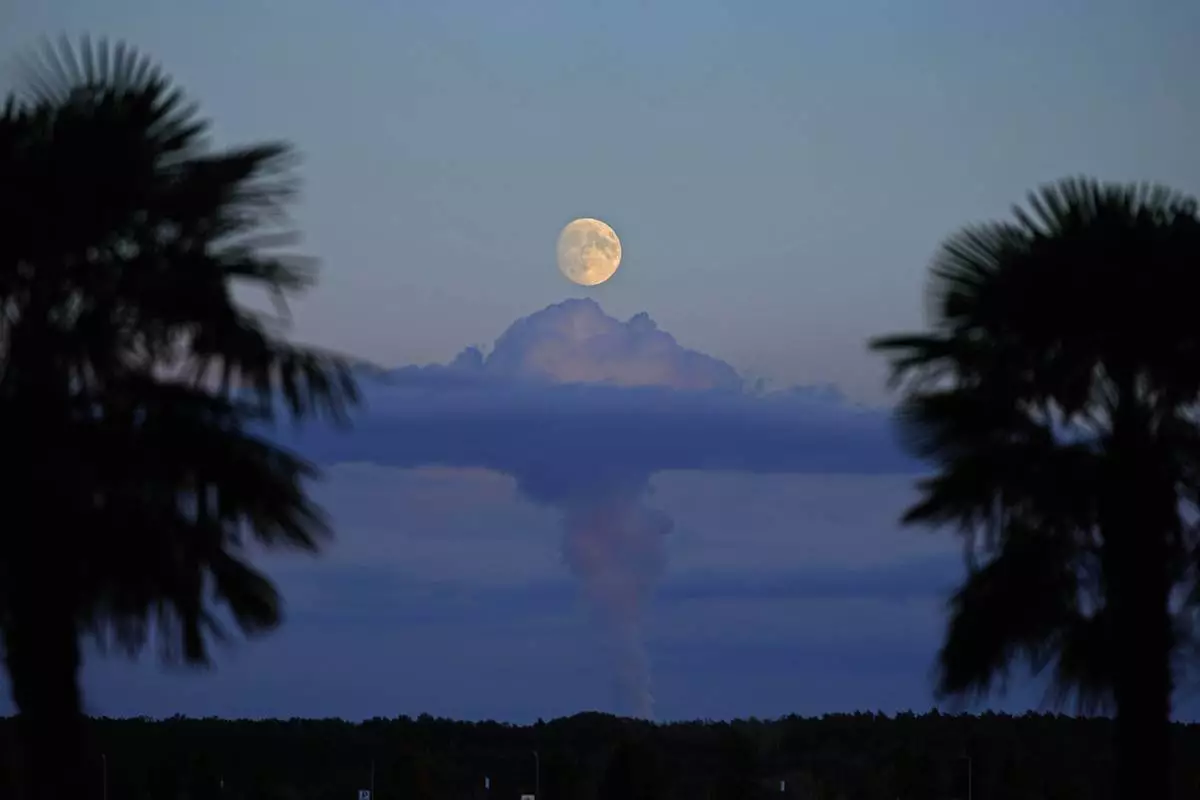
Steam rises from cooling towers of a power plant as the moon rises near Senftenberg, Germany, Tuesday, Oct. 15, 2024. (AP Photo/Matthias Schrader)
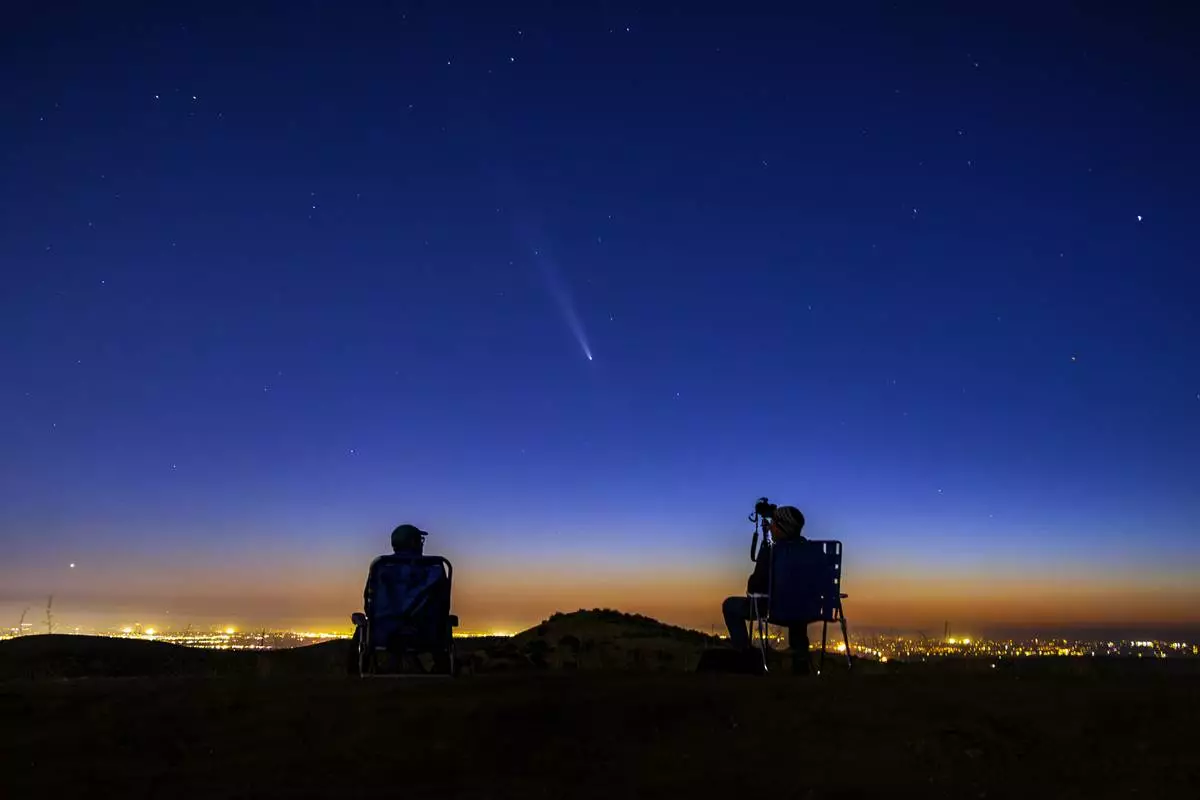
Comet Tsuchinshan-Atlas makes an appearance in the western night sky as amateur photographers Nolan Letellier, left, and Link Jackson observe on a ridge near the Dry Creek Trailhead in Boise, Idaho. Monday, Oct. 14, 2024 (AP Photo/Kyle Green)

The full moon rises in the over a beer sign in the outfield at Kauffman Stadium during a baseball game between the Kansas City Royals and the Detroit Tigers, Tuesday, Sept. 17, 2024, in Kansas City, Mo. (AP Photo/Charlie Riedel)
The Lumbee Tribe of North Carolina achieved a goal more than a century in the making on Wednesday when it secured federal recognition as a tribal nation through the passage of a defense bill in Congress.
The state-recognized tribe, whose historic and genealogical claims have been called into question by several tribal leaders, has been seeking federal acknowledgement for generations. Congress has considered the issue for more than 30 years, but the effort gained momentum after President Donald Trump endorsed the state-recognized tribe on the campaign trail last year.
Legislation to recognize the Lumbee Tribe had struggled to pass through Congress in recent years, but it was attached to the 2026 National Defense Authorization Act, which was passed by the Senate on Wednesday afternoon. It was unclear when the president would sign it.
“It means a lot because we have been figuring out how to get here for so long,” said Lumbee Tribal Chairman John Lowery moments after celebrating the victory in the office of North Carolina Sen. Thom Tillis. “We have been second-class Natives and we will never be that again, and no one can take it away from us.”
With federal recognition comes a bevy of federal resources, including access to new streams of federal dollars and grants and resources like the Indian Health Service. It also allows the tribe to put land into trust, which gives it more control over things like taxation and economic development, such as a casino.
In the 1980s, the Lumbee Tribe sought recognition through the Office of Federal Acknowledgement within the Interior Department, which evaluates the historical and genealogical claims of tribal applicants. The office declined to accept the application, citing a 1956 act of Congress that acknowledged the Lumbee Tribe but withheld the benefits of federal recognition.
That decision was reversed in 2016, allowing the Lumbee to pursue recognition through the federal administrative process. The tribe instead continued to seek recognition through an act of Congress.
There are 574 federally recognized tribal nations. Since the Office of Federal Acknowledgement was established in 1978, 18 have been approved by the agency, while about two dozen have gained recognition through congressional legislation. Nineteen applications ranging from Maine to Montana are now pending before the agency, with at least one under consideration by Congress.
Once federally recognized, the Lumbee Tribe would become one of the largest tribal nations in the country, with about 60,000 members. Congressional Budget Office estimates have found that providing the tribe with the necessary federal resources would cost hundreds of millions of dollars in the first few years alone.
“Hopefully, Congress will expand the pie in appropriations so that the other tribes, many of which are poor, don’t suffer because there’s suddenly such a larger number of Native Americans in that region," said Kevin Washburn, former assistant secretary of Indian affairs at the Interior Department and a professor at the University of California, Berkeley School of Law.
Over 200 Lumbee members gathered in a gymnasium in Pembroke, North Carolina, to watch the final Senate vote on television. They celebrated with shouts, raised hands and applause as the unofficial tally indicated the bill would receive final congressional approval.
Victor Dial held his 8-month daughter Collins at the celebration. Dial’s grandfather is a late former tribal chairman.
“He told us the importance of this, and he told us this day would happen, but we didn’t know when,” Dial said. “I’m so glad my kids were here to see it.”
Not everyone in Indian Country is celebrating. The move has drawn opposition from some tribal leaders, historians and genealogists who argue that the Lumbee’s claims are unverifiable and that Congress should require the tribe to complete the formal recognition process.
“Federal recognition does not create us — it acknowledges us,” Shawnee Tribe Chief Ben Barnes, an opponent of Lumbee recognition, testified before the Senate last month. He warned against replacing historical documentation with political considerations.
Critics have noted that the Lumbee have a history of shifting claims and previously used different names, including Cherokee Indians of Robeson County, and say the tribe lacks a documented historical language.
“If identity becomes a matter of assertion rather than continuity, then this body will not be recognizing tribes, it will be manufacturing them,” Barnes told lawmakers.
The Lumbee Tribe counters that it descends from a mixture of ancestors “from the Algonquian, Iroquoian and Siouan language families,” according to its website, and notes it has been recognized by North Carolina since 1885.
While the Lumbee Tribe has received bipartisan support over the years, federal recognition became a campaign promise in 2024 for both Trump and Democratic nominee Kamala Harris.
“He kept that promise and showed extraordinary leadership," said Tillis, the Republican senator who introduced a bill to recognize the Lumbee Tribe.
Robeson County, where most Lumbee members live, has shifted politically in recent years. Once dominated by Democrats, the socially conservative area has trended Republican. The Lumbee Tribe's members in North Carolina are an important voting block in the swing state, which Trump won by more than three points.
In January, Trump issued an executive order directing the Interior Department to develop a plan for Lumbee recognition. That plan was submitted to the White House in April, and a department spokesperson said the tribe was advised to pursue recognition through Congress.
Since then, Lowery, the tribal chairman, has worked closely with members of Congress, particularly Tillis, and appealed directly to Trump. In September, Lowery wrote to Trump announcing ancestral ties between the Lumbee Tribe and the president's daughter Tiffany Trump, according to Bloomberg, which first reported on the letter.
Associated Press writers Gary D. Robertson in Raleigh, North Carolina, Allen G. Breed in Pembroke, North Carolina, and Jacquelyn Martin in Washington, D.C., contributed.

John Lowery, N.C. State Rep. and Chairman of the Lumbee Tribe of N.C., center, leads a toast to Sen. Thom Tillis, R-N.C., center, front right, as members of the Lumbee Tribe of North Carolina, celebrate the passage of a bill granting their people federal recognition, on Capitol Hill, in Washington, Wednesday, Dec. 17, 2025. (AP Photo/Jacquelyn Martin)
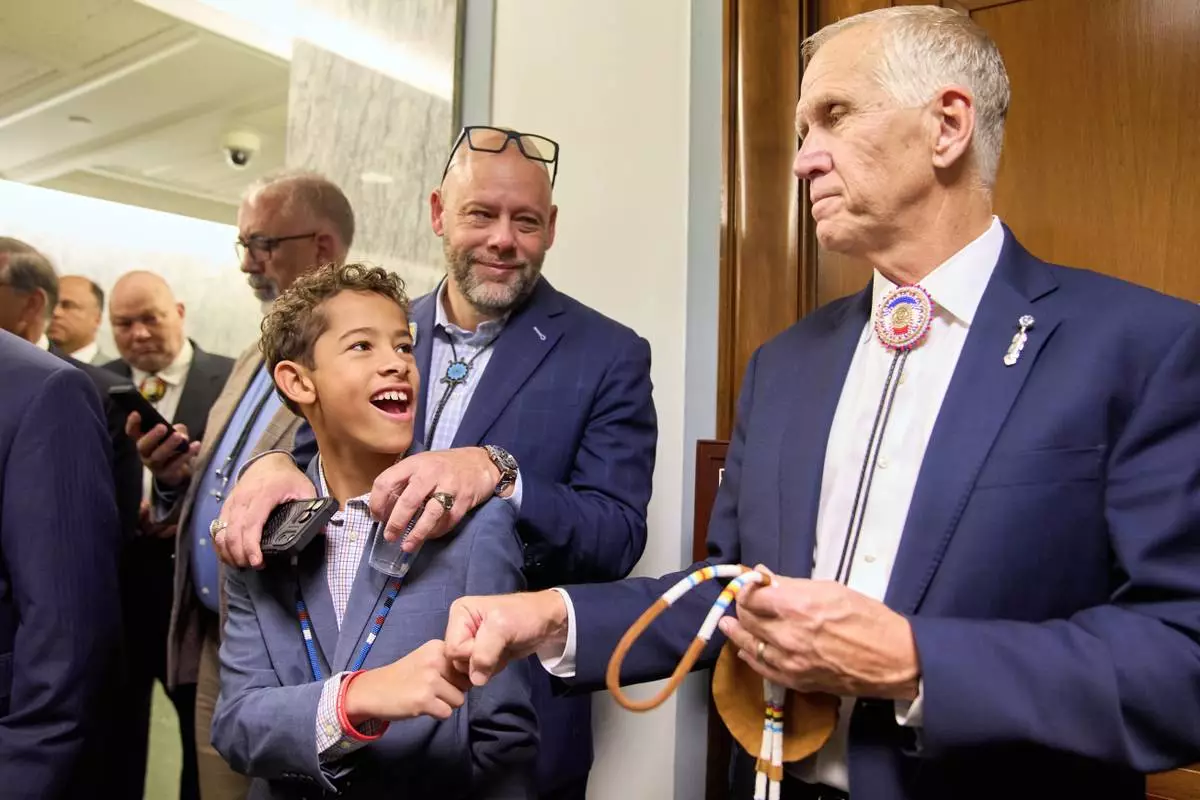
Austin Curt Thomas, 11, gets a celebratory fist bump from Sen. Thom Tillis, R-N.C., as he and his father Aaron Thomas, of Pembroke, N.C., join fellow members of the Lumbee Tribe of North Carolina, to celebrate after the passage of a bill granting their people federal recognition, on Capitol Hill, in Washington, Wednesday, Dec. 17, 2025. (AP Photo/Jacquelyn Martin)
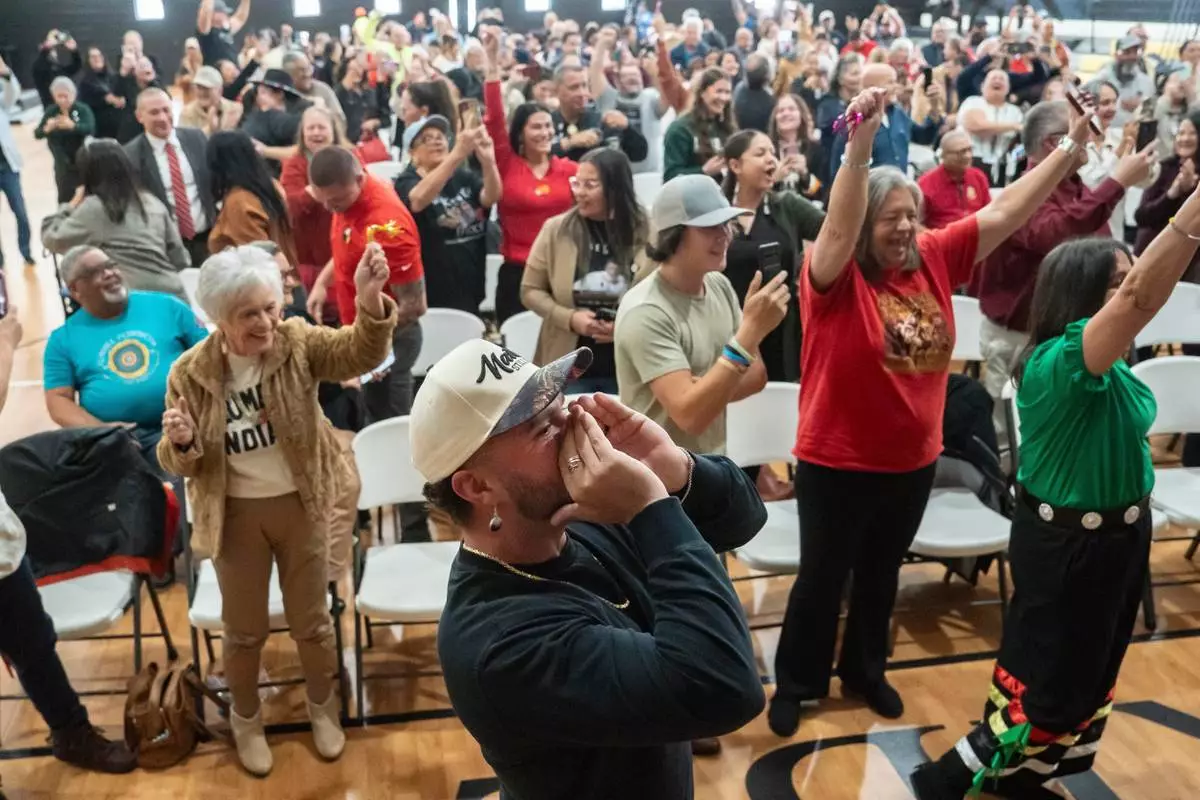
People celebrate after passage of the National Defense Authorization Act by the U.S. Senate during a watch party hosted by the Lumbee Tribe of North Carolina, Wednesday, Dec. 17, 2025, in Pembroke, N.C. (AP Photo/Allison Joyce)

People celebrate after passage of the National Defense Authorization Act by the U.S. Senate, during a watch party hosted by the Lumbee Tribe of North Carolina, Wednesday, Dec. 17, 2025, in Pembroke, N.C. (AP Photo/Allison Joyce)
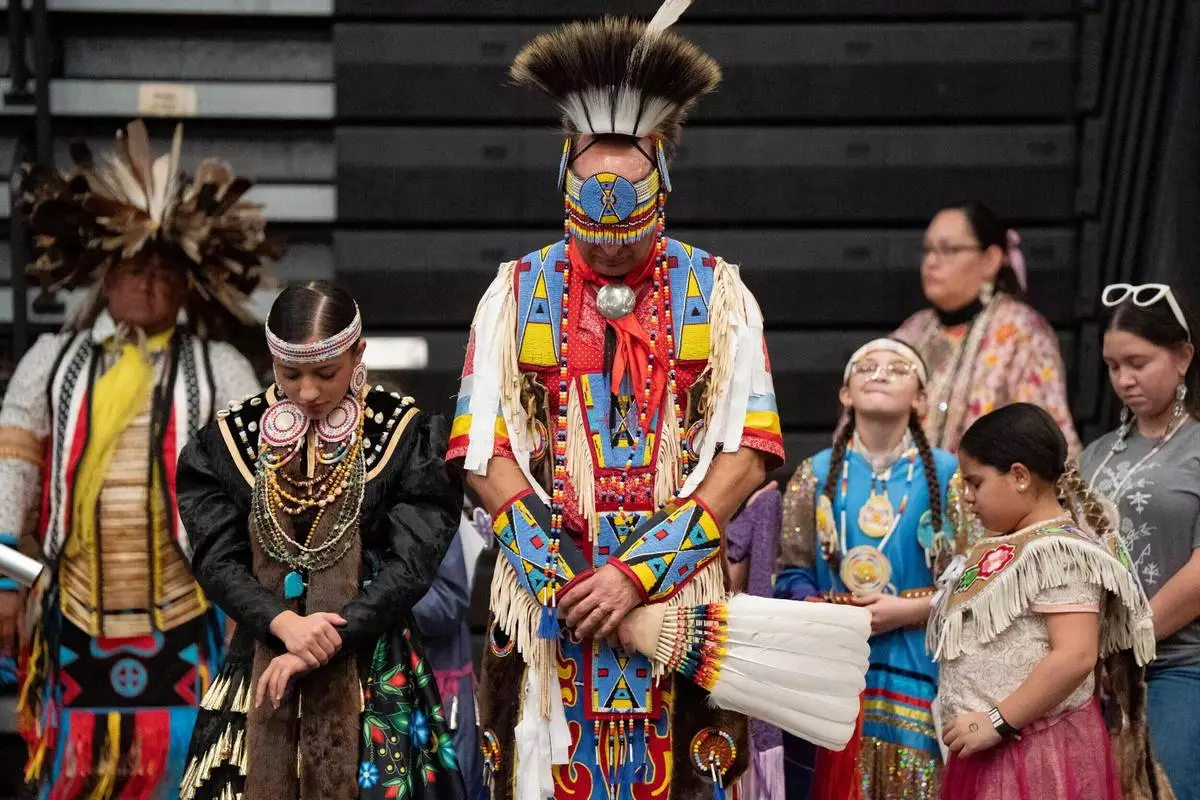
FILE - Members of the Lumbee Tribe bow their heads in prayer during the BraveNation Powwow and Gather at UNC Pembroke, March 22, 2025, in Pembroke, N.C. (AP Photo/Allison Joyce, file)

People sing while playing drums during a watch party hosted by the Lumbee Tribe of North Carolina, Wednesday, Dec. 17, 2025, in Pembroke, N.C. (AP Photo/Allison Joyce)

People celebrate after passage of the National Defense Authorization Act by the U.S. Senate during a watch party hosted by the Lumbee Tribe of North Carolina, Wednesday, Dec. 17, 2025, in Pembroke, N.C. (AP Photo/Allison Joyce)

People celebrate after passage of the National Defense Authorization Act by the U.S. Senate during a watch party hosted by the Lumbee Tribe of North Carolina, Wednesday, Dec. 17, 2025, in Pembroke, N.C. (AP Photo/Allison Joyce)

People celebrate after passage of the National Defense Authorization Act by the U.S. Senate, during a watch party hosted by the Lumbee Tribe of North Carolina, Wednesday, Dec. 17, 2025, in Pembroke, N.C. (AP Photo/Allison Joyce)