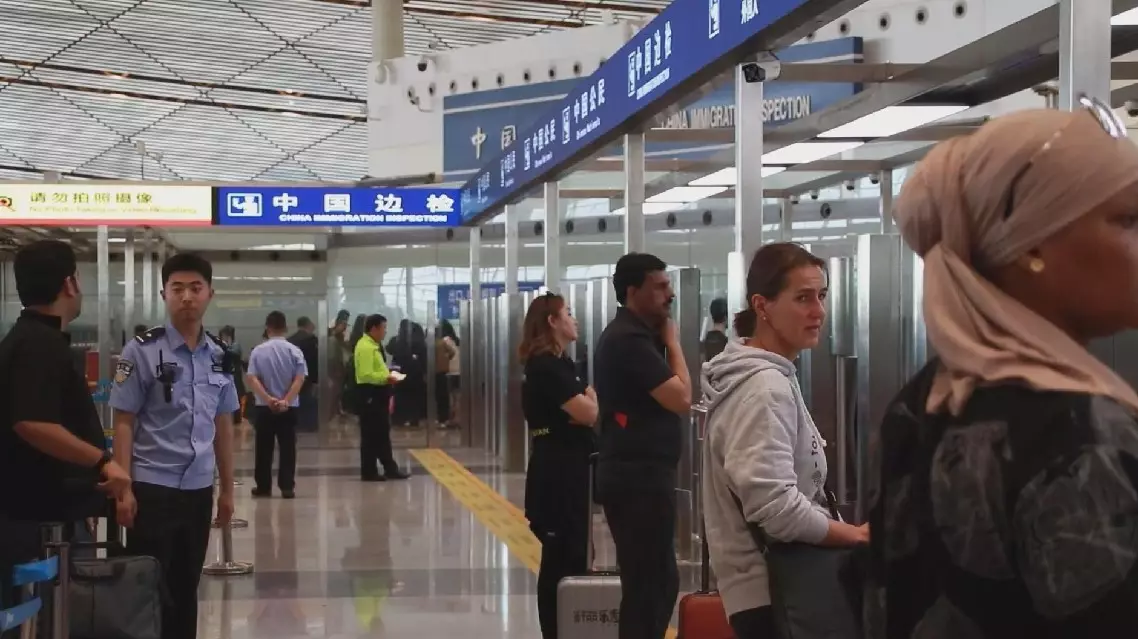
Cities across China have seen increasing numbers of entry-exit trips made by foreign tourists since the beginning of this year, thanks to the implementation of visa-free entry and transit policies and various other preferential policies facilitating foreign tourists’ stay in China.
Border inspection agencies across the country recorded a total of 8.186 million entries made by foreign nationals during the third quarter of this year, representing a year-on-year increase of 48.8 percent, of which 4.885 million trips enjoyed the visa-free policy, up 78.6 percent from the same period of last year, according to the National Immigration Administration (NIA) on Friday.
Since the beginning of this year, China has been making continuous efforts to expand the coverage of its visa-free policy, while introducing a series of policies and measures to facilitate foreign nationals' stay in China.
In addition, China has further extended its visa-free policy for foreign travelers, now allowing visitors from 54 countries to breeze into 37 entry ports nationwide under the 144-hour visa-free transit policy.
According to statistics from the Beijing General Station of Exit and Entry Frontier Inspection, in the first three quarters of this year, more than 1.7 million inbound and outbound trips were made by foreign nationals through ports in Beijing, an increase of 156.6 percent year on year.
"I had a lovely trip to China as been three days here arrived on Sunday. And the visa-free policy was really easy. The coming through immigration was really seamless and was a really good experience," said a New Zealand tourist.
"We enjoyed our trips. We visited the Great Wall. We also went to the downtown in China. We've seen a few places. We did enjoy the visa-free program," said a Polish tourist.
In the first three quarters, east China's Jiangsu Province also seen a climbing number of foreign visitors, registering 272,000 entry-exit trips made by foreign tourists through ports across the province, up by 128.56 percent year on year. Among them, 236,000 trips enjoyed the visa-free policy, a 15-fold increase over the same period of last year.
Southwest China's Mount Emei, one of the most beautiful mountains in China, has become popular among foreign tourists this year. As of Thursday, the scenic spot has received nearly 90,000 foreign tourists.
In order to facilitate foreign tourists' trips, local public security bureau has set up service stations at railway stations and core scenic spots.
"In the next phase, we will continue to optimize and improve policies and measures related to visa-free transit, expand the coverage, increase the linkage areas and optimize the layout of opening up, to further enhance the value and attractiveness of relevant policies. We will also work actively with relevant authorities to make it more convenient for foreign nationals to come to China," said Zhang Ning, a spokeswoman of the NIA.
The NIA has opened an immigration service hotline to provide one-stop resolutions for foreign visitors, while the State Administration of Market Regulation and the National Bureau of Statistics have selected eight cities to pilot the opening of credit supervision data to facilitate mobile payments by foreign nationals in China.
Beijing is the first city in the mainland to open access for using foreign bank cards to take subway. Shanghai has put into use the one-stop service centers for foreigners in terminal 2 of Hongqiao International Airport and terminals 1 and 2 of Pudong International Airport, providing guiding manuals, transportation card sales and foreign currency exchanges.
Chinese cities see surging numbers of entry-exit trips by foreign nationals