Skip to Content Facebook Feature Image

German medical device company continues investment expansion in China with confidence

China

China

China

German medical device company continues investment expansion in China with confidence

2024-10-25 16:52 Last Updated At:17:07

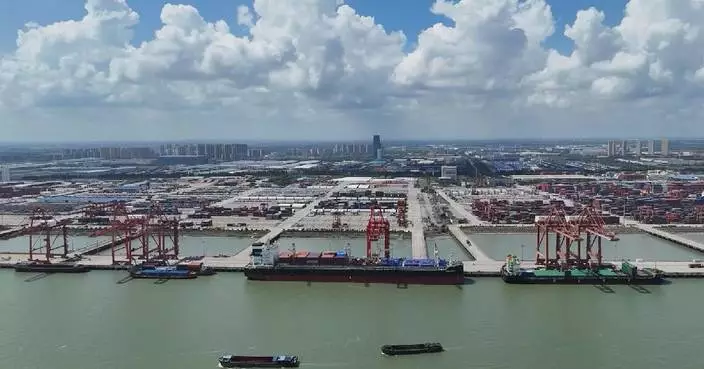
Fresenius Kabi (Nanchang), a subsidiary of the German healthcare giant Fresenius Kabi, has been expanded five times since it first invested in east China's Nanchang City in 2002, driven by the sound development momentum of the Chinese market and the country's favorable business environment.

Located in the Nanchang Economic and Technological Development Zone, the subsidiary, with a workforce of only about 1,000 employees, reported sales revenue exceeding 534 million yuan (about 74.95 million U.S. dollars) in 2023.

As an important research, development and production base of medical devices for Fresenius Kabi, the Nanchang Subsidiary produces infusion and blood transfusion terminal equipment and medical consumables.

"Fresenius Kabi (Nanchang) has become the most important production base, research and development center and logistics distribution hub of the Fresenius Group in the Asia-Pacific region, with its products reaching over 60 countries and regions worldwide," said Zhang Guangzong, vice president of Fresenius Kabi MedTech China.

Since its investment in Nanchang in 2002, the company has undergone five expansions and three capital increases, with the total investment reaching nearly 600 million yuan.

"The Chinese market is very important for us, for our products. So, it is a second largest market in the world for med-tech products. So, it's good to be here local to understand the customers' requirements, customers' needs, and also be close from proximity to customers being easy to supply and deliver. China is a very competitive country when it comes to manufacturing, but also when it comes to R&D (research and development). So, we don't have here only manufacturing, but we also have a very strong R&D team here to do R&D work," said Christian Hauer, a member of the Fresenius Kabi management board and president of Fresenius Kabi MedTech.

Hauer expressed strong confidence in China's investment prospects, saying that the company plans to continue launching more R&D and production projects in the country.

"I think we are growing here in China usually a lower double digit, and we see that should continue the trend, and also the plant. We hear also from our customers good feedback, the market is strong, the market is growing. We see additional opportunities to drive our business here in the Chinese market," he said.

German medical device company continues investment expansion in China with confidence

German medical device company continues investment expansion in China with confidence

The series of erroneous words and actions by Japanese Prime Minister Sanae Takaichi not only seriously deviate from the spirit of pacifist Constitution of the country but also further exacerbate regional tensions, said Tomoko Tamura, a member of the House of Representatives.

In an exclusive interview with China Central Television (CCTV), Tamura criticized Takaichi for straining Japan-China relations by making erroneous remarks on Taiwan, calling on her to improve bilateral relations.

Tamura pointed out that the political consensus reached during the normalization of diplomatic relations between the two countries remains of great significance, and Japan should respect and abide by it as the basis for repairing and rebuilding friendly relations with China.

"The erroneous remarks by Sanae Takaichi this time have led to the deterioration of China-Japan relations. This is absolutely unacceptable and must be retracted. Regarding the relations between two sides, the consensus reached during the normalization of diplomatic relations in 1972 is of utmost importance. At that time, the Chinese government asserted that Taiwan is part of China and the Japanese government fully understood and respected this stance. Now we should reaffirm this consensus, as well as the crucial agreements reached by both countries after 1972. Japan should explicitly acknowledge these significant agreements to rebuild friendly relations with China," she said.

Tamura also pointed out that in recent years, Japan has attempted to reshape its security policy, boosting defense spending, easing arms-export restrictions, pursuing offensive weapons development, and clearly deviating from the fundamental principle of "exclusively defense-oriented" policy.

"Japan's possession of long-range missiles clearly exceeded the scope of 'exclusively defense-oriented' policies. Japan is accelerating its military expansion. From the perspective of the Japanese constitution, this is absolutely not allowed. We are deeply concerned about the current Takaichi administration's disregard for the Japanese constitution. We clearly demand that Japan should adhere to the position of resolving issues through diplomatic efforts," she said.

Japanese official criticizes Takaichi's erroneous remarks

Japanese official criticizes Takaichi's erroneous remarks

Recommended Articles