
Skip to Content Facebook Feature Image

Hong Kong Expands Talent Admission Schemes to Attract Top Global Talent

HK

Hong Kong Expands Talent Admission Schemes to Attract Top Global Talent
HK

HK

Hong Kong Expands Talent Admission Schemes to Attract Top Global Talent

2024-11-01 12:48 Last Updated At:12:58

Measures launched to enhance Top Talent Pass Scheme and Quality Migrant Admission Scheme

This year's Policy Address announced reforms of various aspects of the talent admission regime. The Government today (November 1) launched three measures to enhance the Top Talent Pass Scheme (TTPS) and the Quality Migrant Admission Scheme (QMAS).

(1) Expanding the list of eligible universities under the TTPS

There are originally 185 eligible universities under the TTPS. To further broaden the network for attracting more top talent worldwide, 13 top Mainland and overseas universities/institutions are added to the list of eligible universities under the TTPS starting today, making a total of 198 eligible schools. The newly added universities/institutions include:

(a) nine Mainland universities ranked from 11th to 20th under the Shanghai Jiao Tong University Best Chinese Universities Ranking in the past five years but yet to be included in the original list of eligible universities, namely, Sichuan University; Beihang University; Southeast University; Beijing Institute of Technology; Tongji University; Renmin University of China; Beijing Normal University; Nankai University and Tianjin University; and

(b) four top-five specialised institutions on the QS World University Rankings in the discipline of "Art and Design" in the past five years, namely, Royal College of Art; University of the Arts London; Parsons School of Design, The New School; and Rhode Island School of Design.

The expanded list of eligible universities/institutions has been uploaded to the webpage of the Immigration Department (ImmD) (www.immd.gov.hk/pdf/aggregate_list.pdf) and Hong Kong Talent Engage (www.hkengage.gov.hk/en/how-to-apply-for-a-visa/admission-scheme-matching-tool-institutions/).

(2) Extending the validity period of the first visas of Category A applications under the TTPS to three years

Category A applicants under the TTPS are those with an annual income reaching HK$2.5 million or above in the year immediately preceding the date of application. For the applicants with approval given from the day of announcement in this year's Policy Address (i.e. October 16), the validity period of their first visa has been extended from two years to three years to facilitate their early planning to move to Hong Kong with their families. The new measure also applies to around 21 000 Category A applicants whose applications were approved before the announcement of this year's Policy Address. They may, starting from today onwards, apply to the ImmD for an extension of stay within three months before their limit of stay expires, and will be granted extension of stay for one year unconditionally. If they have secured offers of employment, or have established or joined in a business in Hong Kong upon applying for an extension, they may be granted an extension of stay for up to three years after submitting relevant proof.

(3) Enhancing the assessment criteria and arrangements of the General Points Test under the QMAS

The Government will, starting from today, enhance the General Points Test (GPT) under the QMAS by adopting a more objective and clear scoring criteria, and streamlining the application and selection process. The enhanced GPT replaces the original item-by-item scoring system with an assessment questionnaire. Applicants are required to confirm if they meet the 12 assessment criteria in the questionnaire under six major aspects, namely age, academic qualifications, language proficiency, work experience, annual income and business ownership, and submit supporting documents. The applicants can submit applications if they meet at least six assessment criteria. The ImmD will pass eligible applications received to a newly established assessment panel for further selection. The assessment panel is chaired by the Secretary for Labour and Welfare with other relevant bureau secretaries as members. Based on the deliberation outcome, the assessment panel will provide advice to the Director of Immigration for his approval decision. There will be no annual quotas under the enhanced GPT. For applications submitted under the original GPT before implementation of the enhancement measures, the ImmD will continue the processing in accordance with the original criteria and procedures, and conclude the assessment as soon as possible.

The electronic application platform (www.gov.hk/en/nonresidents/visarequire/visasentrypermits/applyqmas.htm) for the enhanced GPT has commenced operation. For enquiries relating to applications for visa/entry permit, please contact the ImmD by calling the enquiry hotline (2824 6111), by fax (2877 7711) or by email (enquiry@immd.gov.hk).

The Secretary of Labour and Welfare, Mr Chris Sun, said, "The Government proactively trawls for talent and retains talent. Since the implementation of the new talent admission regime at the end of 2022, over 380 000 applications have been received, with nearly 240 000 applications approved. Around 160 000 people of talent have arrived in Hong Kong with their families. The enhancement measures implemented today will help further attract talent conducive to Hong Kong's development, enrich the local talent pool, enhance Hong Kong's competitiveness in the quest for talent, and consolidate Hong Kong's status as an international talent hub."
DH reminds public to take precautions against heat-related illnesses during very hot weather

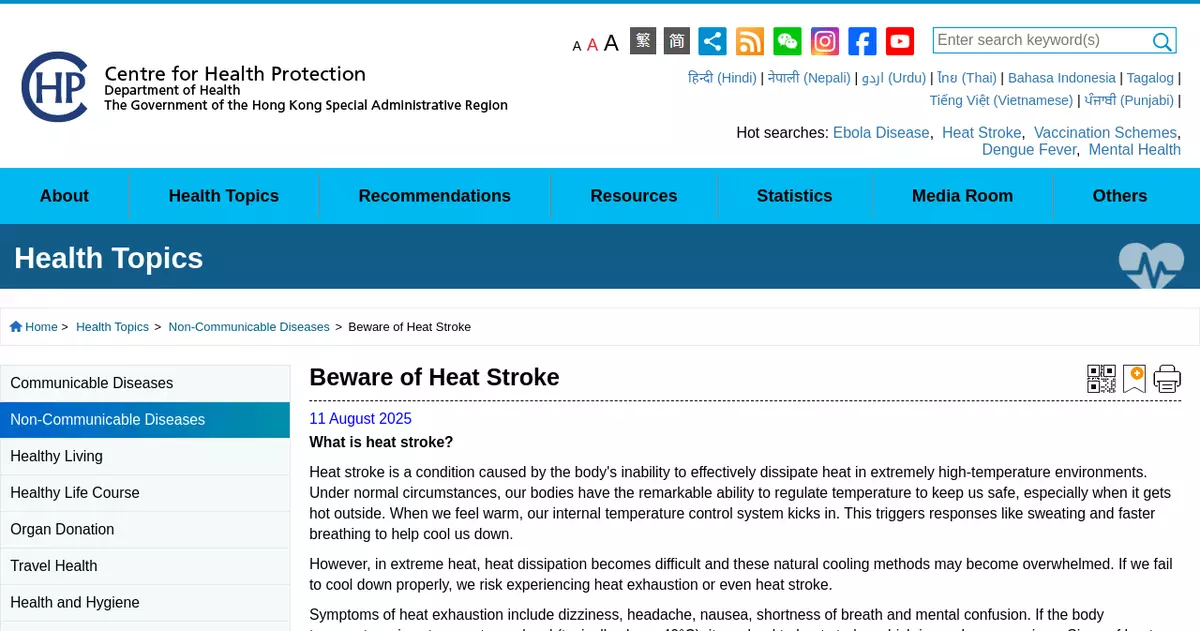
The Centre for Health Protection (CHP) of the Department of Health (DH) today (June 24) reminded members of the public to take appropriate precautions against heat-related illnesses, such as heat cramps, heat exhaustion and heat stroke, during very hot weather.

In a high-temperature environment, excessive sweating and difficulty in heat dissipation can cause stress to the body. Members of the public should take the following precautions:

  • Hydrate in a timely manner to prevent dehydration;
  • Wear light-coloured, loose-fitting and breathable clothing to minimise heat absorption and facilitate perspiration and heat dissipation;
  • Keep indoor areas well ventilated and maintain appropriate temperature and humidity, e.g. by opening windows or using a fan or air-conditioning;
  • Avoid strenuous exercise and prolonged activities such as hiking or trekking;
  • Arrange outdoor activities in the morning or the late afternoon, if possible, and bring enough water; and
  • Avoid beverages containing caffeine, such as coffee and tea, as well as alcoholic beverages, which may speed up water loss through the urinary system.

In addition, infants and children, the elderly, pregnant women, individuals with chronic illnesses such as heart disease or high blood pressure, overweight people and outdoor/manual workers are more susceptible to heat stroke. These groups should pay special attention to the following:

  • Infants and young children: Avoid going outside when the temperature is high. If they must go outside, adults should ensure they stay in places with moderate temperatures and good ventilation or air-conditioning. Infants and young children should never be left unattended in a confined space such as a vehicle;
  • The elderly, pregnant women, individuals with chronic illnesses and overweight people: Pay close attention to health conditions and seek help as soon as possible if experiencing any abnormalities in health indicators such as blood pressure, heart rate, etc or if there are fluctuations in health conditions. Avoid going out when the temperature is high. Make sure there is good ventilation, or turn on a fan or air-conditioner to keep an appropriate temperature indoors. High temperatures can also worsen the condition of people with chronic illnesses (such as cardiovascular and respiratory diseases). Therefore, they should have an ample supply of their usual medication and keep in contact with family members, neighbours and the community. People should seek immediate help if they feel unwell.
  • Outdoor/manual workers: Reschedule work to cooler hours as far as feasible. If working in a hot environment is unavoidable, provide shade where practicable and use ventilation and heat dissipation equipment. Once work has begun, gradually adjust the pace of work and take breaks in the shade to regain strength.

The DH reminded the public that heat stroke is one of the most common health risks in hot weather. Over the past five years, there have been over 200 hospital admissions due to heat stroke each year in Hong Kong, with two to five fatal cases occurring mainly during the summer months from May to September. Vulnerable groups are more susceptible to heat stroke. Symptoms include dizziness, headache, nausea, shortness of breath or confusion. In severe cases, patients may suffer from convulsions or become unconscious, which can be life-threatening if they are not cooled down and resuscitated in a timely manner.

Members of the public are also advised to pay attention to the latest weather, as well as the real-time and forecasted ultraviolet (UV) index released by the Hong Kong Observatory (HKO). When the UV index is high (6 or above), the public should note the following:

  • Avoid direct sunlight exposure to the skin and the eyes;
  • Apply broad-spectrum, water-resistant sunscreen liberally, with a sun protection factor (SPF) of at least 30 or higher, when participating in outdoor activities. Reapply every two hours if staying outdoors for long periods, or after swimming, sweating or towelling off;
  • While using DEET-containing insect repellents for personal protection against mosquito-borne diseases, apply sunscreen before insect repellent;
  • Seek shade;
  • Wear UV-blocking sunglasses;
  • Wear loose-fitting clothing with long-sleeves; and
  • Wear a wide-brimmed hat or use an umbrella.

If symptoms develop, such as dizziness, headache, nausea, shortness of breath or confusion, rest and seek help immediately, and seek medical advice as soon as possible.

For more health information, the public may visit theCHP's heat strokepage andUV radiation page; the HKO's Dial-a-Weather (1878 200),latestweather report and forecast,UV Indexand weather information forhiking and mountaineering; andpress releasesof the Labour Departmenton precautions against heat stroke for outdoor workers and their employers when the Heat Stress at Work Warning is in force.

Source: AI-found images

Source: AI-found images

Recommended Articles