China's stunning autumn landscapes are drawing in tourists from across the country, with millions of visitors seeking to capture these breathtaking sights with their cameras, hoping to preserve the fleeting beauty of the moment.
Visitors to central China's Jianshi County, Hubei Province, are captivated by the breathtaking display of red maple trees and autumn foliage. The vibrant red maples are complemented by a stunning array of other trees and flowers, creating a breathtaking scenery that enthralls tourists.
Further up in northeast China's Jiaohe City, Jilin Province, trees high on the mountain tops are wearing rime ice, creating an awe inspiring scenery.
Meanwhile, a pinky muhly grass field in north China's Qinhuangdao City, Hebei Province, is attracting flocks of tourists, who emerged in waist-high grass, eager to take selfies with the dreamy plants.
To the east, a breathtaking sea of crimson suaeda salsa stretches across a nature reserve in Dongying City, Shandong Province. Majestic red-crowned cranes gracefully soar above and rest among the vibrant plant life.
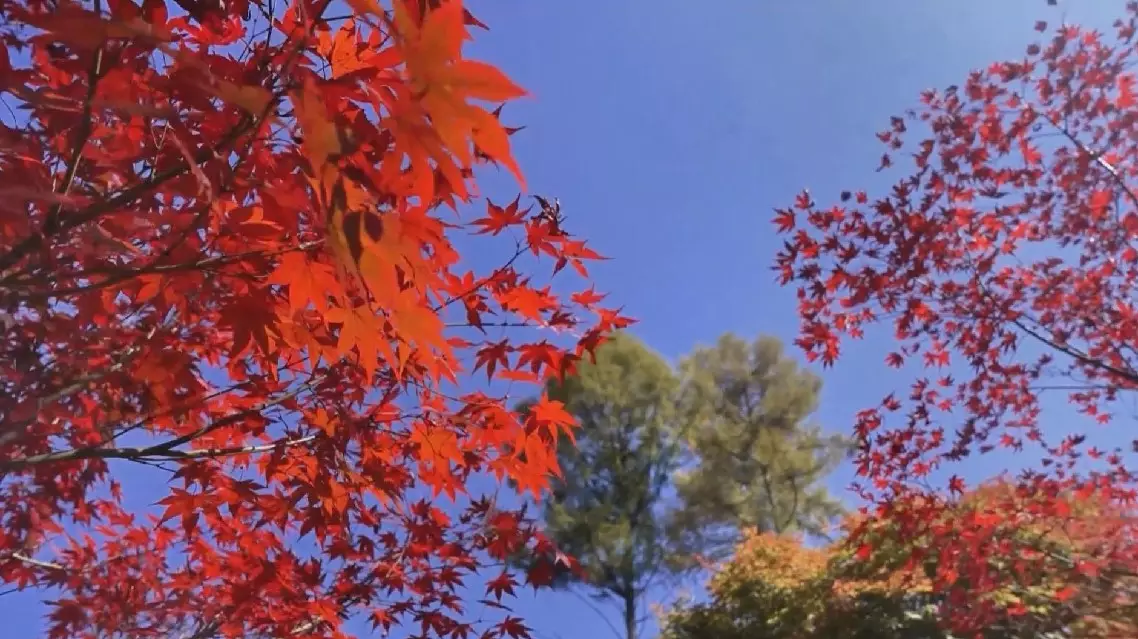
China's stunning autumn scenery captivates visitors
The United States Central Command released a statement on Tuesday saying that a U.S. Army Apache helicopter gunship crashed near the Strait of Hormuz on Monday, and that its two crew members had been rescued.
According to the statement, two crew members from a U.S. Army AH-64 Apache were rescued by American forces after their helicopter went down at 7:33 p.m. Eastern Time on Monday near the coast of Oman while patrolling regional waters.
The soldiers were rescued within around two hours and are in stable condition.
An investigation into the cause of the crash is underway, although U.S. President Donald Trump said in a social media post that the helicopter had been shot down by Iran.
"I have just been informed ... that last night the Iranians shot down one of our highly sophisticated Apache helicopters while patrolling over the Strait of Hormuz," Trump said in a post on Truth Social on Tuesday.
The two pilots onboard the helicopter were rescued and are "safe and uninjured," Trump said.
"Nevertheless, the United States must, of necessity, respond to this attack," he added.
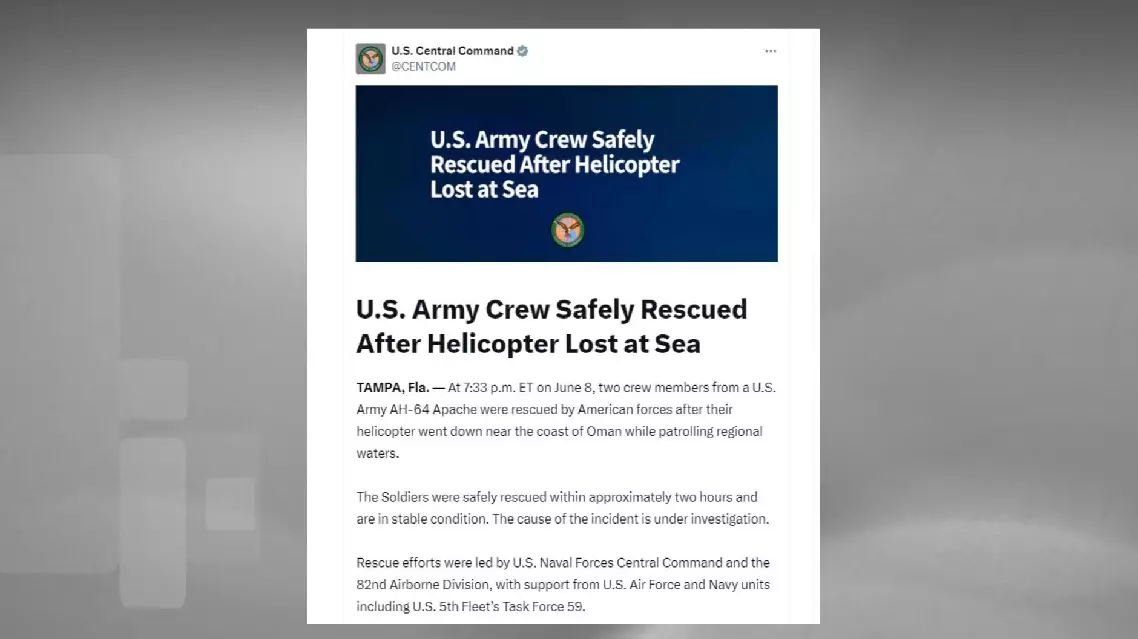
U.S. military confirms helicopter crash near Strait of Hormuz, Trump vows to respond