ST. LOUIS--(BUSINESS WIRE)--Nov 1, 2024--
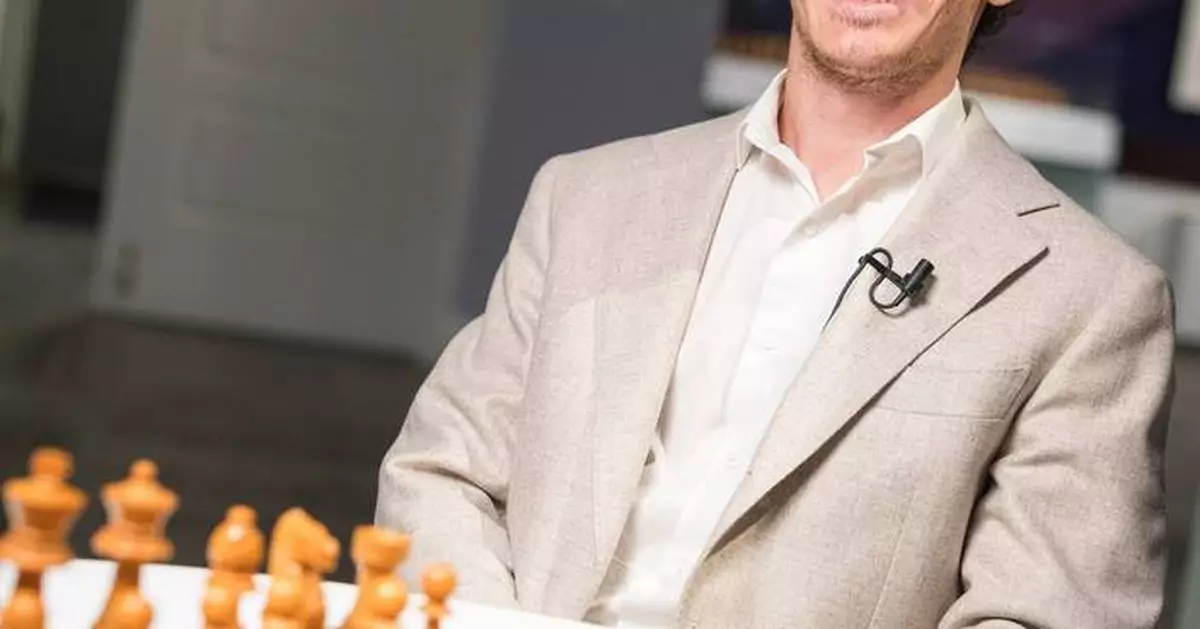
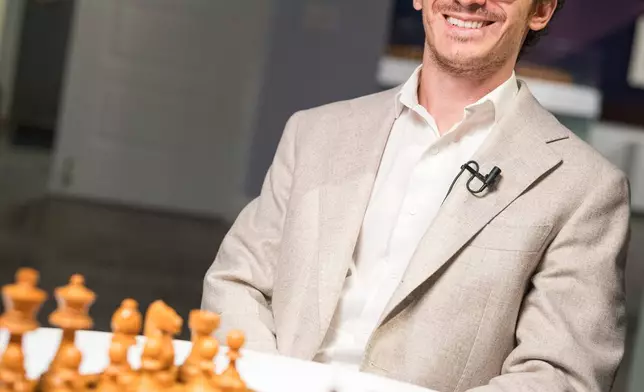
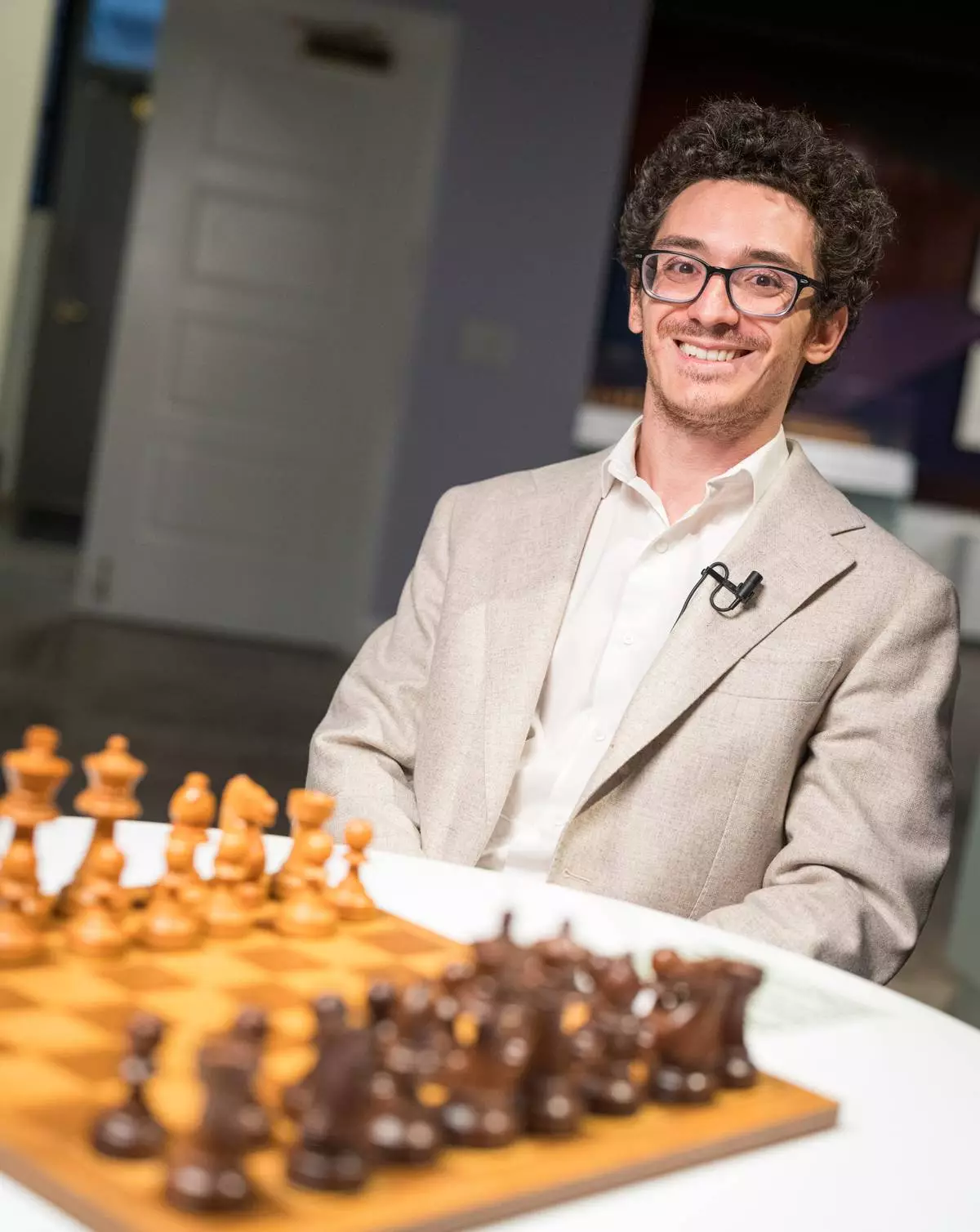
Following an impressive win the 2024 U.S. Chess Championship for the fourth time, Grandmaster (GM) Fabiano Caruana won the 2024 Champions Showdown: Chess 9LX after a brilliant performance, defeating a competitive field of top American players as well as legendary former World Champion Garry Kasparov to take home the $37,500 first place prize. Chess 9LX was hosted by the Saint Louis Chess Club at the World Chess Hall of Fame October 28-30, 2024.
Click to Gallery
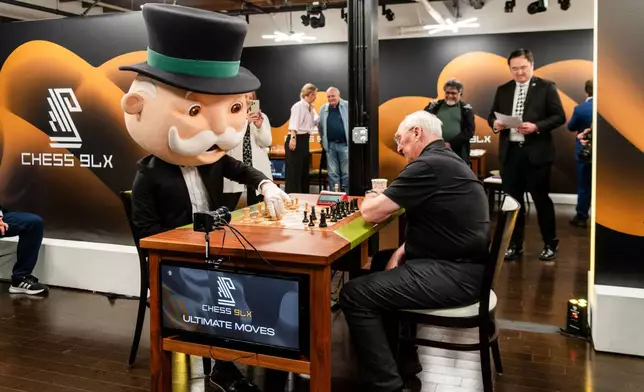
Chess 9LX was preceded by Ultimate Moves, a fun and casual exhibition event featuring Saint Louis Chess Club Co-founder Rex Sinquefield and Mr. Monopoly–in town celebrating the launch of the Saint Louis Monopoly board game, which includes a World Chess Hall of Fame property– who teamed up with legendary World Champion Garry Kasparov and the Champions Showdown: Chess 9LX field. Team Mr. Monopoly emerged as the winners, beating Team Rex 6-3 in the match. (Photo: Business Wire)
Saint Louis Monopoly is available for purchase now through the Saint Louis Chess Campus online gift shop, Q Boutique. (Photo: Business Wire)
Following an impressive win the 2024 U.S. Chess Championship for the fourth time, Grandmaster Fabiano Caruana won the 2024 Champions Showdown: Chess 9LX. (Photo: Business Wire)
This press release features multimedia. View the full release here: https://www.businesswire.com/news/home/20241101432081/en/
Caruana shared: “Going in, it was a race between Hikaru. Having form carry over from the Championships was important. I felt I played well, but did get lucky against Garry.”
GM Hikaru Nakamura finished in second place, earning $25,000 while GM Wesley So took third place and $20,000.
“The Champions Showdown: Chess 9LX is always a treat for our participants and fans watching around the world, especially with the top players from the United States competing alongside legendary former World Champion Garry Kasparov,” said Tony Rich, Technical Director of the Saint Louis Chess Club. “It’s always thrilling to see Fabiano in action, and this year, he’s added yet another impressive win to his already stellar resume.”
Final tournament results include:
Created by the Saint Louis Chess Club, Chess 9LX is an annual tournament played in Chess960 style (i.e. Fischer Random), a chess variant where the starting position of the pieces is randomized along the first rank. The tournament format is a 10-player round-robin, with a time control of 20 minutes per side plus a 5-second increment added every move.
Chess 9LX was preceded by Ultimate Moves, a fun and casual exhibition event featuring Saint Louis Chess Club Co-founder Rex Sinquefield and Mr. Monopoly–in town celebrating the launch of the Saint Louis Monopoly board game, which includes a World Chess Hall of Fame property– who teamed up with legendary World Champion Garry Kasparov and the Champions Showdown: Chess 9LX field. Team Mr. Monopoly emerged as the winners, beating Team Rex 6-3 in the match.
Full event coverage including commentary from GM Yasser Seirawan, GM Maurice Ashely and International Master (IM) Nazí Paikidze can be found on Saint Louis Chess Club’s YouTube and Twitch.tv channels or on uschesschamps.com. Saint Louis Monopoly is available for purchase now through the Saint Louis Chess Campus online gift shop, Q Boutique.
The Club’s next event, the Saint Louis Masters, will be held December 3-8, 2024. More information will be available soon at www.uschesschamps.com.
About the Saint Louis Chess Club
The Saint Louis Chess Club is a non-profit, 501(c)(3) organization that is committed to making chess an important part of our community. In addition to providing a forum for the community to play tournaments and casual games, the club also offers chess improvement classes, beginner lessons and special lectures.
Recognizing the cognitive and behavioral benefits of chess, the Saint Louis Chess Club is committed to supporting those chess programs that already exist in area schools while encouraging the development of new in-school and after-school programs. For more information, visit www.saintlouischessclub.org.
About the World Chess Hall of Fame
The World Chess Hall of Fame (WCHOF) is a 501(c)(3) nonprofit organization committed to building awareness of the cultural and artistic significance of chess. It opened on September 9, 2011, in the Central West End after moving from previous locations in New York, Washington, D.C., and Miami. Housed in a historic 15,900 square-foot residence-turned-business in Saint Louis' Central West End neighborhood, the WCHOF features World Chess Hall of Fame inductees, United States Chess Hall of Fame inductees selected by the U.S. Chess Trust, artifacts from the permanent collection and exhibitions highlighting the great players, historic games and rich cultural history of chess. The WCHOF partners with the Saint Louis Chess Club to provide innovative programming and outreach to local, national and international audiences. For more information, visit worldchesshof.org and on social: Facebook, Instagram, Twitter and YouTube channels.
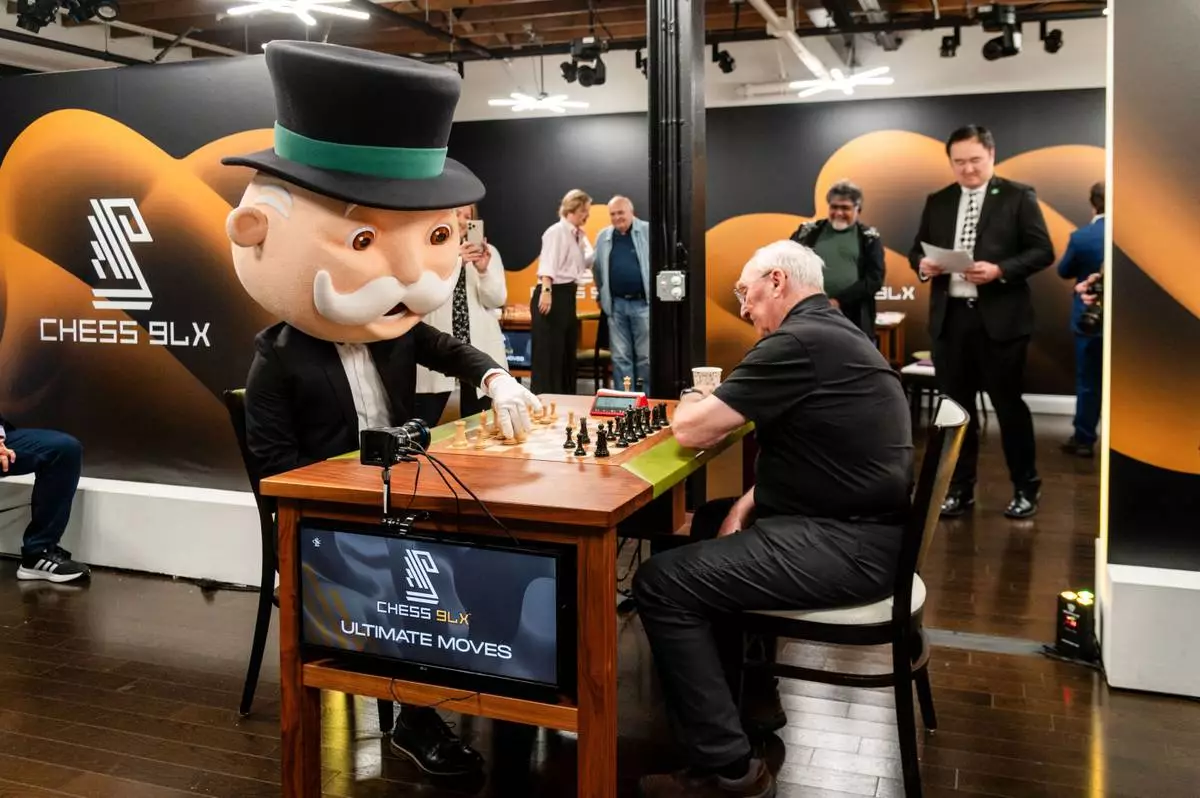
Chess 9LX was preceded by Ultimate Moves, a fun and casual exhibition event featuring Saint Louis Chess Club Co-founder Rex Sinquefield and Mr. Monopoly–in town celebrating the launch of the Saint Louis Monopoly board game, which includes a World Chess Hall of Fame property– who teamed up with legendary World Champion Garry Kasparov and the Champions Showdown: Chess 9LX field. Team Mr. Monopoly emerged as the winners, beating Team Rex 6-3 in the match. (Photo: Business Wire)
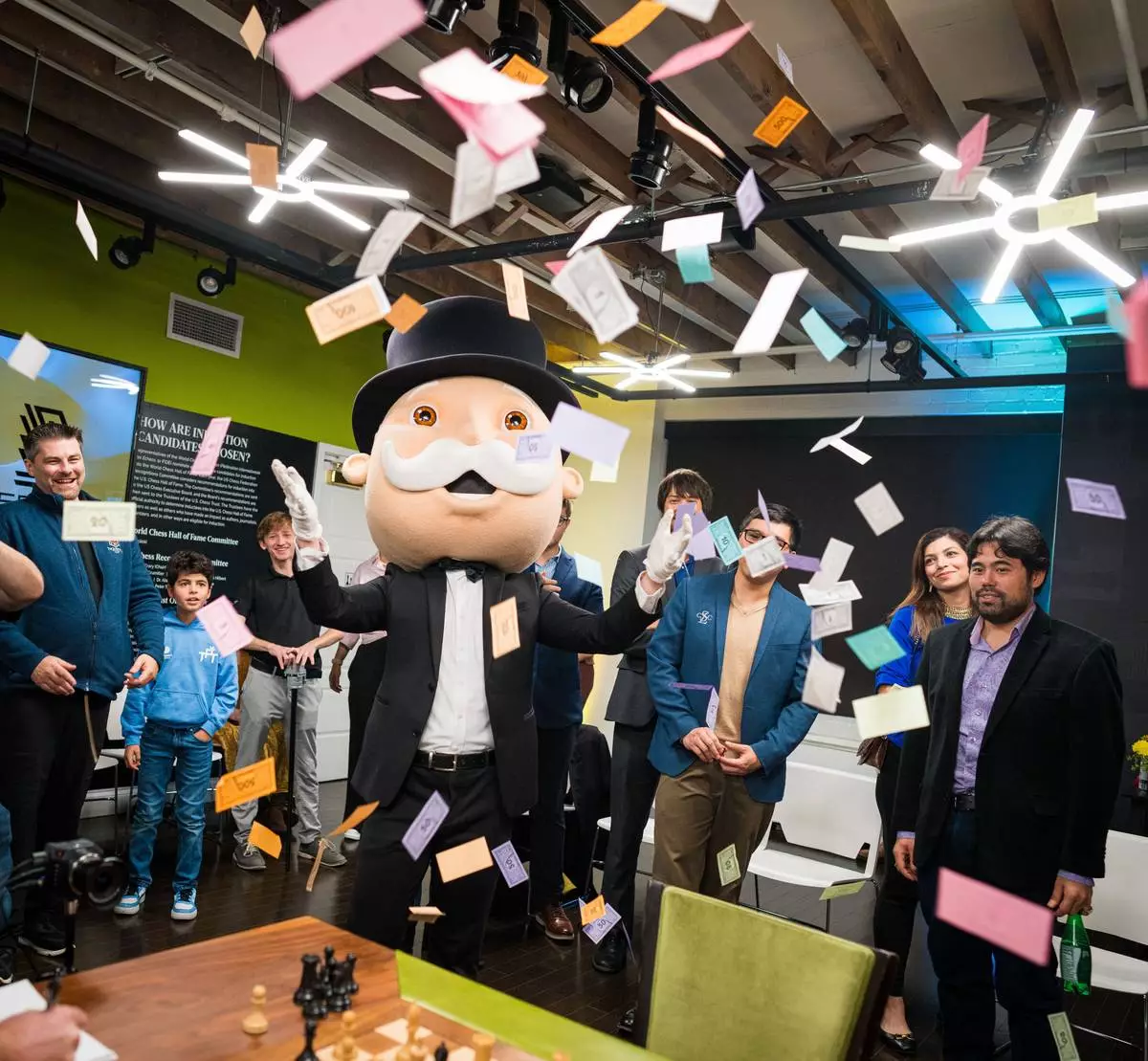
Saint Louis Monopoly is available for purchase now through the Saint Louis Chess Campus online gift shop, Q Boutique. (Photo: Business Wire)
Following an impressive win the 2024 U.S. Chess Championship for the fourth time, Grandmaster Fabiano Caruana won the 2024 Champions Showdown: Chess 9LX. (Photo: Business Wire)
Dr. Molly O’Shea has noticed growing skepticism about vaccines at both of her Michigan pediatric offices and says this week's unprecedented and confusing changes to federal vaccine guidance will only make things worse.
One of her offices is in a Democratic area, where more of the parents she sees are opting for alternative schedules that spread out shots. The other is in a Republican area, where some parents have stopped immunizing their children altogether.
She and other doctors fear the new recommendations and the terminology around them will stoke vaccine hesitancy even more, pose challenges for pediatricians and parents that make it harder for kids to get shots, and ultimately lead to more illness and death.
The biggest change was to stop blanket recommendations for protection against six diseases and recommend those vaccines only for at-risk children or through something called “shared clinical decision-making” with a health care provider.
The phrase, experts say, is confusing and dangerous: “It sends a message to a parent that actually there’s only a rarefied group of people who really need the vaccine,” O’Shea said. “It’s creating an environment that puts a sense of uncertainty about the value and necessity or importance of the vaccines in that category.”
Health Secretary Robert F. Kennedy Jr., who helped lead the anti-vaccine movement for years, said in announcing the changes that they better align the U.S. with peer nations “while strengthening transparency and informed consent.”
But doctors say they are sowing doubt — the vaccines have been extensively studied and proven to be safe and effective at shielding kids from nasty diseases — at a time when childhood vaccination rates are already falling and some of those infectious diseases are spreading.
On Friday, the American Academy of Pediatrics and more than 200 medical, public health and patient advocacy groups sent a letter to Congress about the new childhood immunization schedule.
“We urge you to investigate why the schedule was changed, why credible scientific evidence was ignored, and why the committee charged with advising the HHS Secretary on immunizations did not discuss the schedule changes as a part of their public meeting process," they wrote.
O’Shea said she and other pediatricians discuss vaccines with parents at every visit where they are given. But that’s not necessarily “shared clinical decision-making,” which has a particular definition.
On its website, the Advisory Committee on Immunization Practices says: “Unlike routine, catch-up, and risk-based recommendations, shared clinical decision-making vaccinations are not recommended for everyone in a particular age group or everyone in an identifiable risk group. Rather, shared clinical decision-making recommendations are individually based and informed by a decision process between the health care provider and the patient or parent/guardian.”
In this context, health care providers include primary care physicians, specialists, physician assistants, nurse practitioners, registered nurses and pharmacists.
A pair of surveys conducted last year by the Annenberg Public Policy Center at the University of Pennsylvania suggested that many people don’t fully understand the concept, which came up last year when the federal government changed recommendations around COVID-19 vaccinations.
Only about 2 in 10 U.S. adults knew that one meaning behind shared decision-making is that “taking the vaccine may not be a good idea for everyone but would benefit some.” And only about one-third realized pharmacists count as health care providers to talk with during the process, even though they frequently administer vaccines.
As of this week, vaccines that protect against hepatitis A, hepatitis B, rotavirus, RSV, flu and meningococcal disease are no longer universally recommended for kids. RSV, hepatitis A, hepatitis B and meningococcal vaccines are recommended for certain high-risk populations; flu, rotavirus, hepatitis A, hepatitis B and meningococcal vaccines are recommended through shared decision-making — as is the COVID-19 vaccine, although that change was made last year.
Shortly after the federal announcement Monday, Dr. Steven Abelowitz heard from half a dozen parents. “It’s causing concern for us, but more importantly, concern for parents with kids, especially young kids, and confusion,” said Abelowitz, founder of Ocean Pediatrics in Orange County, California.
Though federal recommendations are not mandates — states have the authority to require vaccinations for schoolchildren — they can affect how easy it is for kids to get shots if doctors choose to follow them.
Under the new guidelines, O'Shea said, parents seeking shots in the shared decision-making category might no longer bring their kids in for a quick, vaccine-only appointment with staff. They'd sit down with a health care provider and discuss the vaccine. And it could be tougher to have a flu clinic, where parents drive up and kids get shots without seeing a doctor.
Still, doctors say they won’t let the changes stop them from helping children get the vaccines they need. Leading medical groups are sticking with prior vaccine recommendations. Many parents are, too.
Megan Landry, whose 4-year-old son Zackary is one of O’Shea’s patients, is among them.
“It’s my responsibility as a parent to protect my child’s health and well-being,” she said. “Vaccines are a really effective and well-studied way to do that.”
She plans to keep having the same conversations she’s always had with O’Shea before getting vaccines for Zackary.
“Relying on evidence and trusted medical guidance really helps me to make those decisions,” she said. “And for me, it’s not just a personal choice for my own son but a way to contribute to the health of everybody.”
But for other families, confidence about vaccines is waning as trust in science erodes. O'Shea lamented that parents are getting the message that they can't trust medical experts.
“If I take my car to the mechanic, I don’t go do my own research ahead of time," she said. “I go to a person I trust and I trust them to tell me what’s going on.”
Abelowitz, the California doctor, likened the latest federal move to pouring gasoline on a fire of mistrust that was already burning.
“We’re worried the fire’s out of control,” he said. “Already we’ve seen that with measles and pertussis, there are increased hospitalizations and even increasing deaths. So the way that I look at it — and my colleagues look at it — we’re basically regressing decades.”
The Associated Press Health and Science Department receives support from the Howard Hughes Medical Institute’s Department of Science Education and the Robert Wood Johnson Foundation. The AP is solely responsible for all content.
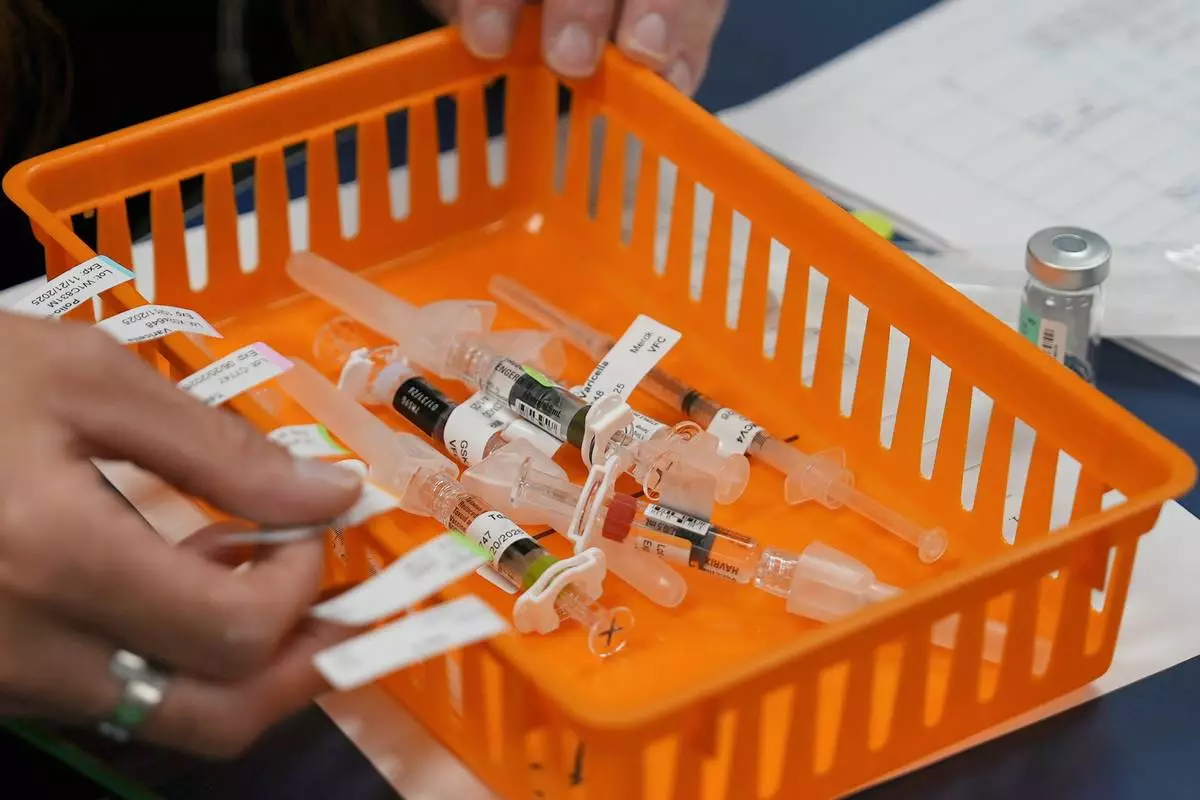
FILE - Vaccines are prepared for students during a pop-up immunization clinic at a school in Louisville, Ky., on Thursday, Aug. 8, 2024. (AP Photo/Mary Conlon, File)