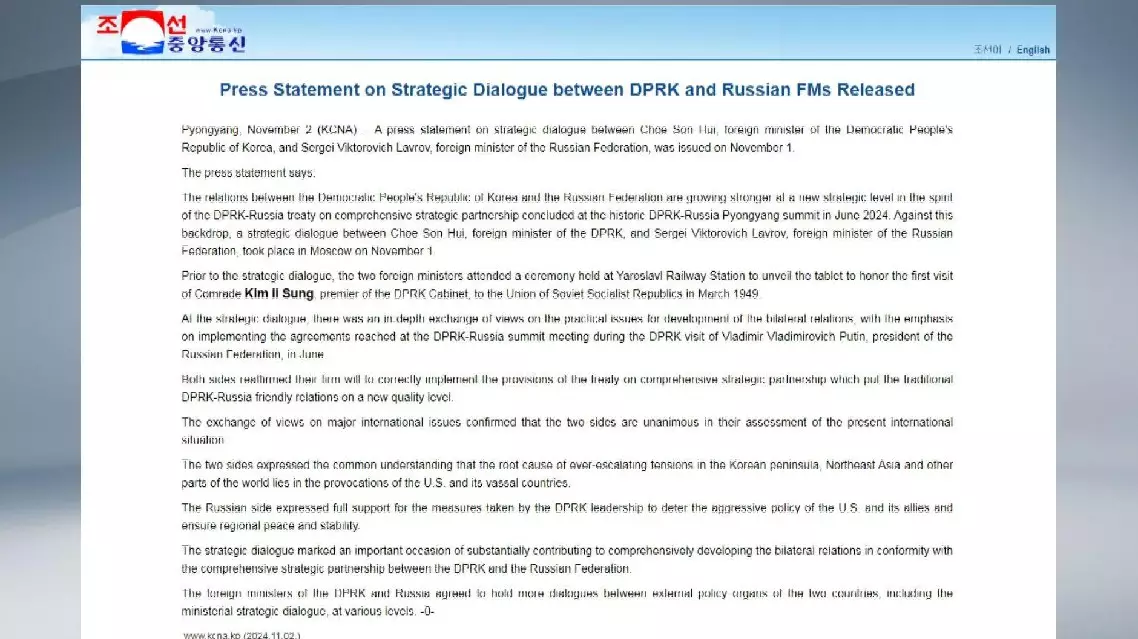
The Democratic People's Republic of Korea (DPRK) and the Russian Federation on Saturday released press statements, respectively, on the common grounds reached during a strategic dialog between their foreign ministers in Moscow on Friday.
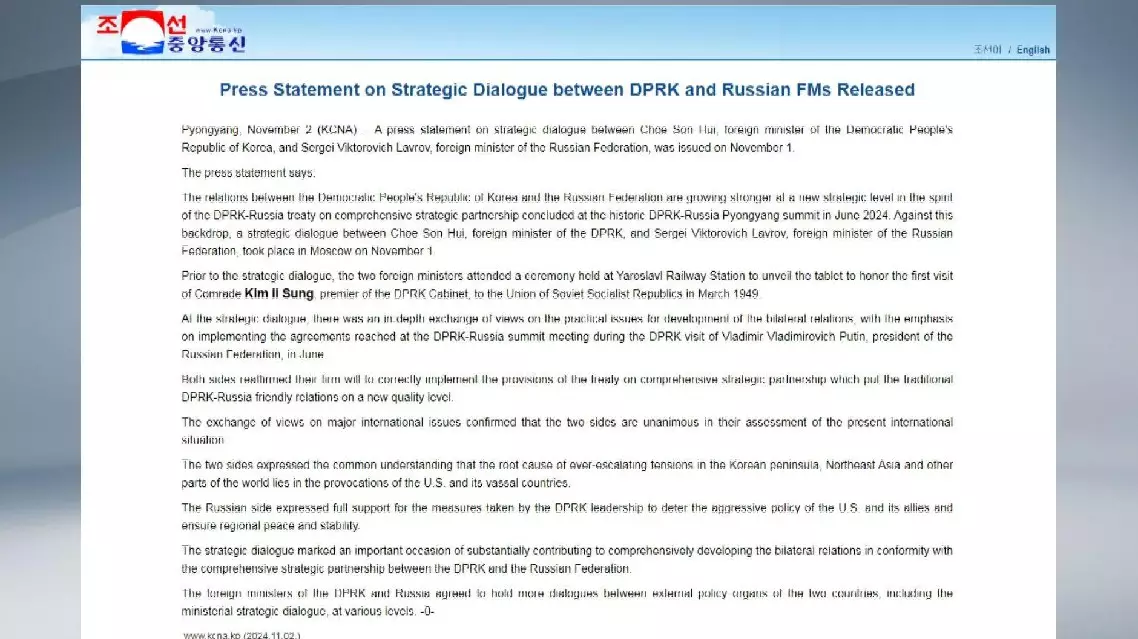
The press release by the Korean Central News Agency said that during the dialog between DPRK Foreign Minister Choe Son Hui and Russian Foreign Minister Sergey Lavrov, the two sides expressed the common understanding that "the root cause of ever-escalating tensions in the Korean Peninsula, Northeast Asia and other parts of the world lies in the provocations of the United States and its vassal countries."
The foreign ministers of the DPRK and Russia agreed to hold more dialogs between external policy organs of the two countries, including the ministerial strategic dialog, at various levels, it said.
The Russian Foreign Ministry's press release said that during the strategic consultations, the two ministers "had a thorough exchange of opinions on the practical issues of developing the bilateral relations."
The Russian side expressed "full support of the measures being taken by the state leadership of the DPRK to contain the aggressive policy of the United States and its satellites," and to ensure peace and stability in the region, it said.
It also said that the foreign ministers' strategic consultations "make an important contribution to further development and expansion of the bilateral relations in line with the comprehensive strategic partnership between the Russian Federation and the DPRK."
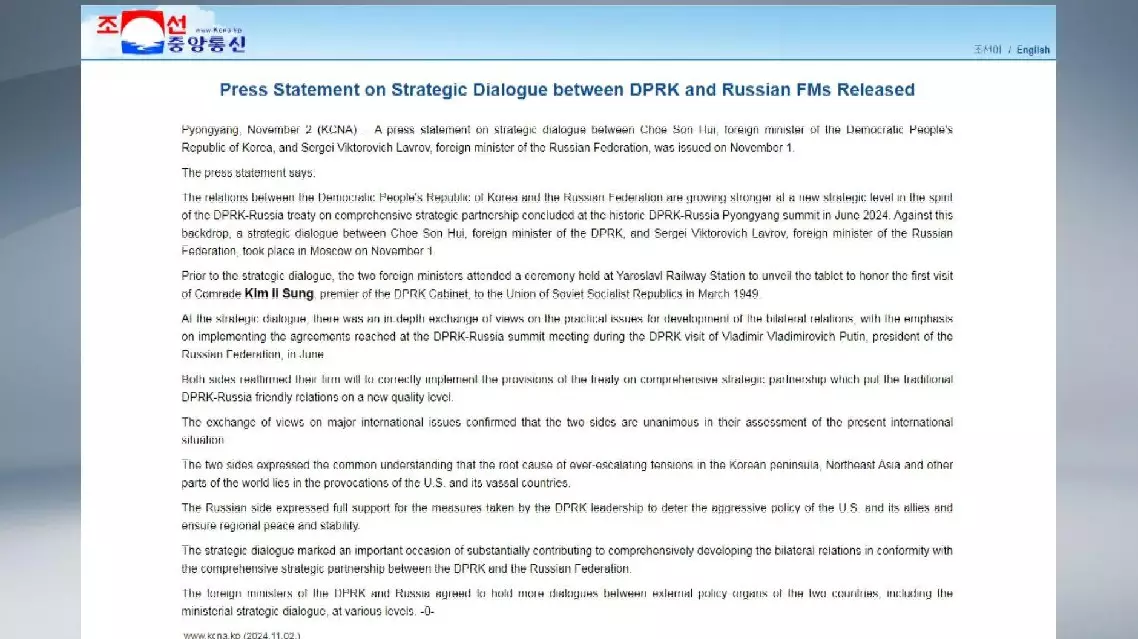
DPRK, Russia release press statements on FM strategic dialog
Nauru's President David Adeang returned to his ancestral home in Jiangmen, Guangdong Province this week, not only to honor family heritage but also to explore renewable energy collaboration and deepen people-to-people ties between the Pacific island nation and China.
He arrived in the province on Sunday for a five-day homecoming visit, marking his second trip to the southern Chinese city in just seven months.
Adeang and his family were welcomed back to Jiangmen as they traced their roots. His great-grandfather's ancestral home stands in the ancient town of Chikan, where more than a century ago his forefathers left for Southeast Asia in search of a livelihood before eventually settling in Nauru.
"I feel like I'm not a stranger anymore, I feel like family. Bilateral relationships can be strengthened through people-to-people exchanges and who better to promote that than the president of my country. That's me," Adeang said.
In a heartfelt ceremony on Wednesday, the president joined local villagers in a traditional ancestral worship ritual, receiving blessings and symbolic gifts from a community elder. Together, they wrote Spring Festival couplets, made rice cakes, shared a warm reunion meal, and distributed red envelopes.
Just a day before this emotional reunion, the president visited a solar panel factory in Jiangmen to explore ways to make full use of Nauru's abundant sunlight.
"The technology is of course world class. And I feel like we are wasting the sunlight that we have in Nauru, but maybe we can, through cooperation with the government, we can develop a project that will take us to 100-percent renewable," Adeang said.
The president also met Jiangmen native Ma Enduo, founder and chairman of Amos, one of China's major candy producers. Struck by an instant bond, Ma pledged to send an entire container of sweets to the people of Nauru.
Adeang thanked Ma for his generous gift to the people of Nauru, highlighting the bond he felt with his ancestral hometown.
"And he is from Jiangmen, my hometown. We are brothers," he said.
Adeang also stressed that the visit bridged heritage and future, adding a sweet note to the deepening Nauru-China ties.
Nauru's president returns to China, strengthening cultural, trade ties