Skip to Content Facebook Feature Image

Chinese, foreign scholars speak highly of World Conference of Classics

China

China

China

Chinese, foreign scholars speak highly of World Conference of Classics

2024-11-08 14:14 Last Updated At:14:37

Participating scholars and experts from China and abroad have lauded the ongoing inaugural World Conference of Classics, saying the event provides a platform for researchers to exchange ideas and build consensus on topics related to classical civilizations.

The first World Conference of Classics convened in Beijing from Wednesday to Friday, uniting 485 scholars and experts from over 30 countries and regions to explore the enduring wisdom of past civilizations.

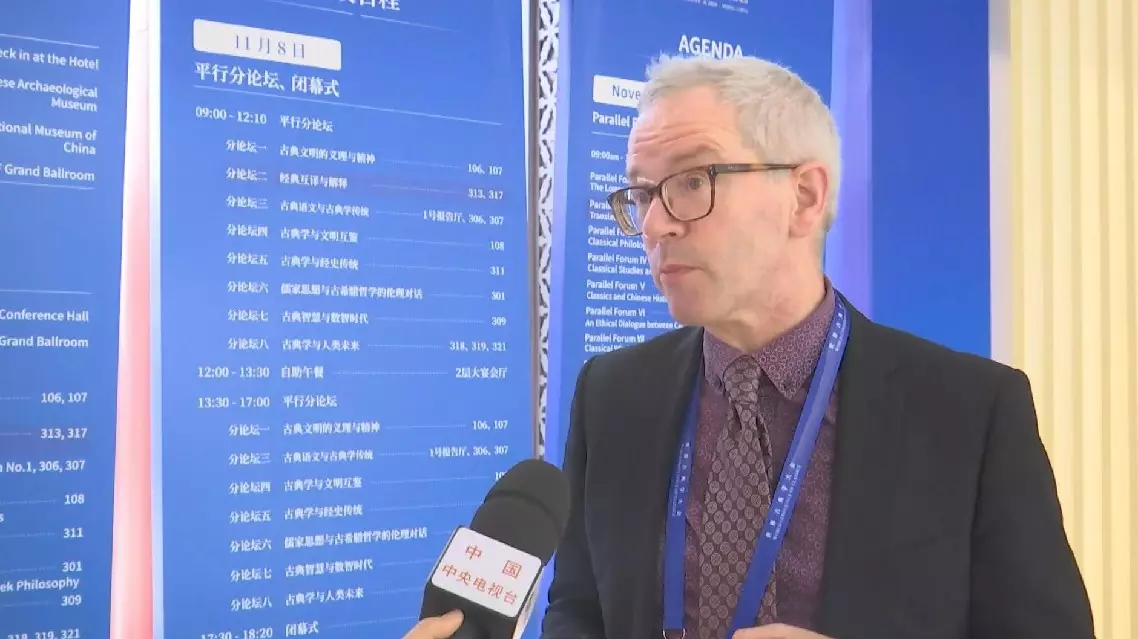
"One of the most significant things that we can expect to get out of this is dialog between West and East, between European and other scholars and Chinese scholars. I mean, it's very clear that these two intellectual disciplines have an awful lot in common. Both of them are about ancient literate cultures that still have a bearing on the present," said Tim Whitmarsh, regius professor of Greek at the University of Cambridge, and a Fellow of Trinity College, Cambridge.

"I think this is precisely opening the way also to collaboration with specialists in Chinese culture, both from western Europe and from China itself. So there are steps that are moving in the right direction for collaboration and openness already," said Michael Trapp, professor emeritus of Classics from the Faculty of Arts and Humanities at King's College London.

Chinese and foreign experts emphasized the importance of classical civilization as a shared heritage, adding that it can inform the development of modern Chinese civilization

"At the current stage, Chinese civilization needs a deeper study and understanding of classical civilization. While exploring Western classical roots, we should use many methods of world classical studies to reinterpret Chinese classics, forming comparisons and mutual interpretations between Chinese and Western civilizations. I think many creative thoughts will gradually emerge in this process," said Wu Fei, professor from the Department of Philosophy and Religious Studies at Peking University.

The event seeks to foster intercultural exchange, provide solutions to global challenges, and inspire human progress while aligning with the Global Civilization Initiative.
Chinese, foreign scholars speak highly of World Conference of Classics


Chinese, foreign scholars speak highly of World Conference of Classics
China will continuously build a robust domestic market to bolster its economy and counter external challenges in accordance with the requirements and arrangement from the annual Central Economic Work Conference, which put domestic demand at the forefront of eight key tasks for next year's economic work, according to experts.

The tone-setting conference was held in Beijing from Wednesday to Thursday in which the Chinese leadership decided priorities for the economic work in 2026.

Over the past four years, domestic demand has contributed an average of 86.4 percent to China's economic growth, according to the National Development and Reform Commission (NDRC), China's top economic planner.

"The top priority is to expand domestic demand as the key reason for this is that our demand is relatively weak. The first step here is figuring out how to increase consumption," said Chen Binkai, vice president of Central University of Finance and Economics.

Consumption has continued to play a leading role in the country's economic growth this year. In the first three quarters, final consumption expenditure contributed 53.5 percent to economic growth, an increase of 9 percentage points compared to the whole of last year.

The annual Central Economic Work Conference proposed that in 2026, a special campaign to boost consumption will be implemented in depth, the supply of high-quality goods and services will be expanded, policies on new and emerging industries will be optimized, unreasonable restrictions in the consumption field will be eliminated, and the potential of service consumption will be unleashed.

"Previously, much of the consumption we have encouraged is for manufactured goods. However, the growth rate of our service sector is not as ideal as that of the manufacturing sector. Therefore, increasing some investment to encourage consumption in the service sector may play a better role in stabilizing growth and expanding domestic demand," said Huang Qunhui, a researcher of the Institute of Economics under the Chinese Academy of Social Sciences.

Experts said that income is the primary factor determining consumption, and only by increasing residents' disposable income, can their consumption capacity be improved.

They also said that the conference, while emphasizing the promotion of consumption, also clearly pointed out the need to formulate and implement a plan to increase the income of urban and rural residents.

"The Third Plenary Session [of the 20th CPC Central Committee] mentioned the need to increase the proportion of residents' income, specifically the proportion of labor compensation within that income. The Fourth Plenary Session [of the 20th CPC Central Committee] further proposed implementing a specific income-increasing plan for urban and rural residents. Of course, consumption is not solely an income issue. We need to strengthen basic public services and improve our social security fund. If these issues are further improved and optimized, and residents have higher incomes, they will be more willing to spend more on consumption, especially on development-oriented consumption," said Huang.

Expanding domestic demand remains top priority for China's economic work in 2026: experts

Expanding domestic demand remains top priority for China's economic work in 2026: experts

Recommended Articles