A nine-year-old boy with cerebral palsy from Rui'an City of east China's Zhejiang Province can walk independently thanks to his parents' unwavering dedication.
Zhuangzhuang was diagnosed with cerebral palsy at the age of one, which left him unable to walk, stand or even sit. Since then, the boy's father and mother, Mr. Ma Kui and Ms. Wang Lili, have been supporting his rehabilitation efforts.
Wang begins her day at 7:00 in the morning, preparing breakfast for the family and helping Zhuangzhuang get up. Due to the contractures and deformities in his joints, Zhuangzhuang faces challenges even with basic tasks like dressing and washing himself.
With the help of his mother, Zhuangzhuang engages in daily rehabilitation training programs for nearly 10 hours each day. This dedicated effort has been ongoing for nine years.
"At eight months old, while other babies can crawl and sit, he was still soft and unable to sit up. It was then that we discovered his condition. From that moment on, my wife and I often wept," said Ma Kui, Zhuangzhuang's dad.
By the age of five, Zhuangzhuang's body began to show symptoms of atrophy and his leg muscles became so weak that he could not stand, even with the support of a wall.
"When Zhuangzhuang was four or five years old, his muscles started to show symptoms of atrophy, causing his head and knees to appear disproportionately large. We were very worried, thinking that we could not let his condition continue. I signed him up for a rehabilitation center where he started practicing crawling. He showed some improvement but still couldn't stand on his own," Wang said.
The rehabilitation training at the center improved Zhuangzhuang's physical condition, but the fees were too high for his parents to afford.
"We had to pay fees twice a year, each costing 38,000 yuan (nearly 5,300 U.S. dollars), totaling about 70,000 to 80,000 yuan (9,750 to 11,140 U.S. dollars) annually. When Zhuangzhuang was undergoing rehabilitation in the center, we were financially strained and struggling to keep up with the payments. Our income was not enough to cover the expenses. But we never considered giving up. We had no other options. If we stopped, he would lose all hope of getting better," Wang said.
To provide better care for Zhuangzhuang, Wang decided to resign from her job, making the computer repair shop run by Ma Kui the family's only source of income. In their desperation, Wang decided to teach herself rehabilitation techniques and become her son's therapist.
Wang researched extensively, enrolled in online courses, consulted with experts, and developed a rehabilitation training plan tailored for Zhuangzhuang's needs. She practiced each movement diligently to ensure she could effectively support her son's recovery.
Zhuangzhuang's dad crafted some rehabilitation training equipment himself, while mom dedicated herself to helping Zhuangzhuang practice each movement daily.
Except for mealtimes and sleep, Wang and Zhuangzhuang devote all their time to rehabilitation training.
"Sometimes mom is serious, and sometimes she is gentle. When my brother cooperates, mom is really gentle," said Ma Hanyi, Zhuangzhuang's younger brother.
On May 7, 2024, a miracle finally occurred. While Ma Kui was working as usual, Zhuangzhuang stood up and took slow, independent steps for the first time in nine years.
"At that moment, I just scratched my head and clicked the mouse randomly on the screen. I didn't know what to do. I was worried he might get frightened and fall. Then he came over to me. I immediately told his mother to come out and see. We wanted to support him, but he wouldn't let us. He wanted to walk ahead and show us that he could do it. That was the happiest day," said Ma Kui.
Along with their relief and joy, Zhuangzhuang's parents hope that he will be able to learn and eventually integrate into society like any other child.
Nowadays, in addition to his daily rehabilitation training, Zhuangzhuang has started to practice writing Chinese characters and numbers as he prepares for school.
"I have wanted my brother to go to school with me since the very beginning. My wish is for him to study hard and walk well," said Ma Hanyi.
Zhuangzhuang's parents had attempted to enroll him in kindergarten when he was six, but Zhuangzhuang had to leave shortly afterwards due to his cognitive and physical challenges. Now that Zhuangzhuang can walk independently, their hopes of sending him to school have been rekindled.
"I definitely want Zhuangzhuang to go to school. The environment at home is different from that at school, and I just want him to truly learn something," Wang said.
Teachers at the local public special education school told them that once they completed necessary certification and admission application procedures, Zhuangzhuang could be admitted.
"I will study hard and not give up," said Zhuangzhuang.
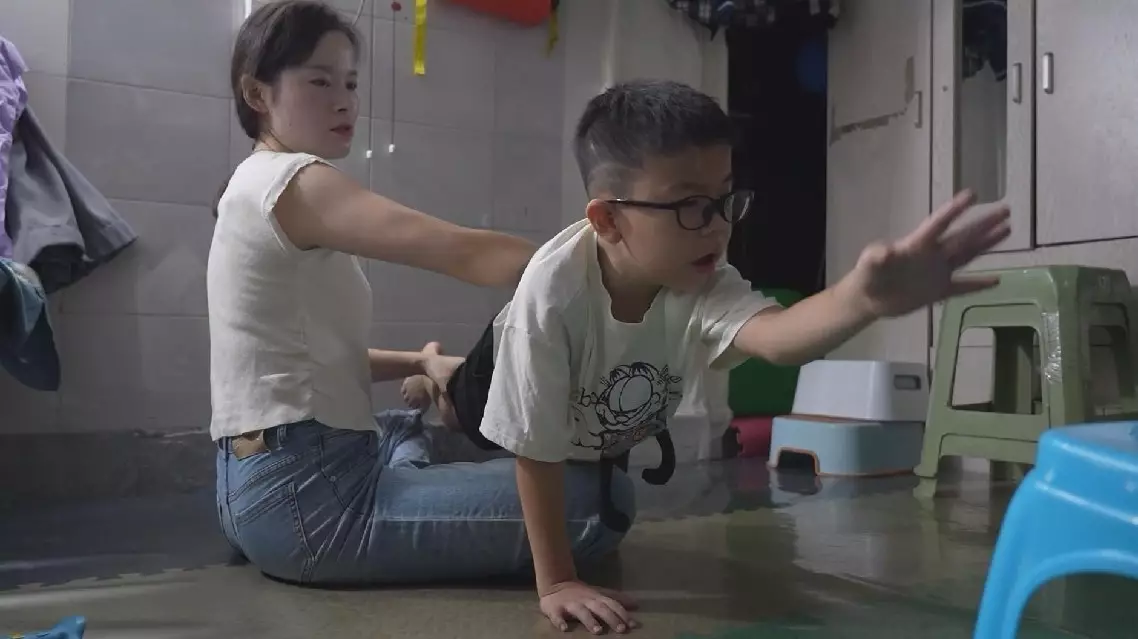
Boy with cerebral palsy able to walk independently thanks to parents' unwavering dedication