The upcoming opening of the Chancay port, a massive Chinese-aided infrastructure project in Peru, will not only facilitate trade between the two sides, but also stands as a testimony of the time-honored ties between two ancient civilizations across the Pacific Ocean.
China and Peru boast a long history of ties, with the two countries first having contact at the end of the 16th century through trade and people-to-people exchanges along the famous ocean route of the Maritime Silk Road through galleon trade or "Nao de China".
Rodrigo Campos, director of the Tusanaje project, a cultural initiative that aims to promote and preserve the cultural heritage, history, and contributions of Peruvians of Chinese descent, pointed to these important historical connections stretching far across the Pacific.
"The Pacific Ocean has been really important for us. First of all, Peru is one of the few countries that have a capital city with a coast. And also because, for us, the descendants of Chinese, the sea, and the ocean have meant the path, the way of our ancestors coming and going. Because even when we nowadays travel to China often, but of course [when going] by the plane you see the ocean, the blue of the ocean, and how this is the connection and the path, when so many things from China come to Peru and so many things [from] Peru go to China," said Campos.
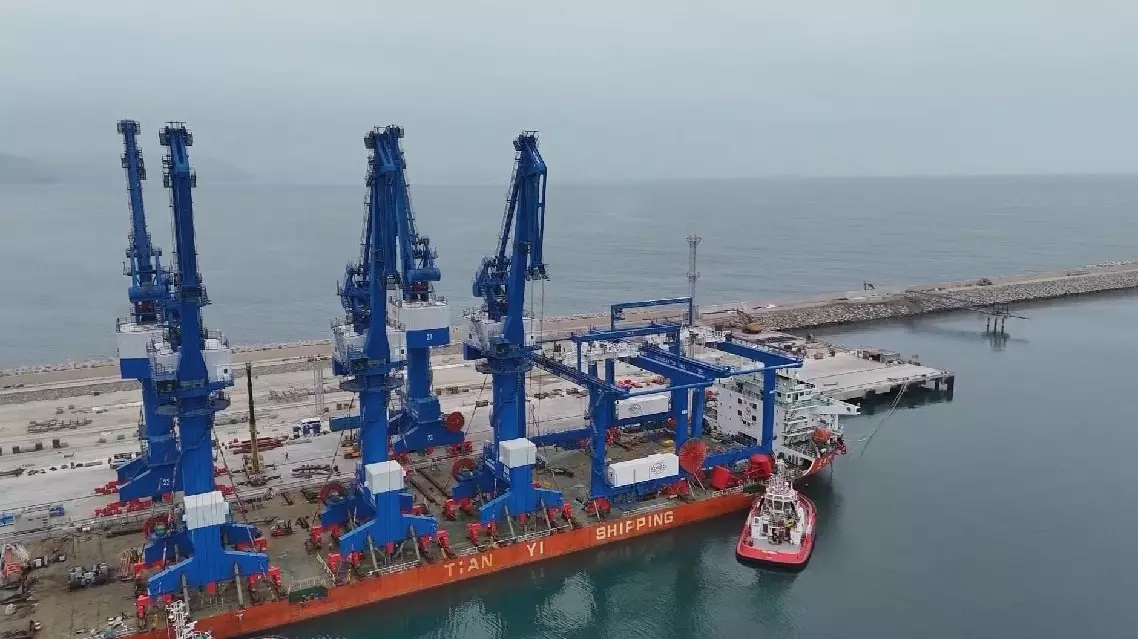
Ties between the two sides are set to receive another huge boost through the Chancay port, which lies in an once quiet coastal city about 80 kilometers north of Peru's capital Lima, and will connect the city with Shanghai across the vast Pacific Ocean. It is expected to be become one of South America's key trading hubs.
Chinese President Xi Jinping is set to attend to the inauguration ceremony of the Chancay port as part of his state visit to Peru from Nov. 13-17 at the invitation of Peruvian counterpart Dina Boluarte.
In a signed article published by Peruvian media on Thursday, Xi described the port as not only an important project under Belt and Road cooperation, but also the first smart port in South America. He noted the first phase of the project will reduce the sea shipping time from Peru to China to 23 days, cutting logistics costs by at least 20 percent, while generating 4.5 billion U.S. dollars in yearly revenues for Peru and creating over 8,000 direct jobs.
Analysts believe the port could play a transformational role in elevating trade and opening up new opportunities.
"The Chancay port is going to become the hub between South America and Asia. Also the port is going to help to trade all the products for example from Brazil as well to reduce the time to send the products to China, and also to receive products from China as well to Peru. So I think in the following years, Chancay is going to be one of the most important places in Latin America, also to give jobs to Peruvian people. It is going to be very helpful for the young people, who would like to be interested in China, and also in Asia in particular. So also it [is] going to provide a platform for the new technology," said Ruben Tang, a former director of the Confucius Institute of Pontifical Catholic University of Peru (PUCP).
China is currently Peru's top trading partner, its biggest export market, and the main source of imported goods. Meanwhile, Peru ranks as China's fourth-largest trade partner in Latin America. In 2023, their bilateral trade reached a total of 37.67 billion U.S. dollars, marking a 0.8 percent increase compared to the previous year.
Chancay port set to boost South America-Asia trade, cement bilateral ties
Chancay port set to boost South America-Asia trade, cement bilateral ties