Residents from the Chinatown of Lima, or "Barrio Chino," extended their warm welcome to the arrival of Chinese President Xi Jinping who arrived in Peru's capital Lima on Thursday.
Many of them say that they are proud to receive the president while hoping for the further cooperation of the two cultures.
Currently, President Xi is in Peru to attend the 31st APEC Economic Leaders' Meeting and to pay a state visit at the invitation of President Boluarte.
"This visit opens up our doors to the world, especially in investment, business and many more things. I am very happy that China is present," said a resident.
"It was an honor for us to receive the president, Xi, and we feel very proud," another resident said.
"I think it's great that cultures of two countries unite all these years," a pedestrian noted.
Peru was one of the first Latin American countries to establish diplomatic relations and a comprehensive strategic partnership with China. It is also the first Latin American country to sign a package of free trade agreements with China.
Since China and Peru signed the memorandum of understanding on Belt and Road cooperation in 2019, bilateral cooperation has achieved fruitful results, with increasingly close collaboration in economy, trade, finance, culture and other fields.
China has been Peru's largest trading partner and largest export market for 10 consecutive years.
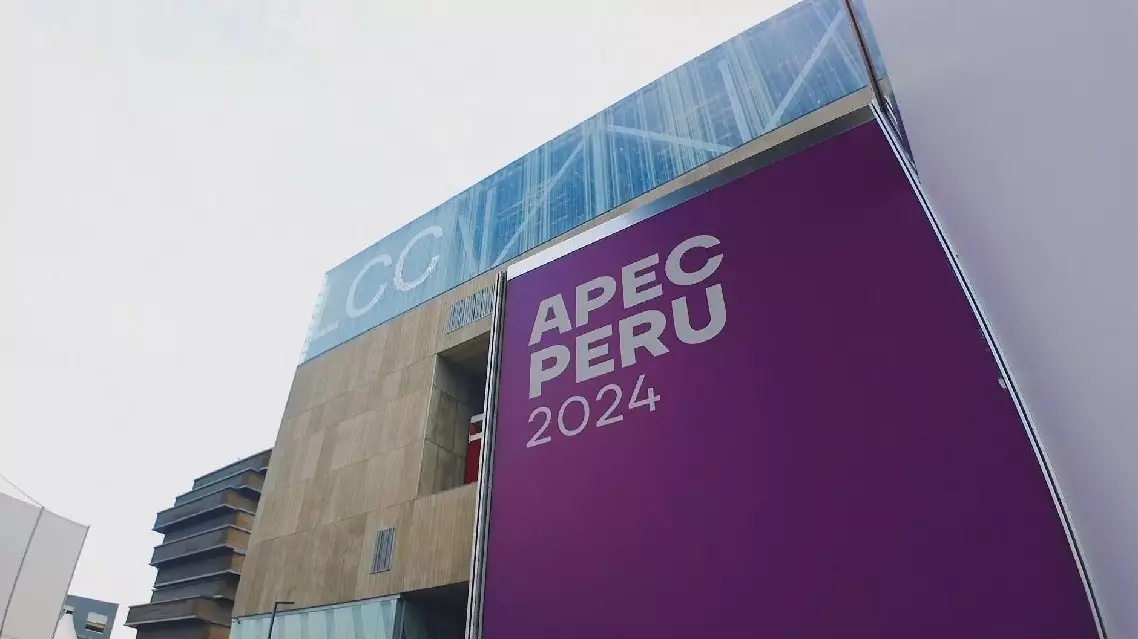
Expectations run high in Chinatown of Lima for Xi's arrival
Marking China's 11th Space Day, the China National Space Administration (CNSA) introduced major space projects in the 15th Five-Year Plan period on Friday in Chengdu, the provincial capital of Sichuan in the southwest, the main venue of a series of events marking this day.
Jointly sponsored by the CNSA and the provincial government, the event revealed major sci-tech achievements and space industry updates, with Shan Zhongde, head of the CNSA, introducing China's major space projects to be implemented in the next five years.
"In the areas of entering space, utilizing space, exploring space, and governing space, we will intensify the efforts to carry out key projects including manned spaceflight, lunar probe, planetary probe, and the national satellite internet. We will pace up the demonstration and launch of a new generation of space-power initiatives such as heavy-lift rockets, reusable launch vehicles, and next-generation national space infrastructure. In the fields of lunar and planetary probe, asteroid defense, on-orbit service, and space debris mitigation, we will deepen international collaboration, build the International Lunar Research Station, have in-depth engagement in global space governance, and create an open and cooperative landscape for China's space industry to build a community with a shared future for mankind," Shan said.
The CNSA also released a series of updates marking the Space Day, including the latest lunar discoveries from the Chang'e-5 mission, two new minerals named magnesiochangesite-(Y) and changesite-(Ce), selected international partners for the Tianwen-3 Mars mission, announcement of international cooperation opportunities for the Xihe-2 mission, and the Version 1.0 of the Commercial Space Standards System.
On the same occasion, Xie Jun, deputy chief designer of the BeiDou system, Zhang Bing, member of the Chinese Academy of Sciences, and veteran astronaut Ye Guangfu, were appointed as the 2026 China Space Public Welfare Ambassadors.
More than 30 side events will take place across Chengdu during the Space Day period. Highlights include a space science exhibition at the Chengdu New International Convention and Exhibition Center, a VR sci-fi drama aimed at extending space knowledge, and the Space Wish Initiative launched by the China Media Group (CMG), inviting the public to share their stories related to space.
"We plan to put up over 30 activities in various forms with rich content for the Space Day to give people a feeling for the evolution and dynamism of China's space program. Aside from offering academic exchange platforms for professionals, we place more emphasis on engaging the public, particularly young people, in carrying forward the spirit and culture of space exploration," said Wang Cheng, secretary-general of the China Space Foundation.
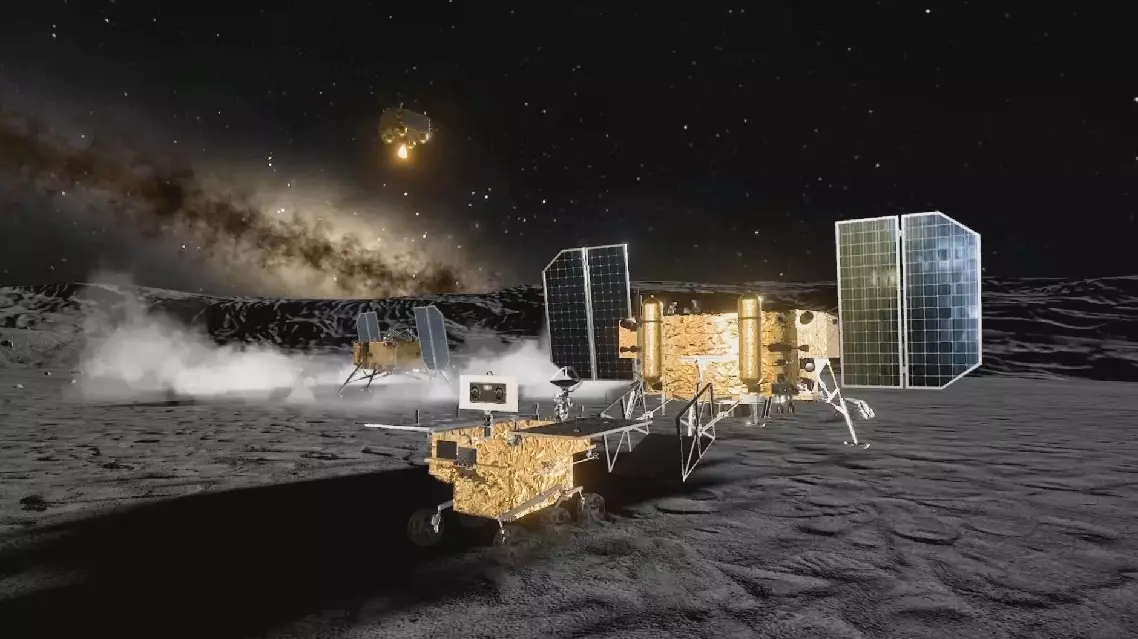
Officials introduces space projects in 15th 5-Year Plan period