Remarks by CE at media session in Peru (with photo/video)
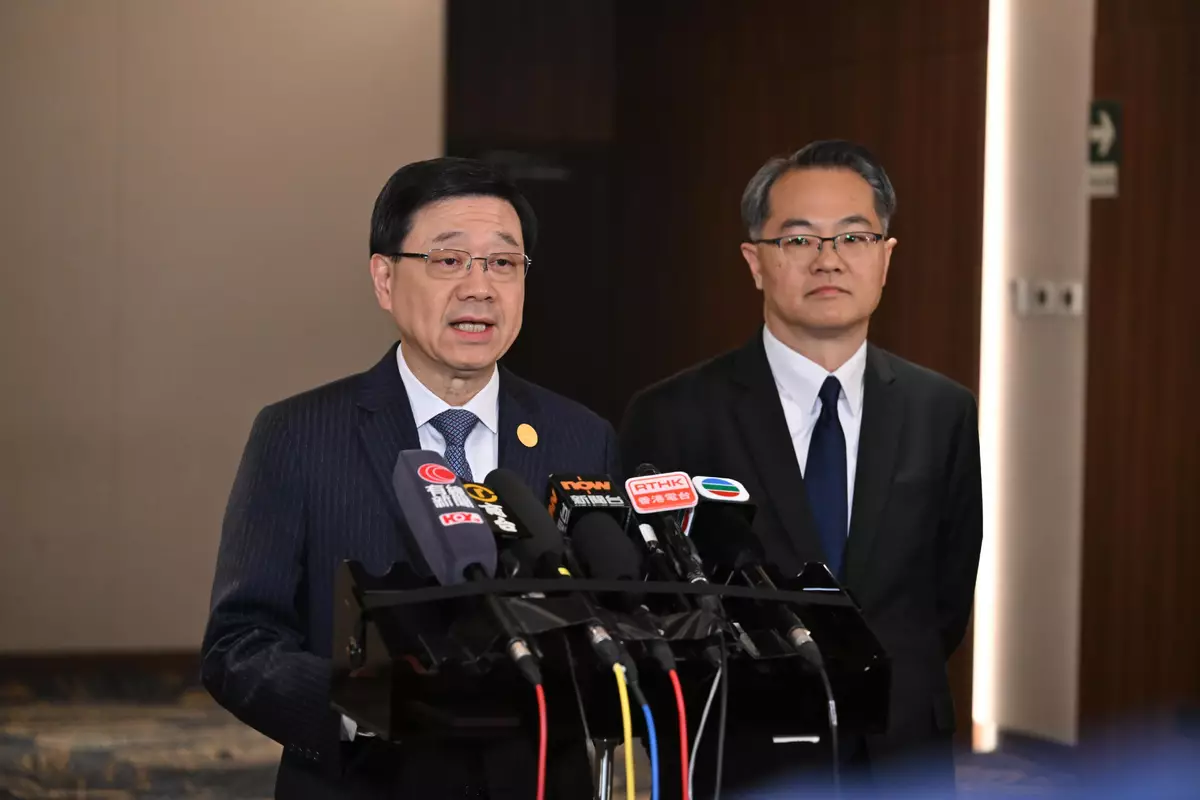
Following are the remarks by the Chief Executive, Mr John Lee, at a media session in Lima, Peru on November 16 (Lima time):
Chief Executive: I would like to take this opportunity to summarise our visit here in Lima, Peru.
In the past few days, I attended the Asia-Pacific Economic Cooperation (APEC) Economic Leaders' Meeting and related activities, which included the APEC Economic Leaders' Informal Dialogue with Guests, the APEC Economic Leaders' Dialogue with the APEC Business Advisory Council, and the Gala Dinner hosted for participating guests. I had bilateral meetings with the leaders of Malaysia, Vietnam and Singapore to exchange views on issues of mutual interest.
The President of Peru and I jointly witnessed the signing of the Free Trade Agreement (FTA) between Hong Kong and Peru. This agreement will create new business opportunities for Hong Kong and boost bilateral trade and investment flows.
Later tonight (November 16, Lima time), I shall also attend a dinner with the Peruvian business leaders in Lima, to highlight Hong Kong's attractiveness recognised by the international community as well as the significance of the FTA in fostering our economic development and partnership.
My visit to Peru and my participation in the APEC Meeting have achieved three results:
First, we demonstrate Hong Kong's commitment to promote regional economic and trade co-operation, and to explore diverse development opportunities. The Leaders' Declaration from this year's APEC Economic Leaders' Meeting outlines the common goal of fostering economic integration, inclusive development, and sustainable growth. These objectives align closely with this year's APEC theme: "Empower. Include. Grow". Hong Kong has all along been firmly committed to promoting international free trade and multilateral trade. Through active participation in APEC, Hong Kong will continue to support and promote regional economic integration and contribute to regional economic development.
Second, we explore new growth areas for Hong Kong and explore market opportunities in South America. The FTA signed between Hong Kong and Peru is the ninth of Hong Kong and the first under this administration. Currently, Hong Kong has already signed FTAs with 21 economies worldwide.
In terms of trade in goods, over 98 per cent of Hong Kong's originating goods will enjoy tariff-free access to the Peruvian market. For trade in services, Hong Kong service providers across more than 150 sectors will benefit. These sectors include professional services, research and development, financial services and transport services.
Peru ranks fifth among Hong Kong's merchandise trading partner in Latin America. With a burgeoning consumer market and ongoing infrastructure development, Peru presents significant opportunities. I look forward to Hong Kong's traders and investors grasping the opportunities brought by the FTA.
I am pleased to note that following the signing of the FTA, Hong Kong and Peru have also commenced negotiations on a separate Investment Promotion and Protection Agreement. I trust that Hong Kong and Peru will further enhance bilateral investment flows to bring about mutual economic growth.
Third, we enhance connections and relationship with the Association of Southeast Asian Nations (ASEAN) economies, as well as built connections with other economies.
Hong Kong values our close relations with the ASEAN region. ASEAN has been our second-largest merchandise trade partner for more than a decade, accounting for 80 per cent of Hong Kong's total foreign trade value.
In Lima, I met with the leaders of three ASEAN countries: the Prime Minister of Malaysia, the President of Vietnam, and the Prime Minister of Singapore. Our discussions focused on enhancing economic and trade relations as well as cultural exchanges.
Since my last visit to these three countries, we have strengthened co-operation at various levels and achieved tangible results. Hong Kong is actively promoting further collaboration, including the plan to establish an Economic and Trade Office in Malaysia. We have gradually increased direct flights between Hong Kong and several ASEAN countries to facilitate greater people-to-people exchanges. I have also made use of the opportunity to establish link with other attending leaders and build connections.
We will continue to strive for regional co-operation and expand our business networks. Thank you.
Reporter: What messages have you got from President Xi Jinping when you talked to him during the APEC Summit? Second, how confident do you think the Hong Kong business community will tap into the South American market, given that there are language and time difference barriers? What will the Government do to unleash the potential of the FTA? Thank you.
Chief Executive: President Xi has always been caring about Hong Kong. I have reported to him Hong Kong's situation regarding the economy and development. He is well verse of our development and has given me encouragement.
In our conversation, he talked about Peru's culture and its agricultural resources. He also talked about China's agricultural development. We also talked about the role and contribution of the construction and the operation of the Port of Chancay in Peru, because it is a new development that will facilitate trade in goods, logistics and also the shipping industry. It will also help supply chain.
I am very much impressed and inspired. I thank President Xi for his care and guidance.
In regard to the signing of the FTA and resultantly the benefits and potential that will be available to Hong Kong businessmen, it will be important for, first of all, Hong Kong businessmen to understand and appreciate the contents of the FTA: what are the areas covered, what is the facilitation and what is the accession facilitation they will get. There is probably a difference in language, because in Peru, usually the business language and official language is Spanish, but a lot of them also speak English. In my dealing with a lot of officials, they are multilingual. Hong Kong people are also versatile. Hong Kong people have been doing business with different parts of the world, including the Middle East, countries such as Korea and Japan, so obviously, language is an issue but not a barrier. I believe in businessmen's versatility and adaptability. What is important is, where there are business opportunities, then our entrepreneurs will be able to find good ways to ensure that they will be able to grasp the opportunities and realise the benefits.
The next step I have suggested to the Peruvian Government is that maybe we shall establish chambers, because through chambers' connection, business-to-business communication and assistance will be more easily established. I am sure that the business sectors will be examining how they will develop their network with the assistance and support of government-to-government contact. I am sure this FTA will open new doors for a lot of business activities to start. I have also explained that we are already embarking on the negotiation for an agreement on promotion and production of investment that will make the whole series of agreements in full coverage of both trading of goods and trading of services, as well as the protection of investment. With Hong Kong being a financial centre, hopefully with these two series of agreements, the opportunities that will be opened to our business community will be vast.
(Please also refer to the Chinese portion of the remarks.)
Remarks by CE at media session in Peru (with photo/video) Source: HKSAR Government Press Releases