China will establish over 100 trusted data spaces by 2028 and develop a series of data space solutions and best practices, according to an action plan released by the National Data Administration of China on Saturday.
A trusted data space is a data circulation and utilization infrastructure that connects multiple parties based on consensus rules, enabling the shared use of data resources.
"For example, a city generates a vast amount of traffic data involving data owners, providers, users, and developers. Many of these data require preprocessing, which the receiving parties may not always have the capability to handle. This is where a platform, referred to as a trusted data space, becomes essential. It facilitates data resource retrieval and utilization, provides an environment for data development and application, and ensures security guarantees," said Wu Hequan, academician of the Chinese Academy of Engineering.
The action plan proposes launching initiatives to cultivate and promote trusted data spaces, focusing on the development and application of five types: enterprise, industry, city, personal, and cross-border trusted data spaces.
According to an expert, this can create new opportunities in the data industry.
"The construction of trusted data spaces will enable more data resources to flow freely, fostering the growth of various enterprises specializing in data processing, hosting, and services. This will lead to a more vibrant and prosperous data industry ecosystem," said Liu Mo, director of the Institute of Information and Industrialization Integration of the China Academy of Information and Communications Technology (CAICT).

China to establish over 100 trusted data spaces by 2028
U.S. stocks ended sharply lower on Friday, as a stronger-than-expected May jobs report heightened bets on a potential Federal Reserve rate hike later this year.
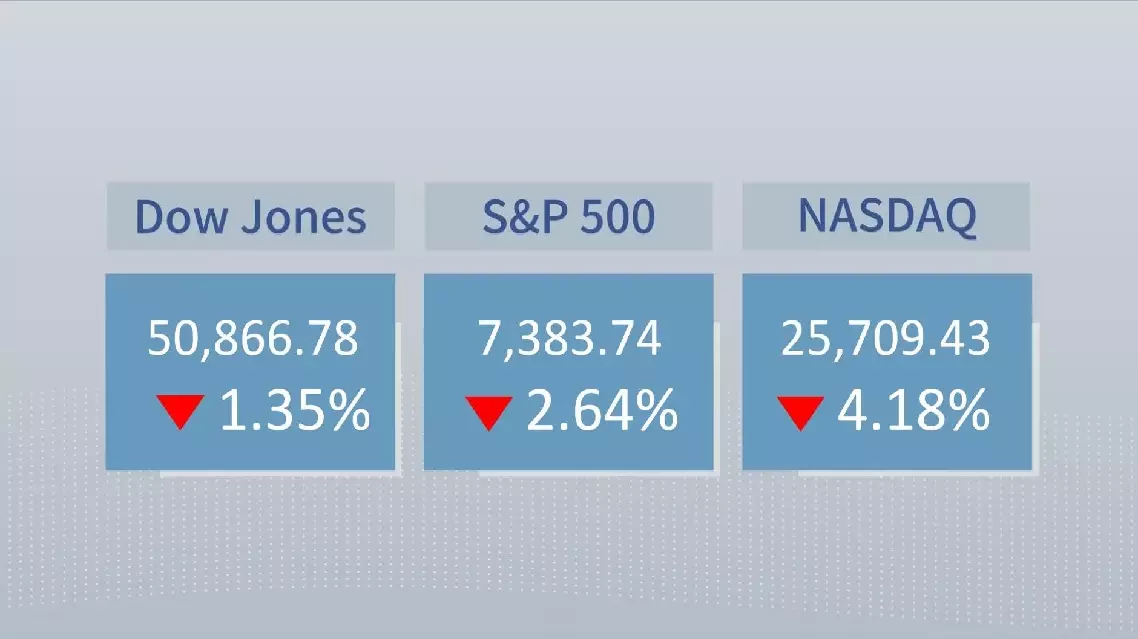
The Dow Jones Industrial Average fell 695.15 points, or 1.35 percent, to 50,866.78. The Standard and Poor's 500 sank 200.57 points, or 2.64 percent, to 7,383.74. The Nasdaq Composite Index shed 1,121.53 points, or 4.18 percent, to 25,709.43.
Six of the 11 primary Standard and Poor's 500 sectors closed in negative territory, with technology and consumer discretionary leading the declines at 5.78 percent and 2.43 percent, respectively. Consumer staples and utilities were the top performers, rising 1.64 percent and 0.8 percent, respectively.
The U.S. Bureau of Labor Statistics reported that employers added 172,000 jobs in May, exceeding economists' expectations of around 88,000. The unemployment rate held steady at 4.3 percent.
While the strong labor market data underscored economic resilience, it also raised concerns about persistent inflation and reduced the likelihood of near-term monetary easing.
Traders now price in a Federal Reserve rate hike by the end of this year. According to the CME FedWatch Tool, the probability of interest rates rising by year-end jumped to 72.7 percent on Friday, up from 50.5 percent the previous day. This shift came even as U.S. President Donald Trump continued to press for interest rate cuts while his nominee, Kevin Warsh, assumed leadership of the Federal Reserve.
Market volatility intensified this week as investors took profits after recent rallies and adjusted expectations for Fed policy. The CBOE Volatility Index, Wall Street's fear gauge, surged over 30 percent to its highest level in two months.
In the technology sector, concerns over the artificial intelligence investment boom persisted. Broadcom continued to plummet following its disappointing earnings forecast earlier in the week, while Micron Technology, Advanced Micro Devices, and Intel also posted notable losses.
U.S. stocks tank as strong jobs report fuels rate-hike expectations