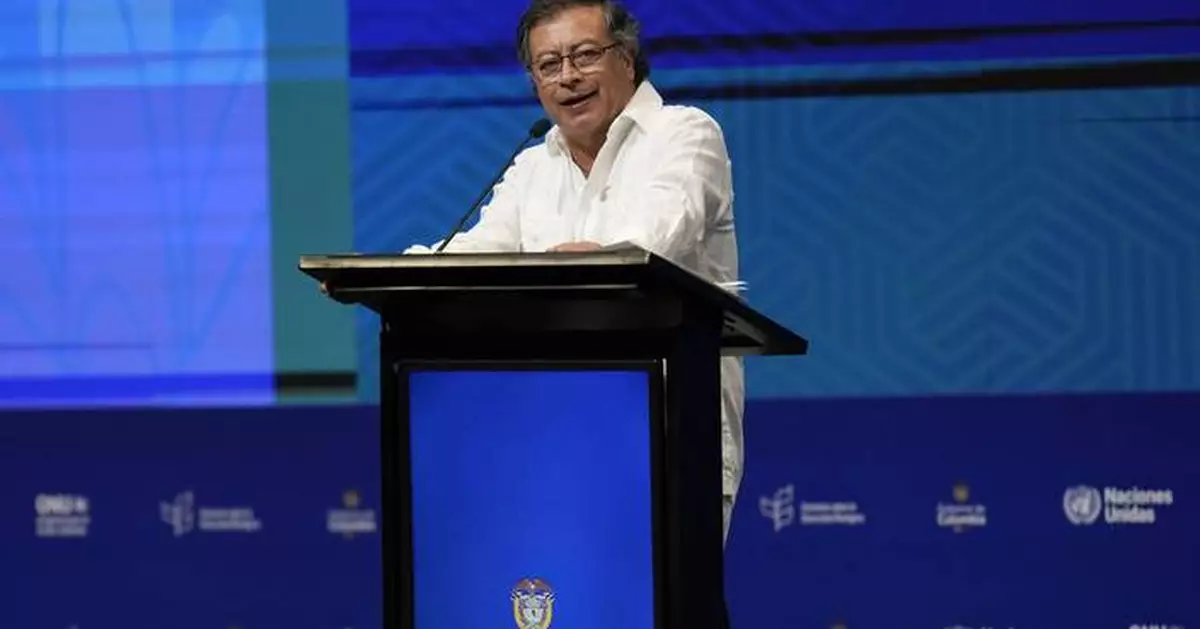
BOGOTA, Colombia (AP) — Colombia's President Gustavo Petro said Tuesday that his country will impose visa requirements on British citizens, in retaliation for a decision made by the United Kingdom to remove Colombia from a list of countries whose nationals can visit Britain without a tourist visa.
In a message published on X, Petro said that due to “the principle of reciprocity” Colombia’s government will begin asking citizens of the UK for visas. He provided no more details on when the visa restrictions will come into effect.
Earlier on Tuesday, the United Kingdom announced that Colombian citizens will no longer be able to travel to that country without a visa. In a statement published on its social media platforms, the British embassy in Colombia said that over the past two years, there has been a “significant” increase in the number of Colombians who arrive at UK airports and make “unjustified” asylum claims.
The United Kingdom had lifted visa restrictions on Colombians in 2022. But its embassy in Bogota said that the recent rise in asylum claims from Colombians had forced the British government to reimpose visa requirements.
“Sadly, the abuses undertaken by a minority of Colombians who have traveled to the United Kingdom, have led our ministers to take this decision,” the statement reads.
In a radio interview on Tuesday, Roy Barreras, Colombia’s ambassador to the United Kingdom said that more than 940 Colombians have made asylum claims in the United Kingdom this year, with some resorting to travel agencies that allegedly teach them how to cheat in their asylum applications. In 2021, only six Colombians made asylum claims in the UK, the ambassador said.
Over the past three years, hundreds of thousands of Colombians have fled to Europe and the United States. Economic stagnation and rising violence in some parts of the country, particularly from rebel groups and drug traffickers, have forced many to seek safety and opportunity abroad.
In 2022, U.S. border patrol agents conducted more than 165,000 arrests of Colombians at the Mexican border. This number decreased slightly to 155,000 in the following year.
Follow AP’s coverage of Latin America and the Caribbean at https://apnews.com/hub/latin-america

FILE - Colombia's President Gustavo Petro delivers a speech at the opening ceremony of COP16, a United Nations' biodiversity conference, in Cali, Colombia, Oct. 20, 2024. (AP Photo/Fernando Vergara, File)
ST. LOUIS (AP) — World champions Ilia Malinin and the ice dance duo of Madison Chock and Evan Bates will anchor one of the strongest U.S. Figure Skating teams in history when they head to Italy for the Milan Cortina Olympics in less than a month.
Malinin, fresh off his fourth straight national title, will be the prohibitive favorite to follow in the footsteps of Nathan Chen by delivering another men's gold medal for the American squad when he steps on the ice at the Milano Ice Skating Arena.
Chock and Bates, who won their record-setting seventh U.S. title Saturday night, also will be among the Olympic favorites, as will world champion Alysa Liu and women's teammate Amber Glenn, fresh off her third consecutive national title.
U.S. Figure Skating announced its full squad of 16 athletes for the Winter Games during a made-for-TV celebration Sunday.
"I'm just so excited for the Olympic spirit, the Olympic environment," Malinin said. “Hopefully go for that Olympic gold.”
Malinin will be joined on the men's side by Andrew Torgashev, the all-or-nothing 24-year-old from Coral Springs, Florida, and Maxim Naumov, the 24-year-old from Simsbury, Connecticut, who fulfilled the hopes of his late parents by making the Olympic team.
Vadim Naumov and Evgenia Shishkova were returning from a talent camp in Kansas when their American Airlines flight collided with a military helicopter and crashed into the icy Potomac River in January 2025. One of the last conversations they had with their son was about what it would take for him to follow in their footsteps by becoming an Olympian.
“We absolutely did it,” Naumov said. “Every day, year after year, we talked about the Olympics. It means so much in our family. It's what I've been thinking about since I was 5 years old, before I even know what to think. I can't put this into words.”
Chock and Bates helped the Americans win team gold at the Beijing Games four years ago, but they finished fourth — one spot out of the medals — in the ice dance competition. They have hardly finished anywhere but first in the years since, winning three consecutive world championships and the gold medal at three straight Grand Prix Finals.
U.S. silver medalists Emilea Zingas and Vadym Kolesnik also made the dance team, as did the Canadian-born Christina Carreira, who became eligible for the Olympics in November when her American citizenship came through, and Anthony Ponomarenko.
Liu was picked for her second Olympic team after briefly retiring following the Beijing Games. She had been burned out by years of practice and competing, but stepping away seemed to rejuvenate the 20-year-old from Clovis, California, and she returned to win the first world title by an American since Kimmie Meissner stood atop the podium two decades ago.
Now, the avant-garde Liu will be trying to help the U.S. win its first women's medal since Sasha Cohen in Turin in 2006, and perhaps the first gold medal since Sarah Hughes triumphed four years earlier at the Salt Lake City Games.
Her biggest competition, besides a powerful Japanese contingent, could come from her own teammates: Glenn, a first-time Olympian, has been nearly unbeatable the past two years, while 18-year-old Isabeau Levito is a former world silver medalist.
"This was my goal and my dream and it just feels so special that it came true,” said Levito, whose mother is originally from Milan.
The two pairs spots went to Ellie Kam and Danny O'Shea, the U.S. silver medalists, and the team of Emily Chan and Spencer Howe.
The top American pairs team, two-time reigning U.S. champions Alisa Efimova and Misha Mitrofanov, were hoping that the Finnish-born Efimova would get her citizenship approved in time to compete in Italy. But despite efforts by the Skating Club of Boston, where they train, and the help of their U.S. senators, she did not receive her passport by the selection deadline.
“The importance and magnitude of selecting an Olympic team is one of the most important milestones in an athlete's life,” U.S. Figure Skating CEO Matt Farrell said, "and it has such an impact, and while there are sometimes rules, there is also a human element to this that we really have to take into account as we make decisions and what's best going forward from a selection process.
“Sometimes these aren't easy," Farrell said, “and this is not the fun part.”
The fun is just beginning, though, for the 16 athletes picked for the powerful American team.
AP Olympics: https://apnews.com/hub/milan-cortina-2026-winter-olympics
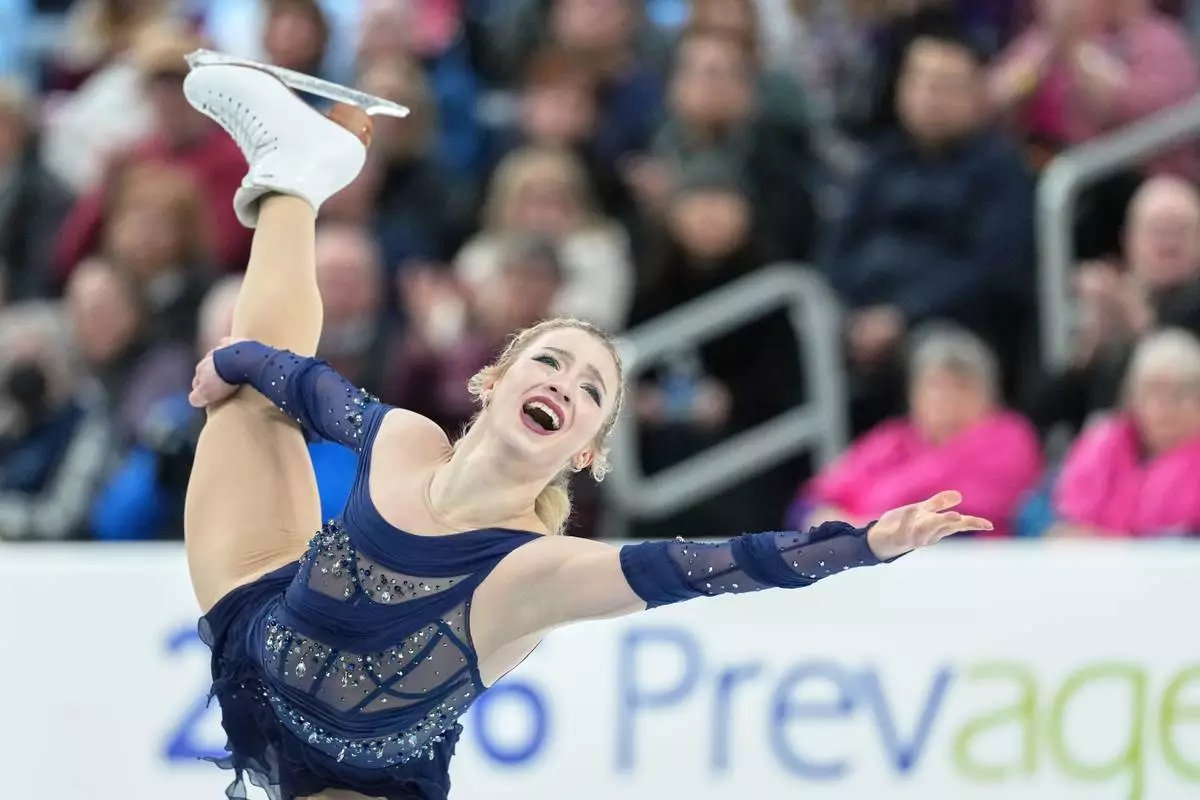
Amber Glenn competes during the women's free skating competition at the U.S. Figure Skating Championships, Friday, Jan. 9, 2026, in St. Louis. (AP Photo/Stephanie Scarbrough)

Alysa Liu skates during the "Making Team USA" performance at the U.S. Figure Skating Championships, Sunday, Jan. 11, 2026, in St. Louis. (AP Photo/Stephanie Scarbrough)
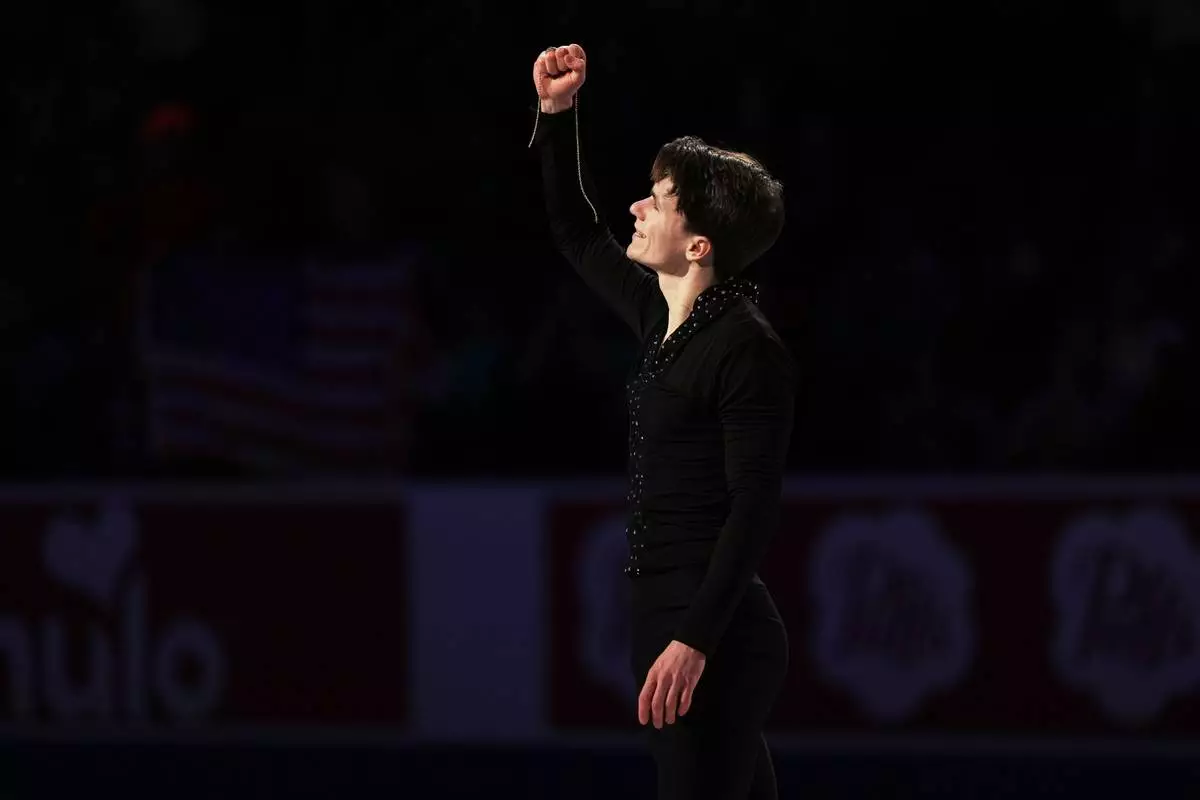
Maxim Naumov skates during the "Making Team USA" performance at the U.S. Figure Skating Championships, Sunday, Jan. 11, 2026, in St. Louis. (AP Photo/Stephanie Scarbrough)

Madison Chock and Evan Bates skate during the "Making the Team" performance at the U.S. Figure Skating Championships, Sunday, Jan. 11, 2026, in St. Louis. (AP Photo/Stephanie Scarbrough)

Gold medalist Ilia Malinin arrives for the metal ceremony after the men's free skate competition at the U.S. Figure Skating Championships, Saturday, Jan. 10, 2026, in St. Louis. (AP Photo/Jeff Roberson)