Skip to Content Facebook Feature Image

Knorr-Bremse "collaborating but competing" amid integration into Chinese industry: executive

China

China

China

Knorr-Bremse "collaborating but competing" amid integration into Chinese industry: executive

2024-11-27 21:53 Last Updated At:22:47

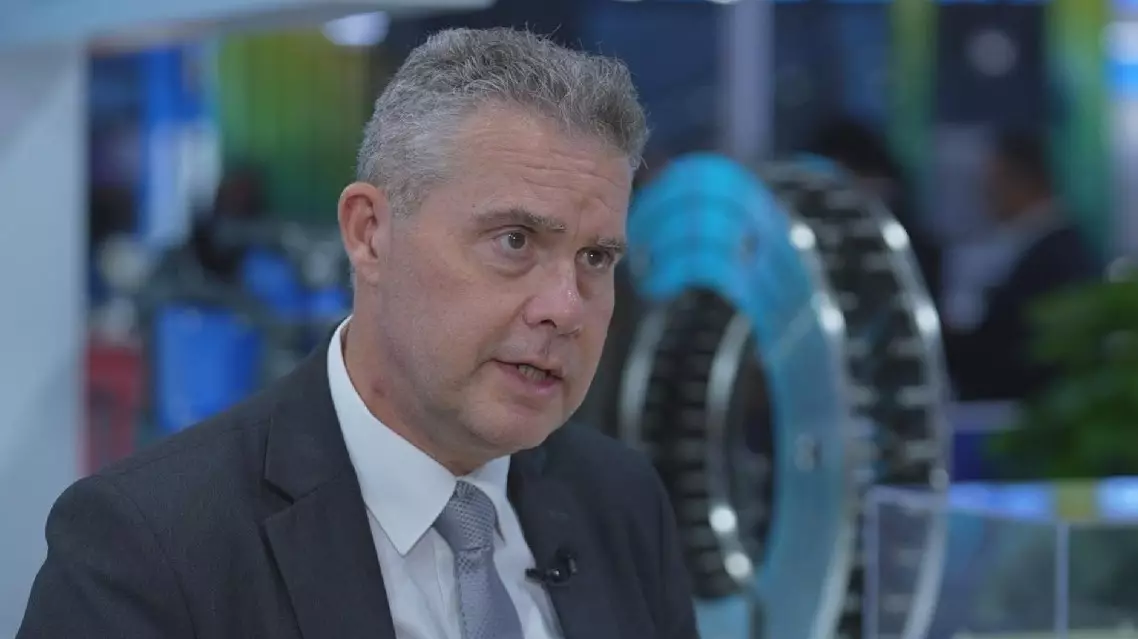
Germany's Knorr-Bremse, the world's leading manufacturer of braking systems for rail and commercial vehicles, is "collaborating but also competing" as it looks to further integrate into the Chinese industry, a company executive said while attending the ongoing second China International Supply Chain Expo(CISCE) in Beijing.

The CISCE, which opened in the Chinese capital on Tuesday and will run through Saturday, is seeing the participation of more than 600 companies, with the number of foreign exhibitors also increasing this year.

Among those taking part for the first time is Knorr-Bremse. The German firm has had a production presence in China for 20 years, and earlier this year deepened its localization efforts by opening a new plant in northeast China's Dalian.

Jonathan Paddison, a member of the board at Knorr-Bremse Asia Pacific, outlined how the company is stepping up its operations and stressed that the firm's rail and truck divisions are "very much integrated" into the Chinese industry.

"Actually, although we're a German company originally, we have more people in China than we do in Germany these days. So China becomes an extremely important part of our business, and we need to be integrated into the infrastructure," he said in an interview with the China Global Television Network(CGTN).

"We don't just see it anymore as being a foreign company coming into China. We are a Chinese company with Chinese development, Chinese manufacturing and a Chinese supply chain. Yet we have the advantage of being the bridge builder to the rest of the world and drawing on know-how when we need it. But the most important thing we've learned is we need to be very strong in China to keep up with our domestic competition, which is getting better and better. But we still like to think we have the edge, with our combination of being in China, for China, but also drawing on that worldwide experience that we have," he continued.

As Chinese manufacturers are catching up with their global counterparts, especially in high-speed train technologies, Paddison said he envisions this competition will actually deliver greater opportunities for collaboration and help to drive development.

"We welcome the competition to spur us on to develop and make even better products. Without competition, there is no innovation. And that's why we have four R and D centers here in China, to develop products for the future in our different market areas in China. And we use that very much, we have a large number of engineers working here on adaptions for the market," he said.

"Competition is good, we like to have the competition, but also we collaborate. And here on the stand we have a number of products which are built by joint ventures which we work with our main customer CRRC, but also with China Railway, we have a joint venture, so we are both collaborating but also competing at the same time," said Paddison.

The expo has drawn more than 600 companies from around the globe, with many showcasing their latest technologies and products while seeking cooperation in areas ranging from advanced manufacturing and green agriculture to clean energy.

Nearly one-third of exhibitors at the expo come from overseas, up 26 percent from last year, highlighting the widespread desire for international cooperation.
Knorr-Bremse "collaborating but competing" amid integration into Chinese industry: executive

Knorr-Bremse "collaborating but competing" amid integration into Chinese industry: executive
The ongoing closure of Yemen's Aden International Airport has raised concerns that the country's humanitarian predicament may further worsen.

The airport is a primary aviation gateway for people in southern Yemen to travel for medical care, education and labor services. However, almost all commercial flights have been suspended since the tensions escalated earlier this month between the Yemeni government forces and the Southern Transitional Council (STC), a major party to the Yemeni Civil War, with only a few flights operating between Jeddah and Riyadh in Saudi Arabia.

The airport closure has left hundreds of passengers trapped in the waiting hall and unable to depart.

"I came here from outside Aden and planned to go to Egypt for medical treatment. There are really a lot of people like me who are affected. Due to the airport closure, I have been staying in hotel for three days, incurring significant losses - not only in accommodation costs but also in various daily living expenses," said Abdulkarim Mohammed, a stranded passenger.

The Saudi-backed Yemeni government and the United Arab Emirates (UAE)-sponsored STC have each blamed the other for the airport closure.

Saudi Arabia has recently ordered all international flights departing and entering Yemen to undergo security screenings at Jeddah Airport before continuing to their final destinations. While some of those restrictions were later eased, they remain in place for all flights traveling to and from the UAE.

Officials loyal to the STC refused to comply with the new protocols ordered by Yemen's central government, and partially halted operations in Aden International Airport, said a source within the Yemeni government.

The Yemeni government said that the control on some international routes was ordered in accordance with the previously declared state of emergency, and at the same time accused the STC of suspending all flights at the airport.

However, the STC-controlled Ministry of Transport said that Saudi Arabia imposed flight restrictions without providing prior clear communication and explanation, which eventually led to the closure of the airport.

Analysts say that the shutdown of Aden International Airport forces tens of thousands of people seeking medical assistance, educational opportunities and economic activities to suspend their plans, which will further deteriorate the already fragile livelihood situation in Yemen.

Tensions between the factions escalated after the STC seized large swathes of the oil-rich Hadramout province and the eastern province of Al-Mahrah last month. Riyadh considers these areas a "red line" due to their proximity to the Saudi border and their concentration of Yemen's remaining energy reserves.

Yemen has been mired in conflict since 2014, when Houthi forces captured Sanaa and large swathes of the north, prompting a Saudi-led coalition to intervene in 2015.

Formed in 2017, the UAE-sponsored STC seeks self-determination and eventual independence for southern Yemen. Despite joining the Saudi-led coalition and integrating into Yemen's ruling Presidential Leadership Council in 2022, the group continues to push for southern sovereignty, leading to recurring disputes over power-sharing and control of resources.

Major airport closure raises concerns over worsening humanitarian situatio in Yemen

Major airport closure raises concerns over worsening humanitarian situatio in Yemen

Major airport closure raises concerns over worsening humanitarian situatio in Yemen

Major airport closure raises concerns over worsening humanitarian situatio in Yemen

Recommended Articles