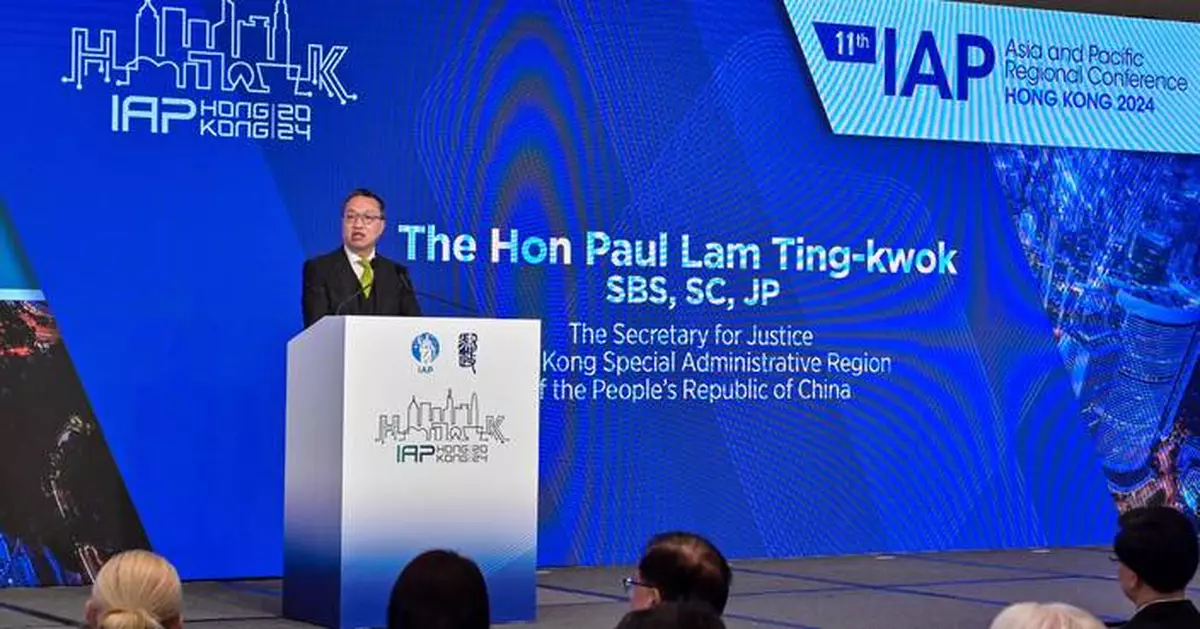
Speech by SJ at opening ceremony of 11th Asia and Pacific Regional Conference of the International Association of Prosecutors (with photo/video)
Following is the speech by the Secretary for Justice, Mr Paul Lam, SC, at the opening ceremony of the 11th Asia and Pacific Regional Conference of the International Association of Prosecutors today (November 28):
The Honorable Chief Executive John Lee, Vice President of the IAP (International Association of Prosecutors) First Deputy Prosecutor General Tong Jianming (First Deputy Prosecutor General of the Supreme People's Procuratorate of the People's Republic of China, Class One Grand Prosecutor), Deputy Head Chen Feng (Deputy Head of the Office for Safeguarding National Security of the Central People's Government in the Hong Kong Special Administrative Region), Deputy Commissioner Fang Jianming (Deputy Commissioner of the Office of the Commissioner of the Ministry of Foreign Affairs of the People's Republic of China in the Hong Kong Special Administrative Region),Secretary-General of the IAP Roel Dona, Attorneys General, Prosecutors General, Consuls-General, delegates, distinguished guests, ladies and gentlemen,
Good morning. I would like to begin by expressing my heartfelt gratitude to the International Association of Prosecutors for giving Hong Kong the valuable opportunity of hosting the 11th Asia and Pacific Regional Conference. I also extend a very warm welcome to delegates and representatives of prosecutorial agencies across the world who are joining us for this meaningful event.
The International Association of Prosecutors, or "IAP" in short, was established in 1995, and is the only worldwide organisation of prosecutors. Today, it has more than 183 organisational members from over 177 jurisdictions. Hong Kong was elected to organisational membership of the IAP in 2001.
Since joining the IAP, Hong Kong has played an active role. At present, Mr Grenville Cross SC, a former Director of Public Prosecution of Hong Kong, is the Vice-Chairman of the Management Committee of the Senate of the IAP. Back in November 2004, Hong Kong hosted the 2nd Asia and Pacific Regional Conference. This was followed by the hosting of the 12th Annual Conference and General Meeting in September 2007.
And today, we gather together again to open the IAP's 11th Asia and Pacific Regional Conference. 20 years ago, representatives from some 14 jurisdictions attended the 2nd Regional Conference. This time, we have around 100 distinguished guests, senior government officials, legal professionals and experts, and representatives coming from around 30 jurisdictions and Hong Kong. Even though this is a regional conference of the Asia and Pacific, we have friends from the Middle East, Europe, Africa, North and South America.
This conference, like other conferences of the IAP, is significant because it serves as an important forum for members to consider collectively how we may better achieve the following purposes and objectives of the IAP, namely, "To improve international co-operation to combat crime" and, in particular, "to promote international co-operation in gathering and providing evidence; in tracking, seizing and forfeiting the proceeds of serious crime; and in the prosecution of fugitive criminals" as well as "to promote speed and efficiency in such international co-operation."
Hong Kong's strong commitment to support and participate in the work of the IAP is beyond doubt. In Hong Kong, prosecutors must follow the Prosecution Code promulgated by the Department of Justice. The Standards of Professional Responsibility and Statement of the Essential Duties and Rights of Prosecutors of the IAP adopted in 1999 are expressly mentioned and appear as Appendix II in the Code. Paragraph 5.1 of the Standards stresses the importance of international co-operation to ensure the fairness and effectiveness of prosecutions.
Hong Kong has signed bilateral mutual legal assistance agreements with 33 jurisdictions. In addition, 13 multilateral conventions targeting serious crimes which provide for mutual legal assistance have been applied to Hong Kong. And even in the absence of any applicable bilateral agreement or multilateral convention, mutual legal assistance may still be provided on the basis of a reciprocity undertaking provided by the requesting place.
We live in a world where technology is advancing at an unprecedented rapid pace. But while our society benefits substantially from modern technology, so too do criminals. New technologies enable traditional crimes to be committed by new methods, and peoples' heavy reliance on technology is constantly being exploited by criminals for illicit gains. Furthermore, crimes in this technological age are very often transboundary. It is clear that crimes featuring the use of modern technology have created novel challenges to prosecutors. For example, it can be difficult to identify the criminals or their whereabouts; and even if they can be identified and found, it can be difficult to bring them to justice in the relevant jurisdiction. How to preserve, transfer and adduce digital or technological evidence properly before the court can be challenging. To trace and recover the proceeds of crime in order to ensure that criminals will not benefit from their wrongdoings and victims can recover their loss is also a daunting task.
Even though we are coming from different jurisdictions having different criminal justice systems, we face the common question of how to maintain and promote the effectiveness of prosecutions in the light of these new challenges. International co-operation has become even more essential; and one important aspect is the sharing of knowledge and experience. That is why we have decided to select the theme of our Conference to be "Effective Prosecution Service in the Technological Age". Over the course of the next two days, there will be five plenary sessions in which distinguished speakers will lead us to explore various topics including law reform to combat technological crimes, the changing landscape and challenges of decentralisation from social media to virtual assets, strengthening mutual legal assistance arrangements, obtaining and handling digital evidence, and the impact of technological advancements on criminal evidence and procedure.
Modern technology is, of course, not inherently evil; it becomes evil only when it is misused and abused by criminals. Our overriding objective is not only to prevent, suppress and punish such misuses and abuses but also to outwit the criminals by becoming better users of modern technology, and make modern technology our close ally in our war against the criminals. I am confident that with a strong sense of determination, solidarity and co-operation among the prosecutors from around the world, we shall prevail.
Before I conclude, I wish to remind ourselves on one important point. While the theme of this conference is focused on effective prosecutions, we must never lose sight of the crucial importance that prosecutions must always be fair. While we may have to change our law, practice and procedure as well as to enhance international co-operation in different ways in order to meet the challenges posed by crimes in this technological age, fundamental principles governing fairness of prosecutions must not be compromised. After all, the rule of law requires that prosecutions must be both fair and effective.
On this note, I wish this Conference every success, and that all of you will have a fruitful and enjoyable time in Hong Kong. Thank you very much.
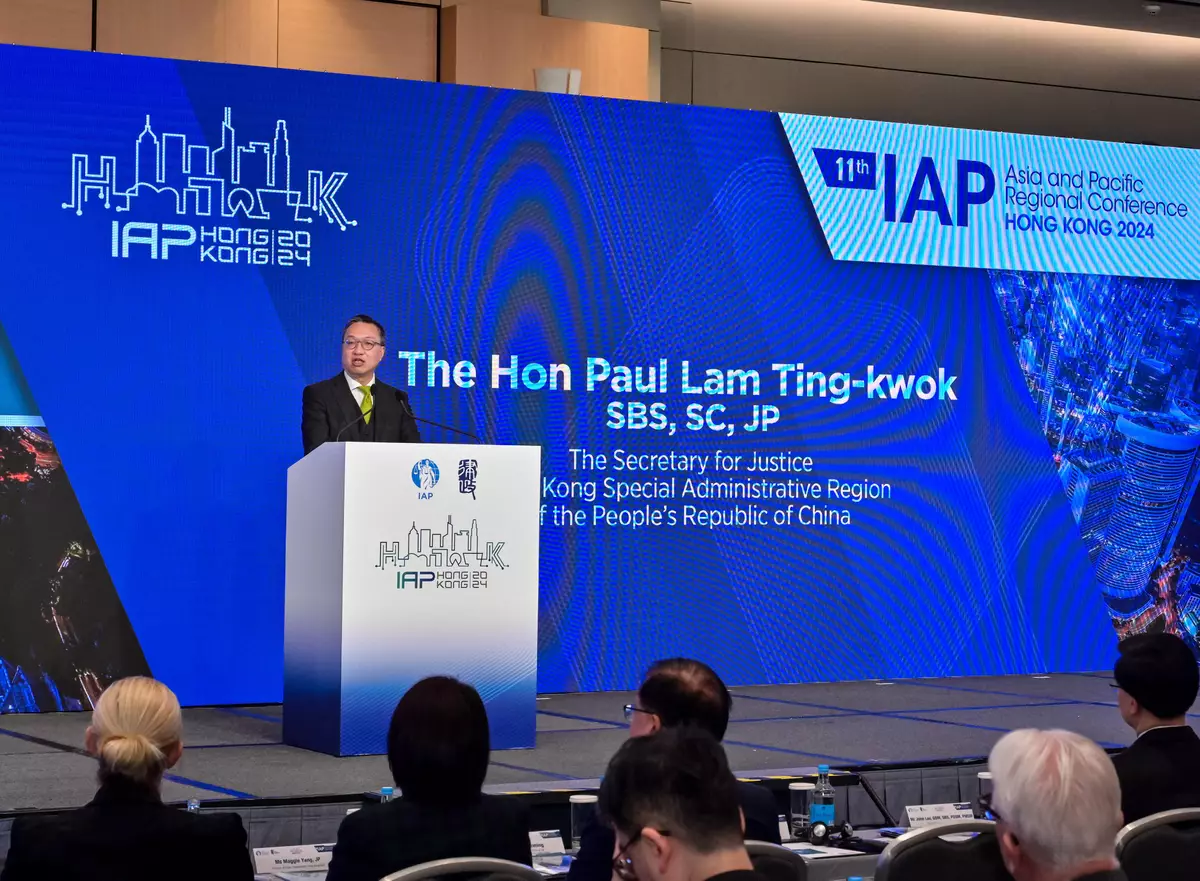
Speech by SJ at opening ceremony of 11th Asia and Pacific Regional Conference of the International Association of Prosecutors (with photo/video) Source: HKSAR Government Press Releases