Skip to Content Facebook Feature Image

'AI Jesus' avatar tests man's faith in machines and the divine

News

'AI Jesus' avatar tests man's faith in machines and the divine
News

News

'AI Jesus' avatar tests man's faith in machines and the divine

2024-11-28 20:21 Last Updated At:20:30

LUCERNE, Switzerland (AP) — Would you trust an “AI Jesus” with your innermost thoughts and troubles?

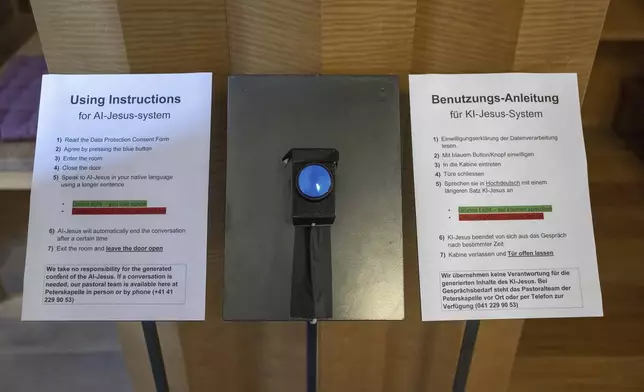
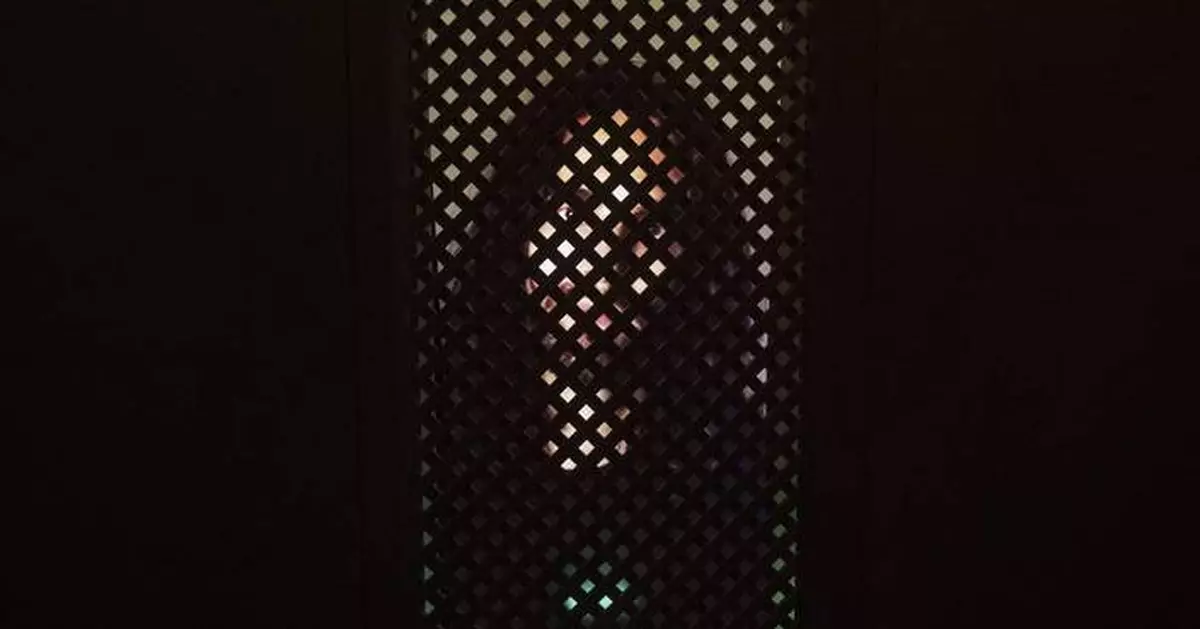
Researchers and religious leaders on Wednesday released findings from a two-month experiment through art in a Catholic chapel in Switzerland, where an avatar of “Jesus” on a computer screen — tucked into a confessional — took questions by visitors on faith, morality and modern-day woes, and offered responses based on Scripture.

More Images
An experimental art installation with an AI Jesus entitled, Deus in Machina, installed in a confessional in St. Peter's Chapel in the old town of Lucerne, Switzerland, Sunday, Aug. 25, 2024. (Urs Flueeler/Keystone via AP)
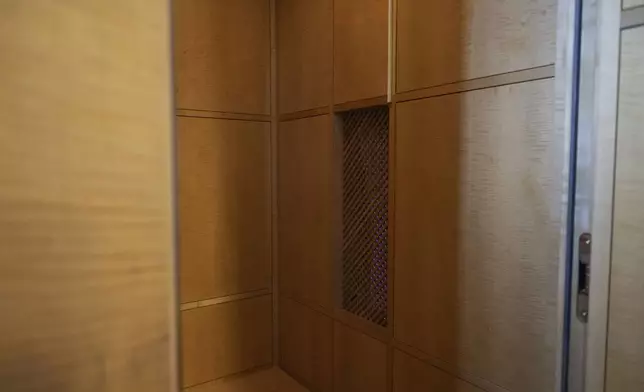
An experimental art installation with an AI Jesus entitled, Deus in Machina, installed in a confessional in St. Peter's Chapel in the old town of Lucerne, Switzerland, Sunday, Aug. 25, 2024. (Urs Flueeler/Keystone via AP)
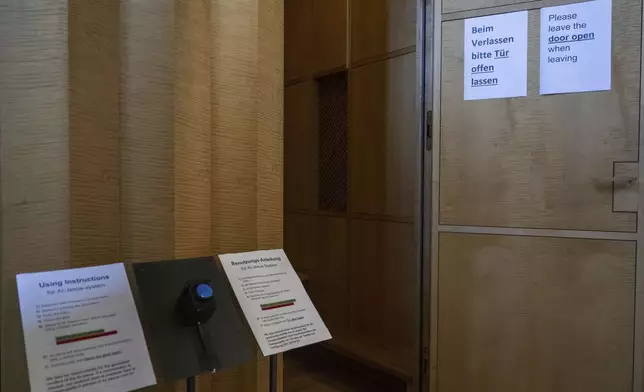
An experimental art installation with an AI Jesus entitled, Deus in Machina, installed in a confessional in St. Peter's Chapel in the old town of Lucerne, Switzerland, Sunday, Aug. 25, 2024. (Urs Flueeler/Keystone via AP)
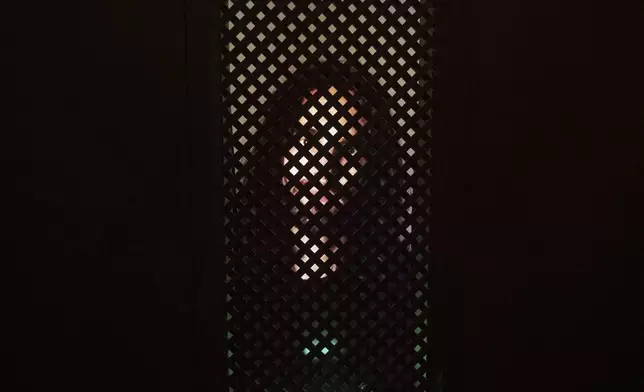
An experimental art installation with an AI Jesus entitled, Deus in Machina, installed in a confessional in St. Peter's Chapel in the old town of Lucerne, Switzerland, Sunday, Aug. 25, 2024. (Urs Flueeler/Keystone via AP)

An experimental art installation with an AI Jesus entitled, Deus in Machina, installed in a confessional in St. Peter's Chapel in the old town of Lucerne, Switzerland, Sunday, Aug. 25, 2024. (Urs Flueeler/Keystone via AP)

An experimental art installation with an AI Jesus entitled, Deus in Machina, installed in a confessional in St. Peter's Chapel in the old town of Lucerne, Switzerland, Sunday, Aug. 25, 2024. (Urs Flueeler/Keystone via AP)

An experimental art installation with an AI Jesus entitled, Deus in Machina, installed in a confessional in St. Peter's Chapel in the old town of Lucerne, Switzerland, Sunday, Aug. 25, 2024. (Urs Flueeler/Keystone via AP)

An experimental art installation with an AI Jesus entitled, Deus in Machina, installed in a confessional in St. Peter's Chapel in the old town of Lucerne, Switzerland, Sunday, Aug. 25, 2024. (Urs Flueeler/Keystone via AP)

The idea, said the chapel’s theological assistant, was to recognize the growing importance of artificial intelligence in human lives, even when it comes to religion, and explore the limits of human trust in a machine.

After the two-month run of the “Deus in Machina” exhibit at Peter’s Chapel starting in late August, some 900 conversations from visitors –- some came more than once –- were transcribed anonymously. Those behind the project said it was largely a success: Visitors often came out moved or deep in thought, and found it easy to use.

A small sign invited visitors to enter a confessional -– chosen for its intimacy –- and below a lattice screen across which penitent believers would usually speak with a priest, a green light signaled the visitor's turn to speak, and a red one came on when “AI Jesus” on a computer screen on the other side was responding.

Often, a lag time was needed to wait for the response – a testament to the technical complexities. After exiting, nearly 300 visitors filled out questionnaires that informed the report released Wednesday.

Philipp Haslbauer, an IT specialist at the Lucerne University of Applied Sciences and Arts who pulled together the technical side of the project, said the AI responsible for taking the role of “AI Jesus” and generating responses was GPT-4o by OpenAI, and an open-source version of the company’s Whisper was used for speech comprehension.

An AI video generator from Heygen was used to produce voice and video from a real person, he said. Haslbauer said no specific safeguards were used “because we observed GPT-4o to respond fairly well to controversial topics.”

Visitors broached many topics, including true love, the afterlife, feelings of solitude, war and suffering in the world, the existence of God, plus issues like sexual abuse cases in the Catholic Church or its position on homosexuality.

Most visitors described themselves as Christians, though agnostics, atheists, Muslims, Buddhists and Taoists took part too, according to a recap of the project released by the Catholic parish of Lucerne.

About one-third were German speakers, but “AI Jesus” — which is conversant in about 100 languages — also had conversations in languages like Chinese, English, French, Hungarian, Italian, Russian and Spanish.

“What was really interesting (was) to see that the people really talked with him in a serious way. They didn’t come to make jokes,” said chapel theologian Marco Schmid, who spearheaded the project. Most visitors were aged 40 to 70, and more Catholics respondents found the experience stimulating than did Protestants, the report showed.

Schmid was quick to point out that the “AI Jesus” – billed as a “Jesus-like” persona – was an artistic experiment to get people thinking about the intersection between the digital and the divine, not substitute for human interaction or sacramental confessions with a priest, nor was it intended to save pastoral resources.

“For the people it was clear that it was a computer ... It was clear it was not a confession,” Schmid said. “He wasn’t programmed to give absolutions or prayers. At the end, it was more summary of the conversation.”

The Catholic Church from the Vatican on down has been wrestling with the challenges –- and possible opportunities -– presented by the explosion in public interest in AI since generative artificial intelligence captured the world’s attention two years ago when OpenAI's ChatGPT made its debut.

The Vatican has appointed a friar from a medieval Franciscan order as its top expert on AI, and a Lutheran church in Bavaria served up sermons delivered by a chatbot last year. Pope Francis, in his annual peace message for this year, pushed for an international treaty to ensure the ethical use of AI technology.

Chatbots like ChatGPT are powered by algorithmic models trained on vast pools of text and other data to mimic speech and generate seemingly unique and human-like responses.

Haslbauer is sensitive to public reaction and has noted chatter on social media saying the project is “blasphemous” or the “work of the devil.”

“If you read comments on the internet about it, some are very negative — which is scary,” Haslbauer, whose long-haired look featured as a basis for the image of the virtual Jesus.

In a demonstration of the technology in the chapel, Haslbauer queried “AI Jesus” about its message for a troubled world, and about whether AI could be helpful as a way for people to find God.

“All knowledge and wisdom ultimately come from God," the chatbot said in a soothing voice, after a pause to respond, and the image briefly crackled. “If used wisely, AI can indeed be a tool to explore the wonders of creation, deepen our understanding of Scripture, and foster connections among people.”

"Yet it remains essential to seek God with all your heart and soul beyond any technology,” it added.

Kenneth Cukier, a journalist, author and expert with the U.S.-based nonprofit group called “AI and Faith,” said if “AI Jesus” helps people connect deeper to themselves and the world, it “has to be a good thing.”

“It will lead to better individuals and a better world,” he said. “However — and there’s a big however — this does feel a little bit infantile, and pardon my pun, machine-like.”

“The risk is that it pulls people, ultimately, farther away from that which is more meaningful, deeper and authentic in spirituality,” said Cukier, co-author of “Big Data: A Revolution that Will Transform How We Work, Live and Think.”

For Schmid, the exhibit was a pilot project — and he doesn't foresee a second coming of “AI Jesus” anytime soon.

“For us, it was also clear it was just a limited time that we will expose this Jesus," he said, adding that any return would need to be done after deeper thought.

“We are discussing ... how we could revive him again," he said, noting interest from parishes, schoolteachers, researchers and others as the project got media attention in Switzerland and beyond. “They all are interested and would like to have this ‘AI Jesus’. So we have now a little bit to reflect on how we want to continue."

Associated Press religion coverage receives support through the AP’s collaboration with The Conversation US, with funding from Lilly Endowment Inc. The AP is solely responsible for this content.

——

The Associated Press and OpenAI have a licensing and technology agreement that allows OpenAI access to part of AP’s text archives.
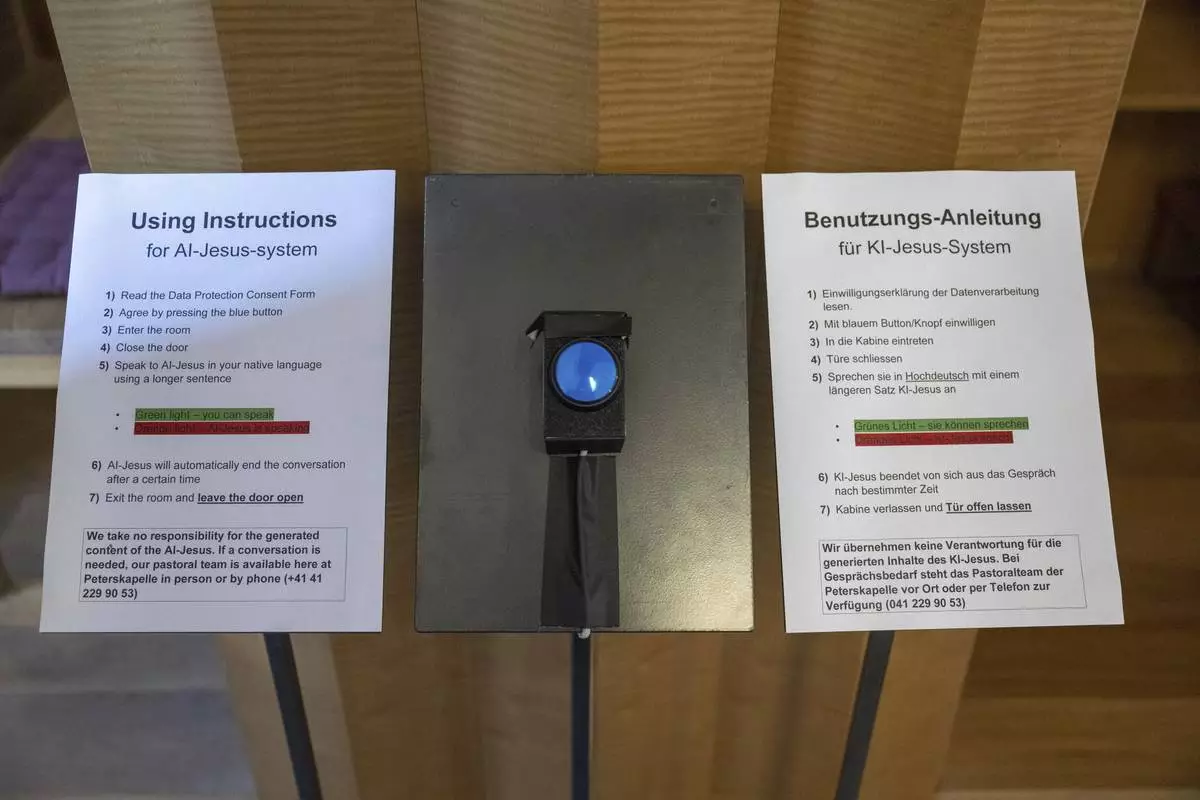
An experimental art installation with an AI Jesus entitled, Deus in Machina, installed in a confessional in St. Peter's Chapel in the old town of Lucerne, Switzerland, Sunday, Aug. 25, 2024. (Urs Flueeler/Keystone via AP)
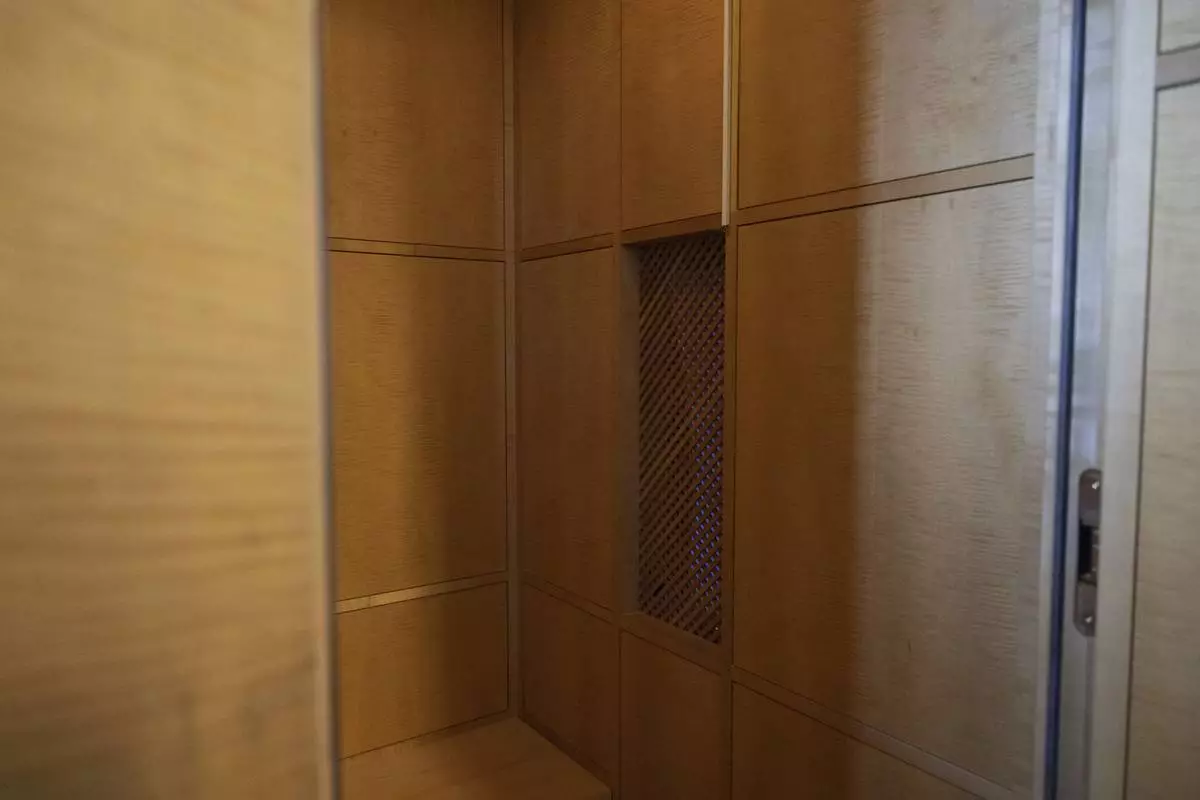
An experimental art installation with an AI Jesus entitled, Deus in Machina, installed in a confessional in St. Peter's Chapel in the old town of Lucerne, Switzerland, Sunday, Aug. 25, 2024. (Urs Flueeler/Keystone via AP)
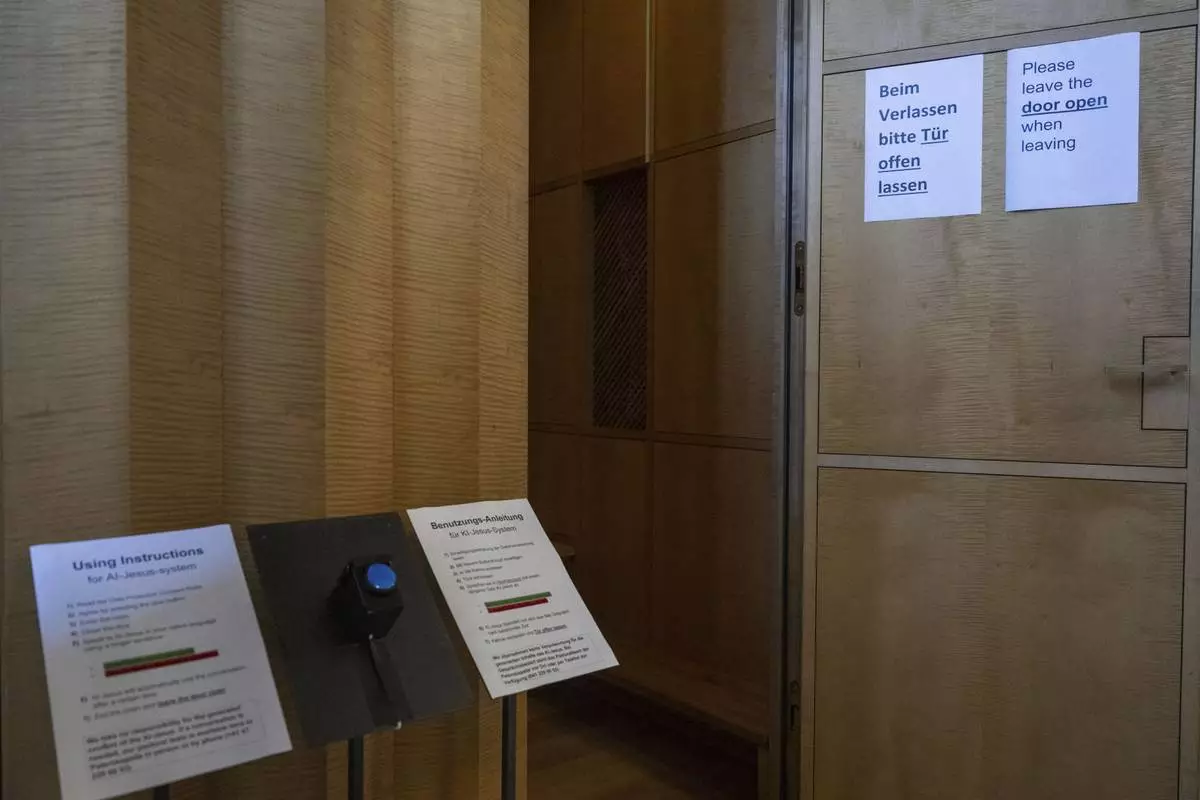
An experimental art installation with an AI Jesus entitled, Deus in Machina, installed in a confessional in St. Peter's Chapel in the old town of Lucerne, Switzerland, Sunday, Aug. 25, 2024. (Urs Flueeler/Keystone via AP)
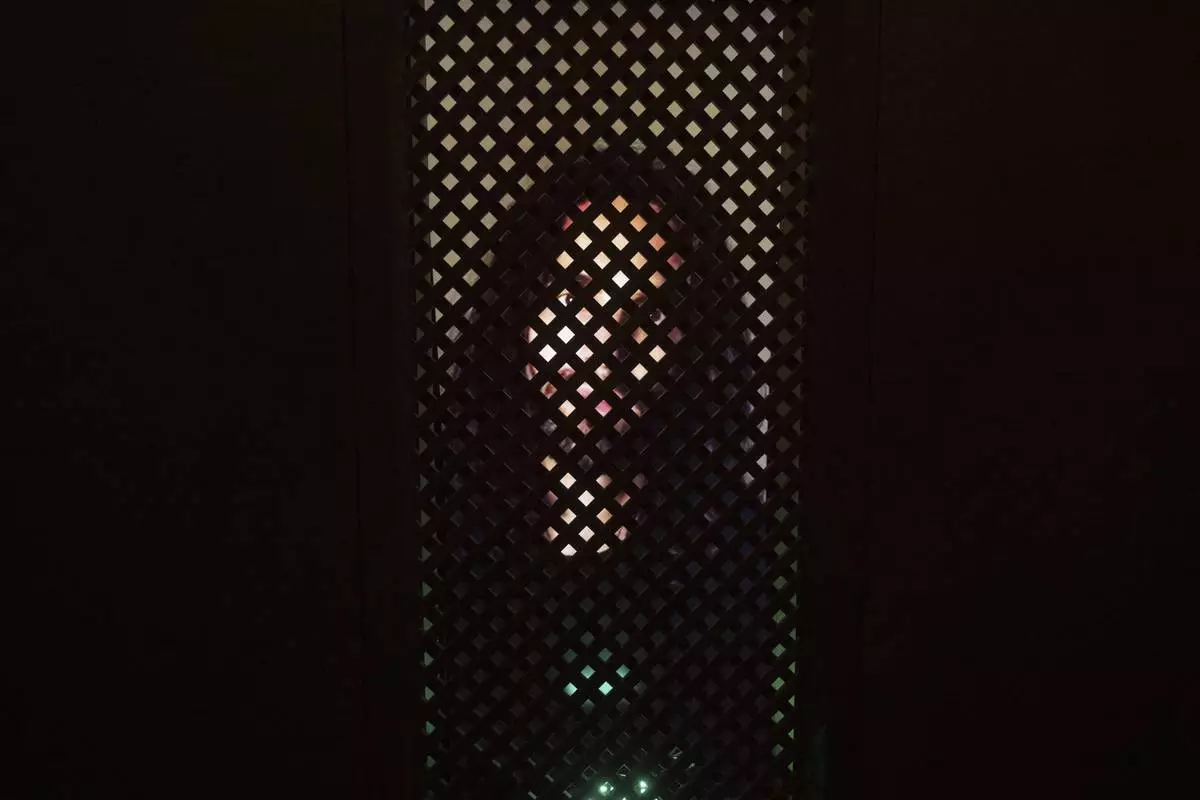
An experimental art installation with an AI Jesus entitled, Deus in Machina, installed in a confessional in St. Peter's Chapel in the old town of Lucerne, Switzerland, Sunday, Aug. 25, 2024. (Urs Flueeler/Keystone via AP)

An experimental art installation with an AI Jesus entitled, Deus in Machina, installed in a confessional in St. Peter's Chapel in the old town of Lucerne, Switzerland, Sunday, Aug. 25, 2024. (Urs Flueeler/Keystone via AP)
An experimental art installation with an AI Jesus entitled, Deus in Machina, installed in a confessional in St. Peter's Chapel in the old town of Lucerne, Switzerland, Sunday, Aug. 25, 2024. (Urs Flueeler/Keystone via AP)
An experimental art installation with an AI Jesus entitled, Deus in Machina, installed in a confessional in St. Peter's Chapel in the old town of Lucerne, Switzerland, Sunday, Aug. 25, 2024. (Urs Flueeler/Keystone via AP)
An experimental art installation with an AI Jesus entitled, Deus in Machina, installed in a confessional in St. Peter's Chapel in the old town of Lucerne, Switzerland, Sunday, Aug. 25, 2024. (Urs Flueeler/Keystone via AP)
The sun hung low when Bad Bunny emerged in Puerto Rico's sugar cane fields during his halftime show, surrounded by jíbaros in pavas (rural farmers in traditional straw hats), viejitos playing dominos (an affectionate term for older men) and a piragua stand (shaved ice) — undeniable symbols of Puerto Rico.

From a small Caribbean island with a complicated colonial history, to the world: The artist born Benito Antonio Martínez Ocasio brought Puerto Rican culture to the Levi’s Stadium in Santa Clara, California, for his 2026 Super Bowl halftime show in what was always going to be a landmark moment for Latinos.

He started with his huge reggaeton-and-then-some hits, “Tití Me Preguntó" moving into “Yo Perreo Sola,” as he remerged on top of the casita ("little house") from his Puerto Rican residency — Cardi B, Jessica Alba and Pedro Pascal were guests at his pari de marquesina ("house party.")

Then he crashed through the roof — Daddy Yankee's “Gasolina” played for a moment, clearly an acknowledgement and celebration of the Puerto Rican artists who laid the path for his career to go global.

“Mi nombre es Benito Antonio Martínez Ocasio,” he introduced himself to the crowd in Spanish. “Y si hoy estoy aquí en el Super Bowl 60, es porque nunca, nunca dejé de creer en mí y tú también deberías de creer en ti, vales más de lo que piensas.”

In English: “My name is Benito Antonio Martínez Ocasio, and if I’m here today at Super Bowl 60 it’s because I never, ever stopped believing in myself and you should also believe in yourself, you’re worth more than you think."

The strings of his song “Monaco” played — then, a surprise Lady Gaga emerged at a wedding scene, singing her portion of “Die with a Smile,” her collaboration with Bruno Mars, joined by a salsa band. Her dress featured a maga, Puerto Rico's national flower.

It gave Benito time for a fashion change — rocking a white suit like a classic salsero — for “Baile Inolvidable" and “NuevaYol," with a block party set where he took a shot with Tonita, owner of one of the last Puerto Rican social clubs in New York City, Brooklyn's Caribbean Social Club.

Ricky Martin, one of Puerto Rico's greatest crossover artists, performed Bad Bunny's “Lo Que Le Pasó a Hawaii,” (“What Happened to Hawaii”), a rallying cry for Puerto Rico’s cultural autonomy in an era of neocolonialization. Martin sat in a plastic chair in front of a plantain tree; a scene that mirrored the cover of Bad Bunny's 2025 album “Debí Tirar Más Fotos."

Behind Martin, jíbaros in pavas climbed power poles that exploded, symbolic of Puerto Rico's frequent blackouts and failing power grid. It queued up a moving performance of 2022 song “El Apagón” (“The Blackout”), in reference to Hurricane Maria, its aftermath and the continued anger and frustration over persistent, chronic power outages.

As he sang one of his most political songs, Bad Bunny held a Puerto Rico flag in red, white and baby blue — reflective of the Puerto Rican independence movement.

For around 13 minutes during the halftime show sponsored by Apple Music and Roc Nation, all eyes on the field — and around the world — were on Benito Antonio Martínez Ocasio.

Bad Bunny performed entirely in Spanish — as all of his music is recorded in the language, though he has collaborated with English-language artists. The only English singing came from Gaga.

He did speak in English at the end of the set, however, when he said, “God Bless America,” and then named countries in the Americas: “Chile, Argentina, Uruguay, Paraguay, Bolivia, Peru, Ecuador, Brazil” and so on, including the United States and Canada — a reminder that while it is common to use “America” as a synonym for the U.S. in the U.S., it is the name used across two continents.

“And my motherland, mi patria, Puerto Rico, seguimos aquí." In English, “My homeland, Puerto Rico, we are still here.”

Behind him, a screen read “The only thing more powerful than hate is love” in English text, a direct reference to one of his recent speeches at the 2026 Grammys.

He ended with “DtMF” as he walked out of the stadium, joined by musicians with güiros (a percussive instrument made of a hollow gourd) and panderetas (tambourines, a symbol of plena.)

For years, Bad Bunny has been one of the most-streamed artists on the planet. And on Sunday, he made it clear that his global popularity translates seamlessly to the biggest stage in the U.S. (Though he is no stranger to it. He previously appeared during the halftime show at Super Bowl LIV in 2020 alongside Jennifer Lopez and Shakira. He sang in Spanish alongside two artists whose bilingual hits helped usher in a crossover era for Latin music in the ’00s.)

Consider Bad Bunny's 2026 halftime performance the cherry on top of a huge moment for the 31-year-old global superstar, who just 10 years ago was working at an Econo supermarket in Puerto Rico.

Last week, he took home album of the year at the 2026 Grammys for his “Debí Tirar Más Fotos,” an album that marries folkloric tradition in local Borinquen genres like bomba, plena, salsa and música jíbara with contemporary styles like reggaeton, trap and pop. It marked the first time an all-Spanish language album won the top prize.

Like most headliners, Bad Bunny kept details of his halftime performance under wraps ahead of time, though many theorized there would be some kind of political performance. He's been critical of President Donald Trump in the past and at the Grammys last Sunday, said “ICE out” while accepting a televised award. Bad Bunny's latest tour skipped the continental U.S.; in an interview he said it was at least partially inspired by concerns that his fans could be targeted by immigration agents.

At a press conference on Thursday, Bad Bunny told Apple Music’s Zane Lowe and Ebro Darden viewers could expect a huge party — and joked that while viewers didn't need to learn Spanish to enjoy his set; they should learn to dance.

“I want to bring to the stage, of course, a lot of my culture,” he said at the time. "I don’t want to give any spoilers. It’s going to be fun.”

Of course, he delivered on just that — with a message of hope and a reminder of Puerto Rico's resiliency.

For more on the Super Bowl, visit https://apnews.com/hub/super-bowl

Bad Bunny and Lady Gaga perform during halftime of the NFL Super Bowl 60 football game between the New England Patriots and the Seattle Seahawks, Sunday, Feb. 8, 2026, in Santa Clara, Calif. (AP Photo/Lynne Sladky)

Bad Bunny and Lady Gaga perform during halftime of the NFL Super Bowl 60 football game between the New England Patriots and the Seattle Seahawks, Sunday, Feb. 8, 2026, in Santa Clara, Calif. (AP Photo/Lynne Sladky)

Bad Bunny performs during halftime of the NFL Super Bowl 60 football game between the New England Patriots and the Seattle Seahawks, Sunday, Feb. 8, 2026, in Santa Clara, Calif. (AP Photo/Lynne Sladky)

Bad Bunny performs during halftime of the NFL Super Bowl 60 football game between the New England Patriots and the Seattle Seahawks, Sunday, Feb. 8, 2026, in Santa Clara, Calif. (AP Photo/Lynne Sladky)

Bad Bunny performs during halftime of the NFL Super Bowl 60 football game between the New England Patriots and the Seattle Seahawks, Sunday, Feb. 8, 2026, in Santa Clara, Calif. (AP Photo/Mark J. Terrill)

Bad Bunny performs during halftime of the NFL Super Bowl 60 football game between the New England Patriots and the Seattle Seahawks, Sunday, Feb. 8, 2026, in Santa Clara, Calif. (AP Photo/Mark J. Terrill)

Bad Bunny performs during halftime of the NFL Super Bowl 60 football game between the New England Patriots and the Seattle Seahawks, Sunday, Feb. 8, 2026, in Santa Clara, Calif. (AP Photo/Mark J. Terrill)

Bad Bunny performs during halftime of the NFL Super Bowl 60 football game between the New England Patriots and the Seattle Seahawks, Sunday, Feb. 8, 2026, in Santa Clara, Calif. (AP Photo/Mark J. Terrill)

Bad Bunny, left, performs during halftime of the NFL Super Bowl 60 football game between the New England Patriots and the Seattle Seahawks, Sunday, Feb. 8, 2026, in Santa Clara, Calif. (AP Photo/Godofredo A. Vásquez)

Bad Bunny, left, performs during halftime of the NFL Super Bowl 60 football game between the New England Patriots and the Seattle Seahawks, Sunday, Feb. 8, 2026, in Santa Clara, Calif. (AP Photo/Godofredo A. Vásquez)

Bad Bunny performs during halftime of the NFL Super Bowl 60 football game between the New England Patriots and the Seattle Seahawks, Sunday, Feb. 8, 2026, in Santa Clara, Calif. (AP Photo/Charlie Riedel)

Bad Bunny performs during halftime of the NFL Super Bowl 60 football game between the New England Patriots and the Seattle Seahawks, Sunday, Feb. 8, 2026, in Santa Clara, Calif. (AP Photo/Charlie Riedel)

Bad Bunny performs during halftime of the NFL Super Bowl 60 football game between the New England Patriots and the Seattle Seahawks, Sunday, Feb. 8, 2026, in Santa Clara, Calif. (AP Photo/Julio Cortez)

Bad Bunny performs during halftime of the NFL Super Bowl 60 football game between the New England Patriots and the Seattle Seahawks, Sunday, Feb. 8, 2026, in Santa Clara, Calif. (AP Photo/Julio Cortez)

Bad Bunny performs during halftime of the NFL Super Bowl 60 football game between the New England Patriots and the Seattle Seahawks, Sunday, Feb. 8, 2026, in Santa Clara, Calif. (AP Photo/Lynne Sladky)

Bad Bunny performs during halftime of the NFL Super Bowl 60 football game between the New England Patriots and the Seattle Seahawks, Sunday, Feb. 8, 2026, in Santa Clara, Calif. (AP Photo/Lynne Sladky)

Recommended Articles