China delivered the world's first commercial liquefied carbon dioxide (CO2) transport ship to its client at a port in Dalian City of northeast China's Liaoning Province on Friday.
The ship was built by Dalian Shipbuilding Industry Co.Ltd.
The ship is 130 meters long and 21 meters wide, and has cargo tanks with a capacity of 7,500 cubic meters. Powered by LNG dual-fuel technology, it could meet the strictest global energy efficiency standards.
"This ship is the first of its kind in the world. The CO2 cargo tanks are made with newly developed steel plate materials. This is our first design and building of a CO2 liquid cargo system, and equipped with many energy-saving and environmentally friendly designs. These factors significantly increased the difficulty of shipbuilding, while also opening a new path in the carbon transport industry," said Gai Yong, manager of the ship project at Dalian Shipbuilding Industry Co. Ltd.
The ship will serve Norway's world-first large-scale commercial liquefied CO2 subsea storage project, according to Gai.
CO2 emissions from European industries will be collected and transported by the ship to a CO2 receiving terminal on Norway’s west coast, where the gas will be processed and injected 2,600 meters underground into the ocean for permanent storage.
As the world's first ship dedicated to marine carbon transport and storage, this vessel will play a pioneering role in addressing global CO2 emissions from land-based sources.
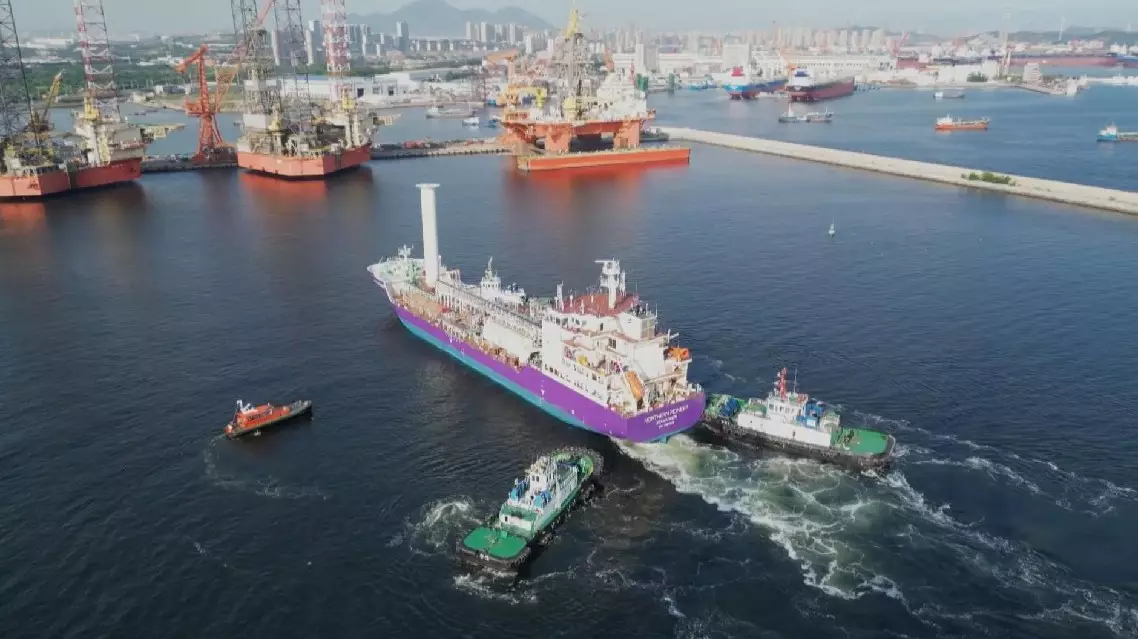
China delivers world's first commercial liquefied CO2 transport ship
China attaches great importance to the development of China-Singapore relations, and is willing to maintain the momentum of high-level exchanges, promote practical cooperation in various fields, and enhance people-to-people exchanges with Singapore, Chinese Foreign Minister Wang Yi said on Monday.
Wang, also a member of the Political Bureau of the Communist Party of China Central Committee, made the remarks when holding talks with Singaporean Foreign Minister Vivian Balakrishnan in Beijing.
Noting that over the past year, under the strategic guidance of leaders of the two countries and joint efforts of both sides, the all-round high-quality and future-oriented partnership between China and Singapore has maintained a good momentum, Wang urged the two countries to continue to enhance strategic communication, increase mutual trust, jointly address the ever-emerging global challenges at present, and safeguard the overall situation of regional peace and stability.
Wang said that maintaining the security of global industrial and supply chains and the smooth flow of maritime navigation is in the common interests of the international community, and China is willing to continue to make efforts to this end.
Noting that Singapore is an important ASEAN member and will assume ASEAN's rotating presidency next year, Wang said China expects the Singaporean side to continue playing an active role in promoting China-ASEAN cooperation.
Balakrishnan said Singapore highly values its relations with China, adheres to the one-China policy, and firmly opposes "Taiwan independence."
Singapore is willing to maintain close high-level exchanges with China, promote practical cooperation in various fields, carry out key cooperation projects of both sides, and promote regional connectivity, he said.
Singapore is ready to promote greater progress in ASEAN-China comprehensive strategic partnership, support the Global Development Initiative, and uphold multilateralism and free trade, and is willing to work with China to make joint efforts in promoting world peace, development and prosperity, he added.
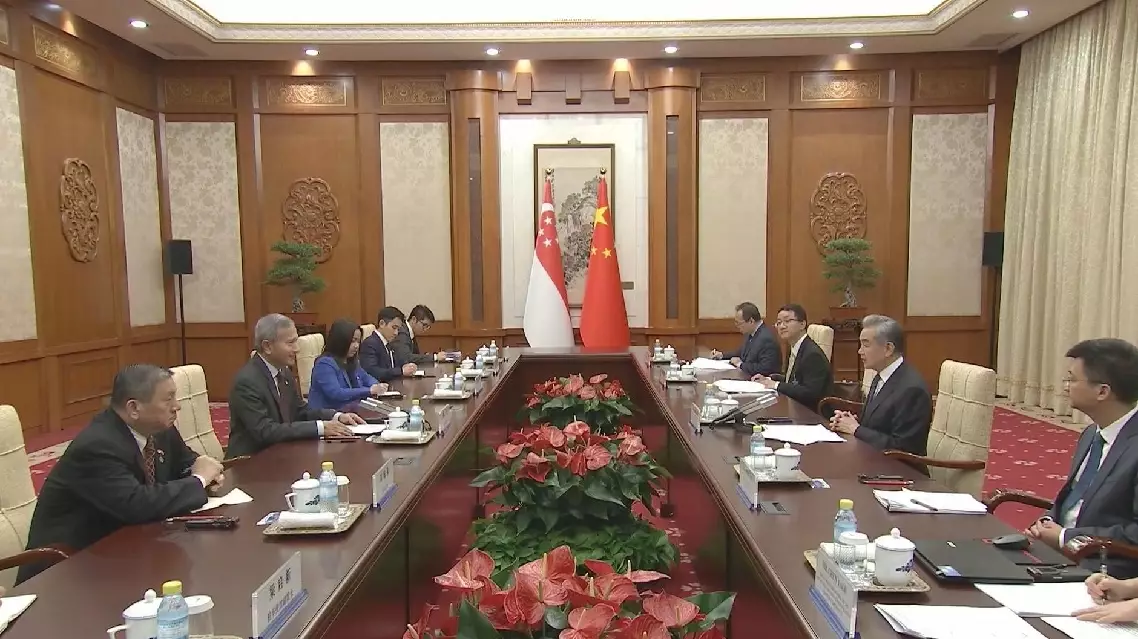
China ready to promote practical cooperation with Singapore: Chinese FM