Jack Ma, founder of Alibaba Group Holding, on Friday visited the company’s campus in Hangzhou, capital of eastern Zhejiang province, in a show of support for the e-commerce empire he created a quarter of a century ago, according to employees.

Jack Ma returns to Alibaba campus. Source from weibo
Ma’s visit was his first known trip back to to his hometown since March 2023, when the billionaire visited a school that he established. While Ma resigned as Alibaba’s executive chairman in 2019 and has kept a low profile since 2020, he remains widely seen as the spiritual leader of the company and the face of Chinese entrepreneurship.
Click to Gallery
Jack Ma returns to Alibaba campus. Source from weibo
Jack Ma returns to Alibaba campus. Source from weibo
Jack Ma returns to Alibaba campus. Source from weibo
Jack Ma returns to Alibaba campus. Source from weibo
His low-key visit to Alibaba’s campus comes at a time when the Chinese government is trying to boost confidence in the country’s private sector, as the world’s second-largest economy grapples with a slew of challenges, ranging from a persistent property market downturn to renewed geopolitical headwinds after US president-elect Donald Trump threatened to levy additional tariffs on Chinese imports.

Jack Ma returns to Alibaba campus. Source from weibo
In a photo taken by an employee on site and shared with the South China Morning Post, a smiling and relaxed Ma, wearing a white cap, was seen waving to staff.
Alibaba, owner of the Post, did not immediately respond to a request for comment on Friday.
Ma’s appearance comes a week after Alibaba announced its largest internal adjustment after implementing a corporate restructuring in early 2023 that carved up its sprawling business empire into six units.
In its latest revamp, Alibaba merged its domestic and overseas e-commerce operations into one unit, furthering its effort to seek greater synergy across its domestic and international supply chains amid intensifying competition with rivals such as Pinduoduo owner PDD Holdings.
Ma in September called on Alibaba employees to “believe in the future” and “believe in the market”, as the company faced fierce competition on multiple fronts.
According to his letter published on Alibaba’s internal website on September 10, marking the 25th anniversary of the group’s founding, Ma said many of the company’s businesses face the prospect of being surpassed amid the “resurgence of … technology and fierce competition in various industries”.

Jack Ma returns to Alibaba campus. Source from weibo
“This is expected, as no company can always stay on top in any field forever,” wrote Ma. “We must constantly [be reminded] not to lose ourselves” amid the competitive pressure. He said Alibaba is made of “an idealistic spirit”, which means that “we believe in the future, we believe in the market”.
In its September-quarter financial results, Alibaba’s income surged 58 per cent to 43.9 billion yuan (US$6 billion). Revenue rose 5 per cent to 236.5 billion yuan.
Alibaba is also doubling down on artificial intelligence (AI). The September-quarter revenue from the Cloud Intelligence Group, one of the company’s most important growth engines, rose 7 per cent to 29.6 billion yuan.
“Growth in our cloud business accelerated from prior quarters, with revenue from public cloud products growing in double digits and AI-related product revenue delivering triple-digit growth,” Alibaba chief executive Eddie Wu Yongming said in a statement.

Jack Ma returns to Alibaba campus. Source from weibo
Alibaba shares rose slightly on Friday to close at HK$83.65. The shares, however, have fallen by more than two-thirds from their peak in late 2020.
Ma and Alibaba co-founder Joe Tsai are currently the two largest shareholders of the e-commerce giant, after they aggressively scooped up its tumbling shares in New York and Hong Kong. Ma bought about US$50 million of shares in the fourth quarter last year, raising his stake beyond 4.3 per cent at the end of 2021, making him the largest single shareholder.
NEW YORK (AP) — The U.S. stock market climbed again Tuesday on hopes for a coming cut to interest rates.
The S&P 500 rose 0.9% after breaking out of a morning lull and is back within 1.8% of its all-time high. The Dow Jones Industrial Average rallied 664 points, or 1.4%, and the Nasdaq composite gained 0.7%.
Stocks got a boost from easing yields in the bond market. Lower interest rates can cover up many sins in financial markets, including prices going too high, and hopes are strong that the Federal Reserve will cut its main interest rate at its next meeting to juice the economy further.
A raft of mixed economic data on Tuesday left traders betting on a nearly 83% probability that the Fed will cut in December, according to data from CME Group. That’s roughly the same as a day before and up sharply from the coin flip’s chance that they saw just a week ago.
One of Tuesday’s reports said that shoppers bought less at U.S. retailers in September than economists expected. Another said confidence among U.S. consumers worsened by more in November than expected, a second signal that the economy could potentially use the help of lower interest rates.
Easier rates can boost the economy by encouraging households and companies to borrow more and investors to pay higher prices for investments than they would otherwise.
A third report, meanwhile, said inflation at the wholesale level was a touch worse in September than economists expected, but a closely tracked underlying trend was slightly better. That’s important because lower interest rates can make inflation worse, and high inflation is the main deterrent that could keep the Fed from cutting rates.
After taking all the data together, economists suggested the Fed and its chair, Jerome Powell, could be leaning toward cutting rates on Dec. 10. The Fed has already cut rates twice this year in hopes of shoring up the slowing job market.
“Taking a pause on rate cuts would probably do more damage to sentiment than a cut would help,” according to Brian Jacobsen, chief economist at Annex Wealth Management, who also said “Powell doesn’t need to be the Grinch that stole Christmas.”
Easier interest rates can give particularly big boosts to smaller companies, because many of them need to borrow to grow. The Russell 2000 index of the smallest U.S. stocks jumped 2.1% to lead the market.
Elsewhere on Wall Street, several retailers leaped after delivering stronger profits for the summer than analysts expected.
Abercrombie & Fitch soared 37.5% after the apparel seller reported a better profit than expected. It also raised the bottom end of its forecasted range for revenue and profit over the full year.
Kohl’s surged 42.5% after reporting a profit for the latest quarter, when analysts were expecting a loss. Best Buy rose 5.3% after boosting its profit forecast for the full year following a better-than-expected third quarter, citing strength across computing, gaming and mobile phones.
Dick’s Sporting Goods erased an early drop of 4% to add 0.2%. It raised its forecast for results at its Dick’s stores, though its purchase of Foot Locker is requiring some work. Executive Chairman Ed Stack said the company is “cleaning out the garage” at Foot Locker by clearing inventory, closing poorly performing stores and making other moves.
Swings also continued in the artificial-intelligence industry, which has battled concerns that too many dollars are pouring into data centers and may not produce the revolution of bigger profits and productivity that proponents are predicting.
Alphabet rose another 1.5%, continuing a strong run on excitement about its recently released Gemini AI model. Chinese giant Alibaba, meanwhile, saw its stock that trades in the United States fall 2.3% after losing an early gain. It reported stronger revenue than analysts expected for the latest quarter thanks in part to the AI boom, but its overall profit fell short of forecasts.
Some chip companies dropped sharply following a report from The Information that Meta Platforms is in talks to spend billions of dollars on AI chips from Alphabet instead of them. Nvidia sank 2.6% and Advanced Micro Devices dropped 4.1%.
All told, the S&P 500 rose 60.76 points to 6,765.88. The Dow Jones Industrial Average rallied 664.18 to 47,112.45, and the Nasdaq composite gained 153.59 to 23,025.59.
In the bond market, the yield on the 10-year Treasury eased to 4.00% from 4.04% late Monday.
In stock markets abroad, indexes rose across Europe and Asia. Germany’s DAX returned 1%, and stocks in Shanghai climbed 0.9% for two of the world’s bigger moves.
AP Business Writer Elaine Kurtenbach contributed.
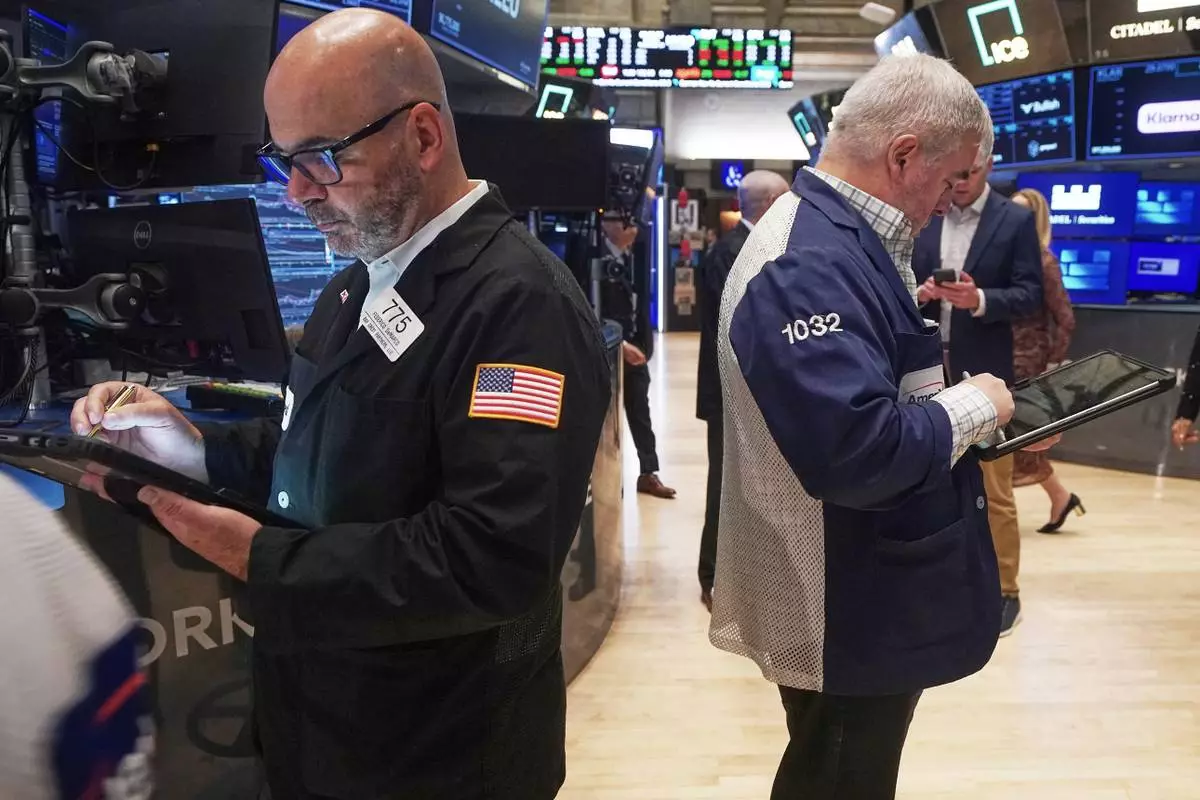
Traders Fred Demarco, left, and Edward McCarthy work on the floor of the New York Stock Exchange, Monday, Nov. 24, 2025. (AP Photo/Richard Drew)
FILE - A woman walks in front of SoftBank store in Ginza shopping district in Tokyo, Jan. 20, 2020. (AP Photo/Eugene Hoshiko, File)
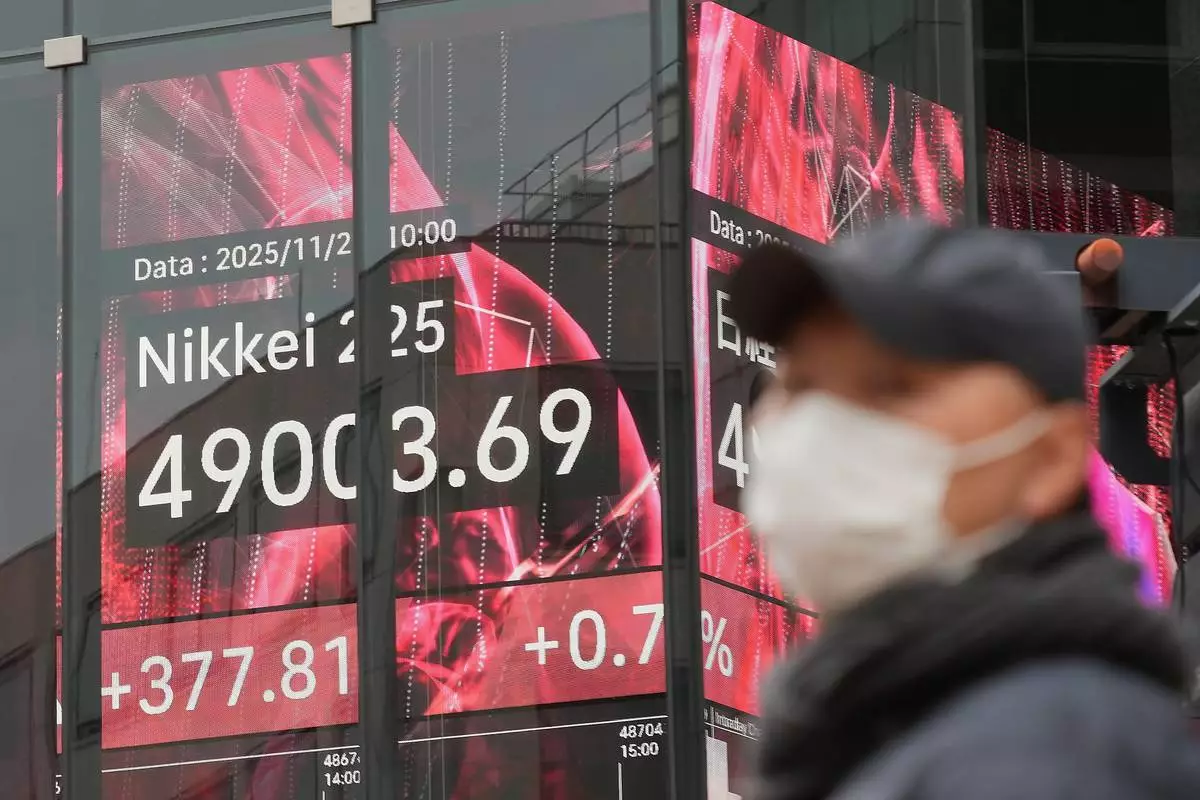
A person stands in front of an electronic stock board showing Japan's Nikkei index at a securities firm Tuesday, Nov. 25, 2025, in Tokyo. (AP Photo/Eugene Hoshiko)
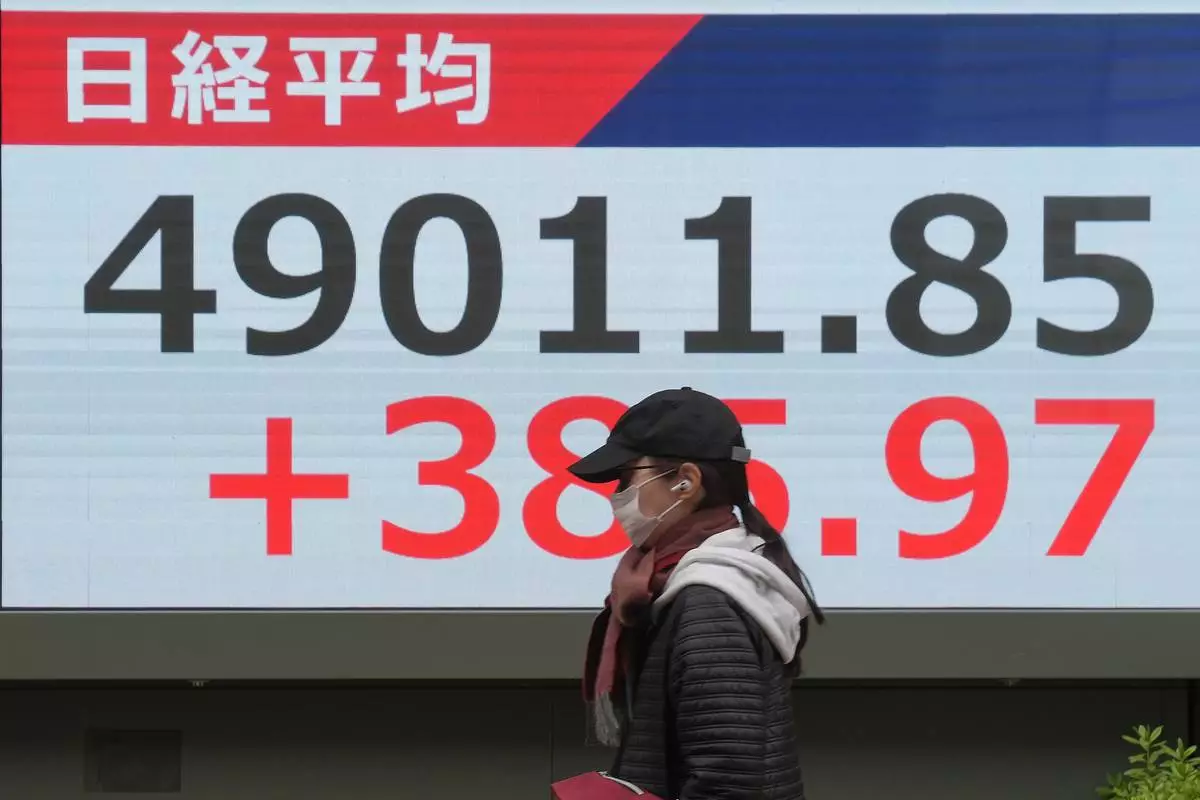
A person walks in front of an electronic stock board showing Japan's Nikkei index at a securities firm Tuesday, Nov. 25, 2025, in Tokyo. (AP Photo/Eugene Hoshiko)
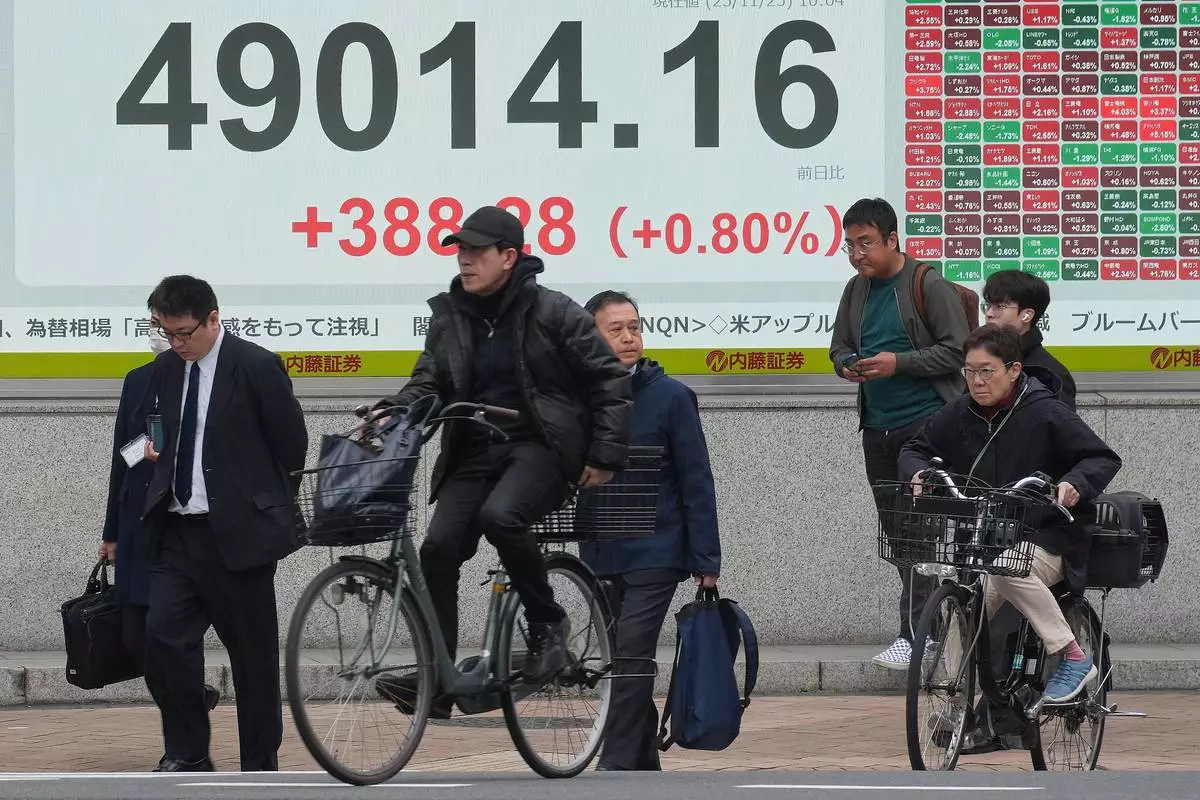
People cross a street near an electronic stock board showing Japan's Nikkei index at a securities firm Tuesday, Nov. 25, 2025, in Tokyo. (AP Photo/Eugene Hoshiko)
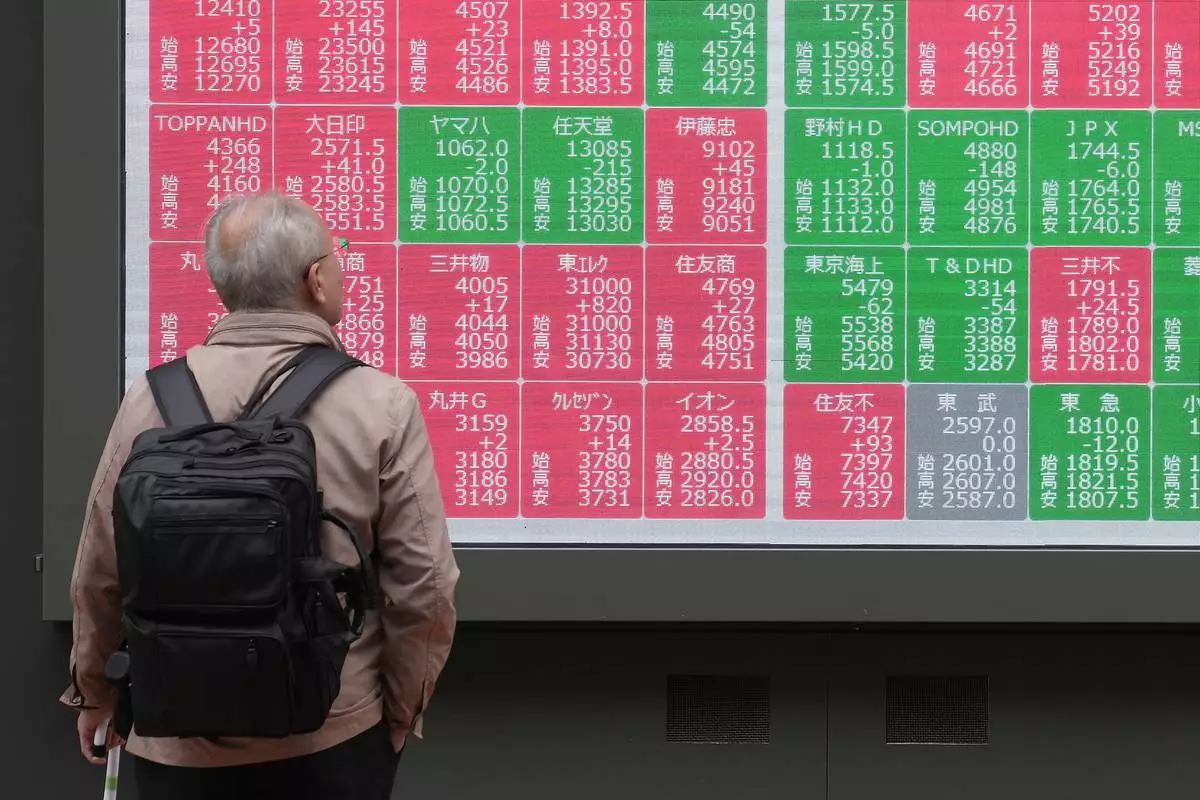
A person looks at an electronic stock board showing Japan's Nikkei index at a securities firm Tuesday, Nov. 25, 2025, in Tokyo. (AP Photo/Eugene Hoshiko)