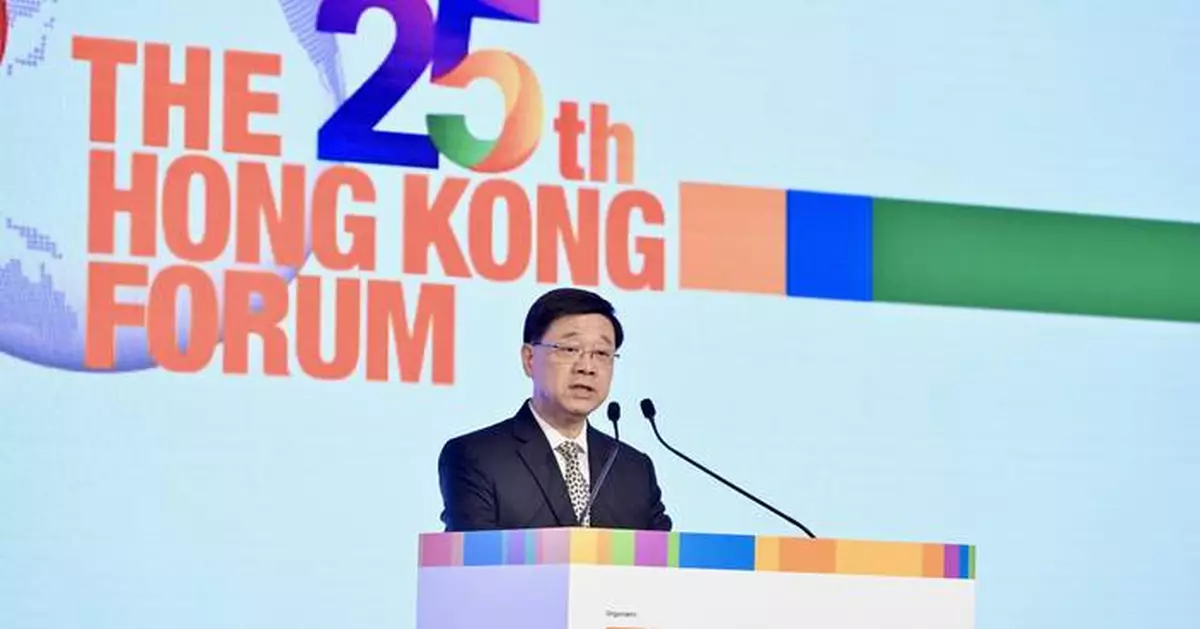
Speech by CE at 25th Hong Kong Forum Keynote Luncheon (with photos/video)
Following is the speech by the Chief Executive, Mr John Lee, at the25th Hong Kong Forum Keynote Luncheon today (December 4):
Mr Hans Poulis (Chairman of the Federation of Hong Kong Business Associations Worldwide), Dr Peter Lam (Chairman of the Hong Kong Trade Development Council),friends of Hong Kong from around the world, distinguished guests, ladies and gentlemen,
Good afternoon. Welcome to Hong Kong, and the annual Hong Kong Forum - the landmark 25th edition of the Forum.
This year's anniversary event gathers some 400 businesspeople from all over the world, from every sector and industry, here - this year and every year, for a quarter of a century now.
Many of you are part of the Federation of Hong Kong Business Associations Worldwide, a global network spanning across some 40 countries and world, counting over 11 000 members around the globe. You are international businesspeople, united by the strong belief in, and commitment to, the city of Hong Kong. Most importantly, you are here, because Hong Kong means business.
Our "one country, two systems" principle makes that possible. It gives Hong Kong singular business, trade and financial opportunities, with the full support of China, our country, while allowing us to do what we have long done so well for so many - and that's create opportunities and connections. Hong Kong, ladies and gentlemen, is the world's "super connector". Your super connector.
Hong Kong has long attracted businesses and investors, thanks to our clear and compelling advantages - from a free and open investment environment and simple and low tax system, to modern infrastructure and logistics networks and the unfettered flow of information, capital, goods and people.
It helps, too, that Hong Kong boasts a long-standing commitment to the rule of law, and is built on a common law system, one that resembles the legal system in many major global financial centres. We are the only common law jurisdiction in China, and the only common law jurisdiction in the world with a body of law accessible in both Chinese and English, our official languages.
Our advantages are widely recognised. Hong Kong is the world's 10th largest merchandise trading entity, and the world's fourth-largest foreign direct investment destination.
Canada's Fraser Institute, in its 2024 Economic Freedom of the World Report, ranked Hong Kong the world's freest economy, number one. We also topped the Report's "freedom to trade internationally".
In this year's World Competitiveness Yearbook, published by the Swiss-based International Institute for Management Development, Hong Kong ranked fifth globally, up two places from last year. We also topped the global rankings in international trade and business legislation.
To build on our strengths, the Hong Kong SAR (Special Administrative Region) Government has implemented a wide range of initiatives, over the past two years, promoting economic opportunities.
We are pressing ahead with the development of the "eight centres" of excellence, as set out in the 14th Five-Year Plan, as well as the Northern Metropolis, the new engine of Hong Kong's economic future. We've also set up Hong Kong Talent Engage and the Office for Attracting Strategic Enterprises, to boost our strategic value and drive for talent and enterprises.
The Northern Metropolis, which makes up one-third of Hong Kong’s area, enjoys the advantage of a close proximity to Shenzhen, one of the most energetic cities on the Mainland. Indeed, the World Intellectual Property Organization has, for five years in a row, ranked the Shenzhen-Hong Kong-Guangzhou science and technology cluster second, globally, in its Global Innovation Index.
These three neighbouring cities, together with Macao and seven other cities in southern China, form the Guangdong-Hong Kong-Macao Greater Bay Area, the GBA.
The GBA boasts a population of 86 million and a combined GDP (Gross Domestic Product) of US$1.9 trillion, rivalling that of the world's 10th largest economy. Hong Kong is joining hands with other cities in the GBA to develop into an international innovation and technology (I&T) centre.
We are developing in the Loop, an area in the Northern Metropolis that straddles across the boundary between Hong Kong and Shenzhen, a science and technology innovation co-operation zone. We will roll out a series of measures that facilitate the flow of personnel, materials, capital and data between Hong Kong and Shenzhen in the zone.
The zone will provide wide, and welcome, opportunities for a world of investors and entrepreneurs to pursue I&T developments, capitalising on the best of both sides of the Shenzhen River, and tapping into the vast Mainland market.
And much more is in the policy pipeline. In my annual Policy Address, in October, I introduced initiatives to enhance Hong Kong's position as an international financial, shipping and trade centre. Integrating their strengths, we will create a high value-added supply chain centre in Hong Kong, attracting Mainland Chinese and overseas companies to establish international or regional headquarters here.
Hong Kong offers diversified advisory services for enterprises, as well as extensive networks in offshore trading and supply chain management. In realising this development, I am counting on the expertise and far-reaching connections of the Trade Development Council and Invest Hong Kong.
My Policy Address also focused on high value-added industries, such as the low-altitude economy. A working group will come up with strategies and interdepartmental plans to help open up the low-altitude airspace. Pilot projects will explore drone use for surveys, performances, delivery and other prospects.
Similarly, we are committed to driving innovation in telecommunications, artificial intelligence and the wide-ranging, ever-evolving digital industry.
We strive to attract the best enterprises and talent to Hong Kong. We have got good news on these fronts, I'm pleased to add. Our Office for Attracting Strategic Enterprises, set up just two years ago, has already brought to Hong Kong over 60 strategic enterprises. They are from such key industries as artificial intelligence and data science, life and health technology, fintech, and advanced manufacturing and new energy technology. These enterprises are expected to bring in HK$42 billion in investments and create over 17 000 jobs.
As for talent, the enhanced talent attraction regime launched by us two years ago is seeing encouraging results as well. Some 160 000 professionals have already settled in Hong Kong with their families over the past two years.
We go all out in bringing the best to Hong Kong. In July, I led a high-level delegation to Laos, Cambodia and Vietnam, following my visit, last year, to Singapore, Indonesia and Malaysia. I also made my first visit, as Chief Executive, to Saudi Arabia and the United Arab Emirates last year.
Highlights of these visits included the signing of some 100 MOUs covering a wealth of sectors, industries and institutions. The agreements will create fresh opportunities for collaboration between Hong Kong and our valued partners in ASEAN (Association of Southeast Asian Nations) countries and the Middle East.
Alongside our overseas visits, the Government maintains 16 offices and liaison units in the Mainland and 14 Hong Kong Economic and Trade Offices overseas.
Add Invest Hong Kong and the Trade Development Council's worldwide offices, and Hong Kong has a formal presence in 66 cities covering 129 countries.
We are believers, too, in the immediate benefits and long-term promise of free trade agreements, as well as investment agreements.
To date, we have signed 24 investment agreements with 33 economies, and nine free-trade agreements (FTAs) with 21 economies. That includes our latest FTA, with Peru. It was signed just a few weeks ago, on the sidelines of the Asia-Pacific Economic Cooperation Economic Leaders' Meeting in Lima, the Peruvian capital. Coupled with an earlier FTA with Chile, it reinforces the message that Hong Kong looks forward to creating closer economic ties throughout Latin America.
Investment agreement negotiations with Bangladesh and Saudi Arabia, let me add, are in full swing. And we will explore bilateral FTA prospects with economies in the Middle East.
These wide-ranging trade, investment and co-operation agreements will certainly boost Hong Kong's status as an international trade centre and "super connector" to the world.
We hope soon to add RCEP, the Regional Comprehensive Economic Partnership, to our FTAs and global connectivity. RCEP, of course, is the world’s largest FTA and includes all 10 members of ASEAN.
We have received positive responses from a number of RCEP members in support of Hong Kong's accession to RCEP. And I am pleased to note that RCEP's Joint Committee recently adopted an accession protocol for new members, underlining the Partnership's commitment to openness and inclusivity.
Our accession to RCEP will strengthen our trade relations and business ties with the countries of ASEAN and RCEP, as well as the cities of the Greater Bay Area, bringing mutual benefits to all.
And we recently signed an amendment to the Agreement on Trade in Services of CEPA, the Mainland and Hong Kong Closer Economic Partnership Arrangement. The amended CEPA will introduce further liberalisation measures across several services sectors in which Hong Kong enjoys competitive advantages.
On implementation of the revised CEPA, Hong Kong-invested enterprises will be able to "adopt Hong Kong law" and choose Hong Kong for arbitration in the Greater Bay Area.
There's more. The three-year requirement for business operations in Hong Kong to qualify as a "Hong Kong service supplier" has been removed for most sectors. That will allow companies and entrepreneurs, worldwide, to use Hong Kong as their base for expanding into the Mainland market, enjoying preferential treatment under CEPA that much faster.
I'm pleased to add that the multiple-entry visa for foreign staff of Hong Kong-registered companies has been extended, to a maximum of five years.
These and many other concrete measures underline the unparalleled advantages Hong Kong offers overseas businesses and investors, and our distinct role as a "super connector" and "super value-adder".
In face of challenges in geopolitical tensions and transformation in the global order, Hong Kong remains committed to development and progress. We are dedicated to free trade and working to ensure a flourishing future for our economy and our community. And that includes all those who work with us, who believe in Hong Kong. Ladies and gentlemen, that certainly includes you.
I am grateful to the Federation of Hong Kong Business Associations Worldwide and the Hong Kong Trade Development Council for organising this milestone 25th anniversary Hong Kong Forum, for bringing us together once again.
I wish you all a rewarding Forum and the best of business in the coming year. I invite you, too, to find time for Hong Kong, a world city, and the rising East-meets-West centre for international cultural exchange.
That includes giant pandas. If you're out and about this Saturday afternoon, Ocean Park is holding a Giant Panda Greeting Ceremony, in honour of the two giant pandas our country gifted us in September. A fantastic, or should I say, a "pandastic" time is guaranteed for all.
I wish you the best of business in the year to come. Thank you!
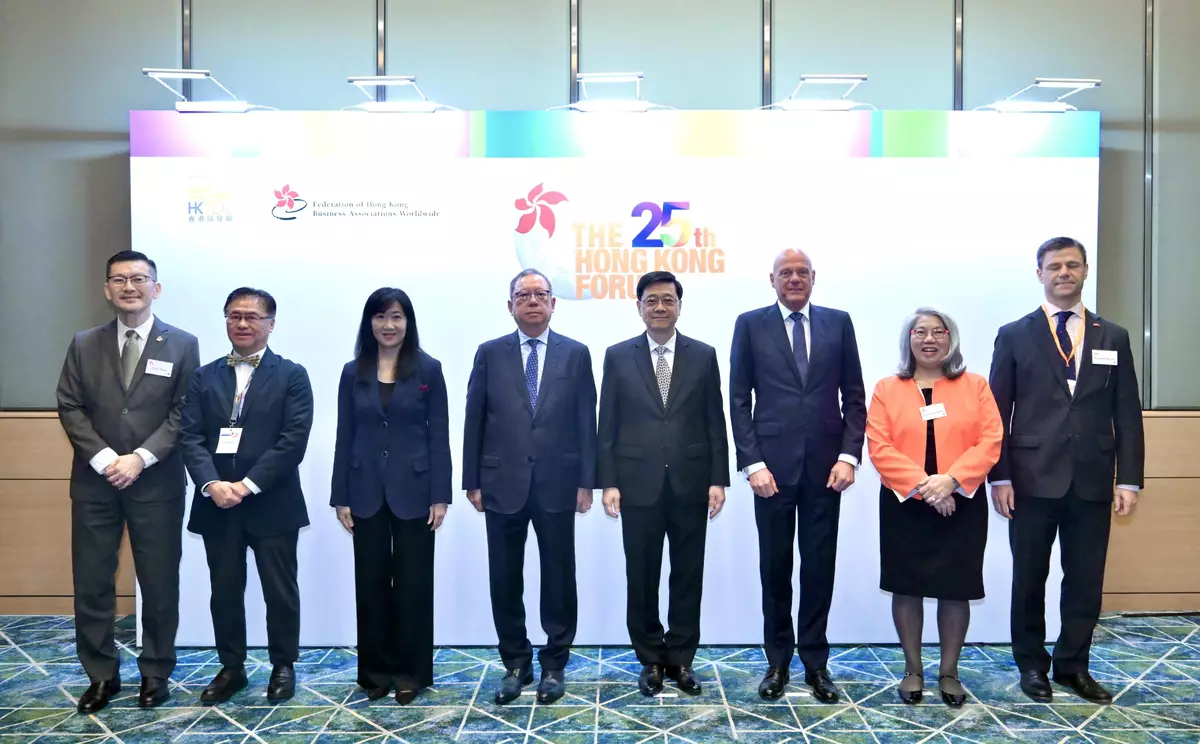
Speech by CE at 25th Hong Kong Forum Keynote Luncheon Source: HKSAR Government Press Releases
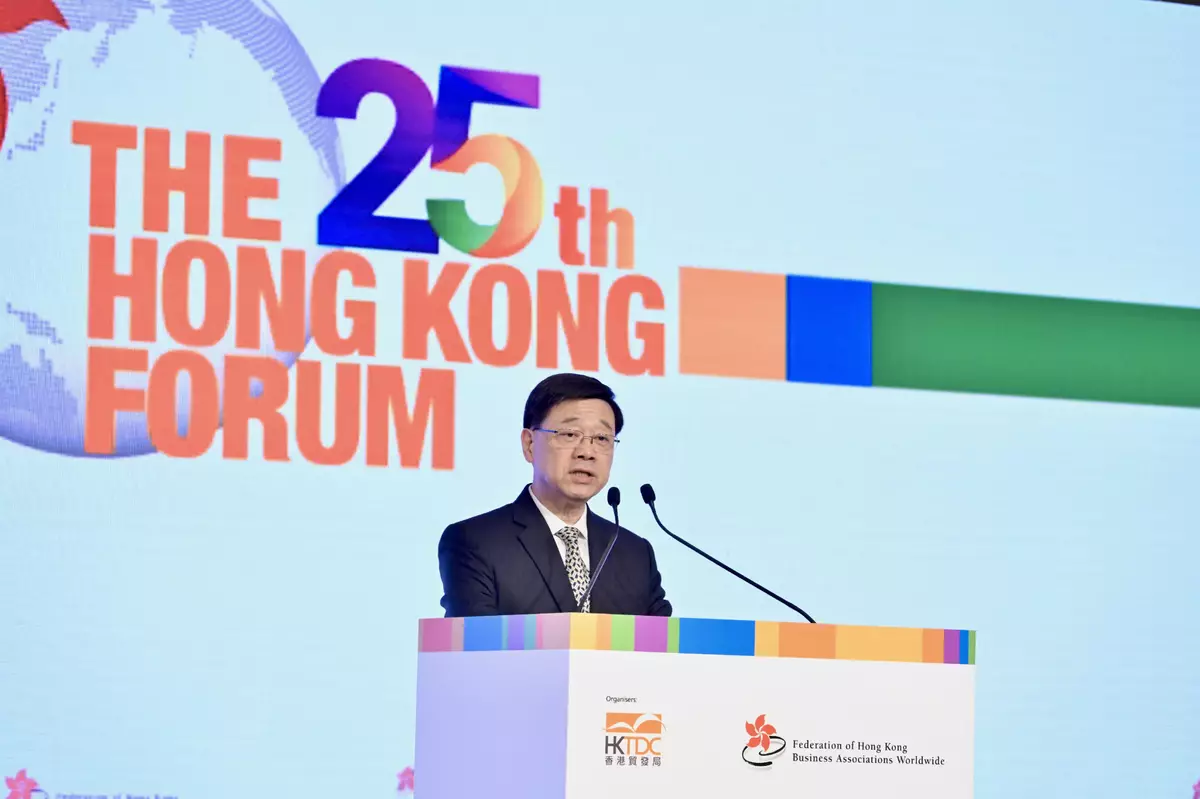
Speech by CE at 25th Hong Kong Forum Keynote Luncheon Source: HKSAR Government Press Releases