
Skip to Content Facebook Feature Image

Soros' Open Society Foundations say they remain focused on human rights

News

Soros' Open Society Foundations say they remain focused on human rights
News

News

Soros' Open Society Foundations say they remain focused on human rights

2024-12-11 04:09 Last Updated At:04:11

NEW YORK (AP) — Despite years of internal turmoil and changes, Open Society Foundations wants those in the human rights sector to know their movements will still receive support from the organization, its president Binaifer Nowrojee said Tuesday.

The foundations, founded by billionaire investor George Soros and now led by one of his sons, Alex Soros, have historically been one of the largest funders of human rights groups. But since 2021, they closed some of their programs and reduced their staff as part of a major internal reorganization.

In the process, many grantees and others in the human rights movement have waited anxiously to see where the chips would fall.

“A reimagination has taken place under the leadership of the new board chair at Open Society Foundations,” Nowrojee said, referring to Alex Soros.

“One of the reasons that we wanted to really reiterate in a large way, with balloons, et cetera, that we are still committed to human rights, is because of this fear that’s permeated with the changes that somehow Open Society Foundations is no longer going to be working on rights or equity or justice,” she said in advance of Human Rights Day, which the United Nations observes on Dec. 10.

Nowrojee offered few new details about OSF's specific funding priorities, though earlier this year, the foundations committed $400 million toward green jobs and economic development.

Another new program focuses on protecting environmental defenders that will work in a few countries, like Colombia and the Democratic Republic of Congo and end after five years, said Sharan Srinivas, a director of programs at OSF.

“We did a survey of what other donors are supporting and in general, we saw that this is where the gap is,” he said of people who come under attack for defending land, water or other resources. “Especially bilateral donors find it much easier to support global organizations, who in turn are able to support prominent rights defenders in capital cities who are well known.”

One benefit of the limited time horizon, Srinivas said, is his team will mostly make grants of three or five years — longer than OSF's typical grants — and offer grantees more flexibility. It will also have some funds to respond to emergencies for human rights defenders all over the world.

In 2020, OSF was the largest global human rights funder, giving out the most money overall and making the largest number of grants. That's according to the Human Rights Funders Network, a membership organization of grantmakers that tracks philanthropic funding for human rights groups.

“When major funders adjust their priorities, it can have a ripple effect. Their decisions can dramatically impact the human rights movements they once supported, especially in regions where they’ve been a long-time champion,” HRFN wrote in its most recent Advancing Human Rights report from September.

To add to the atmosphere of uncertainty, another major human rights funder, Wellspring Philanthropic Fund, announced earlier this year that it would end its work by 2028.

OSF's board aims to employ 600 people in total around the world, Nowrojee said, which is down from a reported 800 in 2021.

Some of the changes OSF made in the last three years include winding down its global public health program and significantly diminishing its programs in the European Union. It spun off its area of work focused on Roma communities into a new organization and issued final grants to many of its partners.

“You never want philanthropy to just be doing the same thing. You want philanthropy to be getting out of stuff,” Nowrojee said. “And so there’s large areas of work where huge achievements were made, which we have retreated from, not because we don’t think that there’s value in them, but the movements themselves have strengthened.”

People who worked for OSF's public health program and some of their grantees have spoken about its impacts over almost three decades through an oral history project led by University of Southern California Institute on Inequalities in Global Health and funded by OSF.

Jonathan Cohen, who led the OSF public health program and now holds positions at USC, told an interviewer with the oral history project about a decision in 2020 by OSF's leadership to take funding from its programs and reallocate it to respond to the COVID-19 pandemic.

“That claw-back in April should have been a sign, I think, to all of us that we were not long for this world,” Cohen said, of the public health program. "But of course, you don’t accept that. You fight. You resist. You try to keep your program, which is what we did until we couldn’t.”

Among the movements that OSF had supported under its public health program was the the Network of Sex Work Projects, a global coalition of sex worker groups. It formed in 1992 in part in response to the killing of sex workers living with HIV, said Ruth Morgan Thomas, who was NSWP's global coordinator for many years, as part of the oral history project. She said she was saddened to see the closure of OSF's public health work.

“I hope as it reemerges and its global strategy reemerges, it will retain its stance and support for promoting the realization of sex workers’ rights and inclusion in our societies,” she said.

Associated Press coverage of philanthropy and nonprofits receives support through the AP’s collaboration with The Conversation US, with funding from Lilly Endowment Inc. The AP is solely responsible for this content. For all of AP’s philanthropy coverage, visit https://apnews.com/hub/philanthropy.

FILE - George Soros, founder and chairman of the Open Society Foundations, attends the European Council on Foreign Relations Annual Council Meeting, May 29, 2018, in Paris. (AP Photo/Francois Mori, File)

FILE - George Soros, founder and chairman of the Open Society Foundations, attends the European Council on Foreign Relations Annual Council Meeting, May 29, 2018, in Paris. (AP Photo/Francois Mori, File)

SAN FRANCISCO & JACKSONVILLE, Fla.--(BUSINESS WIRE)--Jan 12, 2026--

Abridge, the leading enterprise-grade AI for clinical conversations, is collaborating with Availity, the nation’s largest real-time health information network, to launch a first-of-its kind prior authorization experience. The engagement uses cutting-edge technology grounded in the clinician-patient conversation to facilitate a more efficient process between clinicians and health plans in medical necessity review.

This press release features multimedia. View the full release here: https://www.businesswire.com/news/home/20260112960386/en/

Rather than creating parallel AI systems across healthcare stakeholders, Abridge and Availity are working together to ensure shared clinical context at the point of conversation powers administrative processes, such as prior authorization review and submission, improving outcomes for patients and the teams delivering care.

This collaboration unites two trusted and scaled organizations: combining Abridge’s enterprise-grade AI platform, serving over 200 health systems and projected to support over 80 million patient-clinician conversations in 2026, with Availity’s next-generation, FHIR-native Intelligent Utilization Management solution, which helps payers and providers digitize and operationalize coverage requirements within administrative workflows.

Availity’s FHIR-native APIs enable fast, scalable, and secure connectivity of payer information across the entire healthcare ecosystem. With Abridge’s Contextual Reasoning Engine technology, clinicians can gain visibility into relevant clinical information during the conversation to support documentation aligned with prior authorization requirements.

“At Availity, we’ve invested in building AI-powered, FHIR-native APIs designed to bring clinical policy logic directly into provider workflows,” said Russ Thomas, CEO of Availity. “By embedding our technology at the point of conversation, we’re enabling faster, more transparent utilization management decisions rooted in clinical context. We’re excited to collaborate with Abridge and to demonstrate what’s possible when payer intelligence meets real-time provider workflows.”

The development of real-time prior authorization is just a component of a broader revenue cycle collaboration that is focused on applying real-time conversational intelligence across the patient, provider, and payer experiences. The companies intend to support integration by collaborating on workflow alignment between their respective platforms in the following areas:

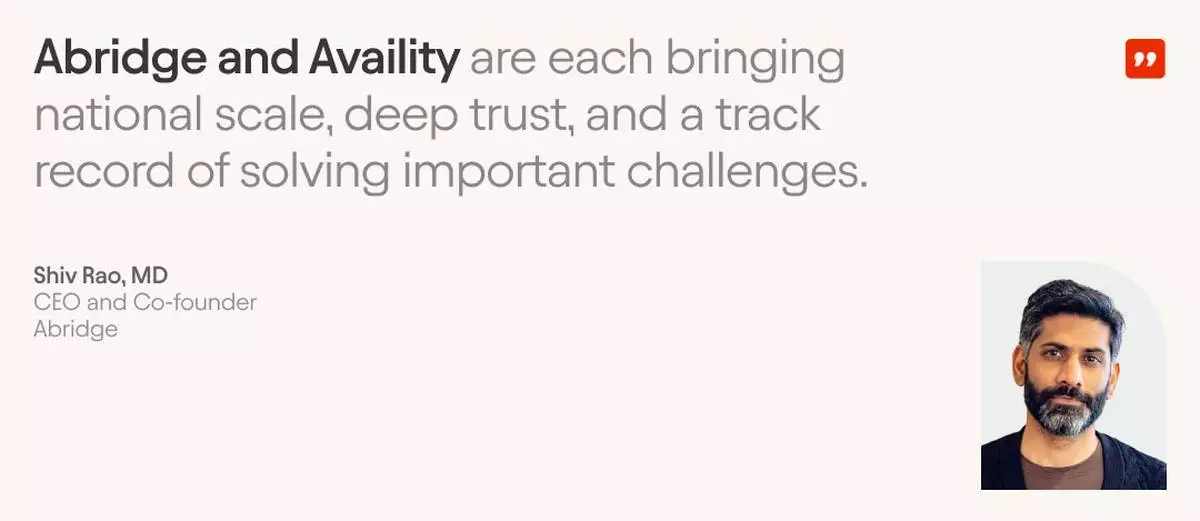
“Abridge and Availity are each bringing national scale, deep trust, and a track record of solving important challenges across the care and claims experience to this partnership,” said Dr. Shiv Rao, CEO and Co-Founder of Abridge. “We’re building real-time bridges between patients, providers, and payers, unlocking shared understanding, focused at the point of conversation.”

About Availity

Availity empowers payers and providers to deliver transformative patient experiences by enabling the seamless exchange of clinical, administrative, and financial information. As the nation's largest real-time health information network, Availity develops intelligent, automated, and interoperable solutions that foster collaboration and shared value across the healthcare ecosystem. With connections to over 95% of payers, more than 3 million providers, and over 2,000 trading partners, Availity provides mission-critical connectivity to drive the future of healthcare innovation. For more information, including an online demonstration, please visit www.availity.com or call 1.800.AVAILITY (282.4548). Follow us on LinkedIn.

About Abridge

Abridge was founded in 2018 to power deeper understanding in healthcare. Abridge is now trusted by more than 200 of the largest and most complex health systems in the U.S. The enterprise-grade AI platform transforms medical conversations into clinically useful and billable documentation at the point of care, reducing administrative burden and clinician burnout while improving patient experience. With deep EHR integration, support for 28+ languages, and 50+ specialties, Abridge is used across a wide range of care settings, including outpatient, emergency department, and inpatient.

Abridge’s enterprise-grade AI platform is purpose-built for healthcare. Supported by Linked Evidence, Abridge is the only solution that maps AI-generated summaries to source data, helping clinicians quickly trust and verify the output. As a pioneer in generative AI for healthcare, Abridge is setting the industry standard for the responsible deployment of AI across health systems.

Abridge was awarded Best in KLAS 2025 for Ambient AI in addition to other accolades, including Forbes 2025 AI 50 List, TIME Best Inventions of 2024, and Fortune’s 2024 AI 50 Innovators.

Abridge and Availity Collaborate to Redefine Payer-Provider Synergy at the Point of Conversation

Abridge and Availity Collaborate to Redefine Payer-Provider Synergy at the Point of Conversation

Abridge and Availity Collaborate to Redefine Payer-Provider Synergy at the Point of Conversation

Abridge and Availity Collaborate to Redefine Payer-Provider Synergy at the Point of Conversation

Recommended Articles