HOUSTON--(BUSINESS WIRE)--Dec 11, 2024--
Global energy technology company SLB (NYSE: SLB) today announced that it has been awarded, after a competitive tender, a new contract by Petrobras (NYSE: PBR) for integrated services across all offshore fields operated by Petrobras in Brazil. SLB will oversee the construction of more than 100 deepwater wells, utilizing advanced drilling, cementing and drilling fluids technologies on up to nine ultra-deepwater rigs.
This press release features multimedia. View the full release here: https://www.businesswire.com/news/home/20241211656672/en/
The services will primarily be provided in the Campos, Santos, and Espírito Santo Basins, along with other Petrobras-operated fields, including exploratory wells. Operations in the Equatorial Margin are also planned, pending exploration license approval within the three-year contract period commencing April 2025. Much of the technology and equipment to be deployed will be sourced locally.
“SLB has maintained a strong relationship with Petrobras as a technology partner for many decades,” said Wallace Pescarini, president of the Offshore Atlantic basin at SLB. “This contract builds on our existing work with Petrobras across its offshore basins and introduces new technologies that enhance both operational and environmental efficiency. Moreover, it aligns with our robust local content journey in Brazil and with our well distributed operational footprint across the country.”
Wllisses Menezes Afonso, executive manager of Wells at Petrobras said, "This investment of approximately $800 million will allow us to intensify our activities in several basins, revitalizing already productive fields and exploring new areas, with new technologies, with a focus on making our operations even safer and more efficient."
Technologies to be deployed under the contract include transition technologies such as SLB’s Ora™ intelligent wireline formation testing platform and SpectraSphere™ fluid mapping-while-drilling service. The Ora platform provides real-time reservoir characterization, minimizing risks and maximizing productivity while significantly reducing emissions. SpectraSphere provides accurate pressure measurements, performs downhole fluid analysis, and acquires high-quality samples while drilling, resulting in better steering decisions and optimized productivity.
About SLB
SLB (NYSE: SLB) is a global technology company that drives energy innovation for a balanced planet. With a global footprint in more than 100 countries and employees representing almost twice as many nationalities, we work each day on innovating oil and gas, delivering digital at scale, decarbonizing industries, and developing and scaling new energy systems that accelerate the energy transition. Find out more at slb.com.
Cautionary Statement Regarding Forward-Looking Statements:
This press release contains “forward-looking statements” within the meaning of the U.S. federal securities laws — that is, statements about the future, not about past events. Such statements often contain words such as “expect,” “may,” “can,” “estimate,” “intend,” “anticipate,” “will,” “potential,” “projected" and other similar words. Forward-looking statements address matters that are, to varying degrees, uncertain, such as forecasts or expectations regarding the deployment of, or anticipated benefits of, SLB’s new technologies and partnerships; statements about goals, plans and projections with respect to sustainability and environmental matters; forecasts or expectations regarding energy transition and global climate change; and improvements in operating procedures and technology. These statements are subject to risks and uncertainties, including, but not limited to, the inability to achieve net-negative carbon emissions goals; the inability to recognize intended benefits of SLB’s strategies, initiatives or partnerships; legislative and regulatory initiatives addressing environmental concerns, including initiatives addressing the impact of global climate change; the timing or receipt of regulatory approvals and permits; and other risks and uncertainties detailed in SLB’s most recent Forms 10-K, 10-Q and 8-K filed with or furnished to the U.S. Securities and Exchange Commission. If one or more of these or other risks or uncertainties materialize (or the consequences of such a development changes), or should underlying assumptions prove incorrect, actual outcomes may vary materially from those reflected in our forward-looking statements. The forward-looking statements speak only as of the date of this press release, and SLB disclaims any intention or obligation to update publicly or revise such statements, whether as a result of new information, future events or otherwise.
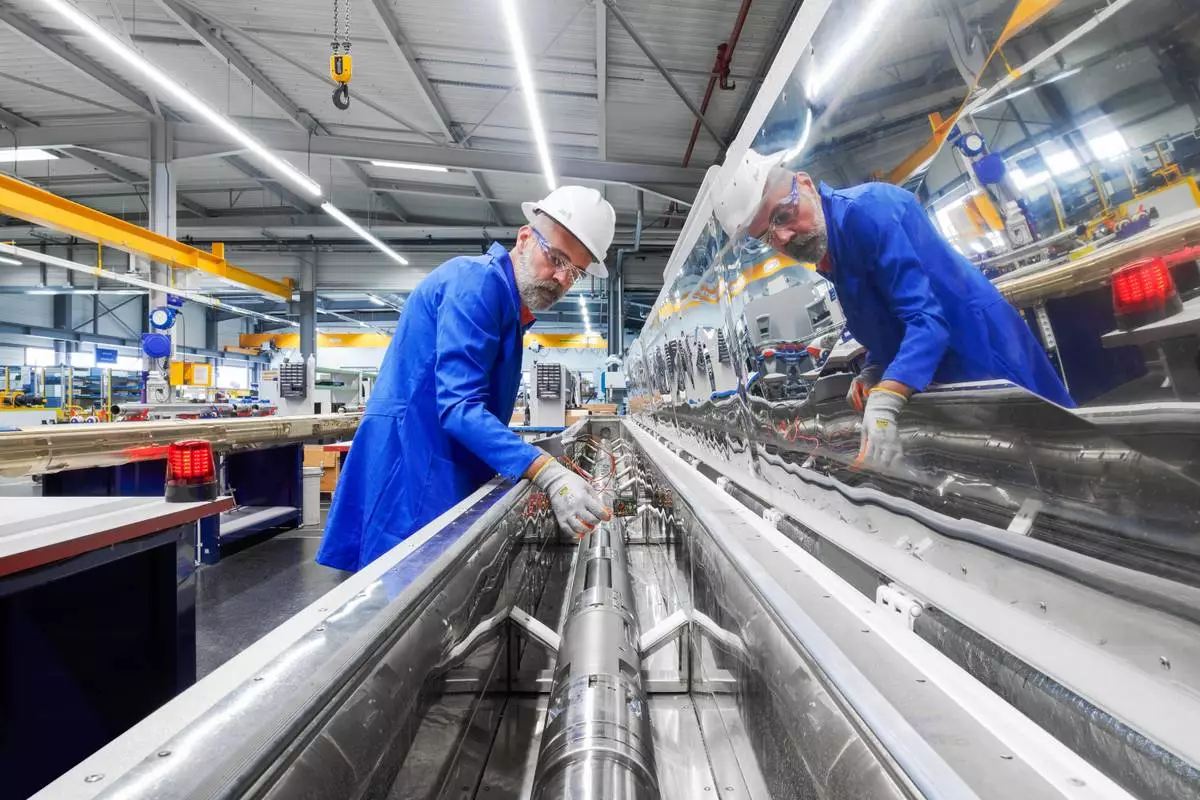
Technologies to be deployed under the contract include transition technologies such as SLB’s Ora™ intelligent wireline formation testing platform and SpectraSphere™ fluid mapping-while-drilling service. (Photo: Business Wire)

HOUSTON (AP) — Now more than halfway to the moon, the Artemis II astronauts prepared for their historic lunar fly-around to push deeper into space than even the Apollo astronauts.
On the downside, their toilet is on the blink again.
The three Americans and one Canadian are set to reach their destination Monday, photographing the mysterious lunar far side as they zoom around. It is the first moon-bound crew in more than 53 years, picking up where NASA’s Apollo program left off.
“The Earth is quite small, and the moon is definitely getting bigger,” pilot Victor Glover reported.
Until the Orion capsule's bathroom is fixed, Mission Control has instructed the astronauts to break out more of the backup urine collection bags. The so-called lunar loo malfunctioned following Wednesday’s liftoff and has been hit-and-miss ever since. A version of the Artemis II toilet was tested on the International Space Station several years ago.
Engineers suspect ice may be blocking the line that is preventing urine from completely flushing overboard. The toilet is still open for No. 2 business.
Debbie Korth, NASA’s Orion program deputy manager, said the astronauts have also reported a smell coming from the bathroom, which is buried in the floor of the capsule with a door and curtain for privacy.
“Space toilets and bathrooms are something everybody can understand .. it’s always a challenge,” she said, noting that the space shuttle toilet was also often on the fritz.
John Honeycutt, chair of the mission management team, said it is human nature to be interested in the space commode, and even though it is “in a good state right now,” he’d like it to be working at 100%.
“They’re OK,” he said of the astronauts. “They trained to manage through the situation.”
Artemis II is poised to set a distance record for humans, traveling more than 252,000 miles (400,000 kilometers) from Earth before hanging a U-turn behind the moon and heading home without stopping or entering lunar orbit. The record is currently held by Apollo 13.
The Canadian Space Agency celebrated the country’s role in the mission, speaking from Quebec with astronaut Jeremy Hansen as he headed toward his lunar rendezvous. Hansen is the first non-U.S. citizen to fly to the moon.
“Today he is making history for Canada,” Canadian Space Agency President Lisa Campbell said. “As we watch him taking this bold step into the unknown, let his journey remind us that Canada’s future is written by those who dare to reach for more.”
In the live televised linkup, Hansen said he has already witnessed “extraordinary” views from NASA's Orion capsule.
Hansen, Glover, Reid Wiseman and Christina Koch are the world's first lunar astronauts since Apollo 17's crew of three in 1972. Koch and Glover are the first female and first Black astronauts to the moon, respectively.
Their nearly 10-day mission — ending with a Pacific splashdown on April 10 — is the first step in NASA's bold plans for a sustainable moon base. The space agency is aiming for a landing by two astronauts near the lunar south pole in 2028.
The Associated Press Health and Science Department receives support from the Howard Hughes Medical Institute’s Department of Science Education and the Robert Wood Johnson Foundation. The AP is solely responsible for all content.
In this undated photo provided by NASA on Saturday, April 4, 20206, Commander Reid Wiseman looks at the Earth from a window aboard the Orion spacecraft Integrity during the Artemis II mission en route to the moon. (NASA via AP)
This photo provided by NASA shows the moon seen from the Orion spacecraft Integrity during the Artemis II mission on Friday, April 3, 2026. (NASA via AP)
This photo provided by NASA shows the exterior of the Orion spacecraft Integrity during the Artemis II mission en route to the moon on Friday, April 3, 2026. (NASA via AP)
In this photo provided by NASA, astronaut Christina Koch, background left, is illuminated by a screen inside the darkened Orion spacecraft Integrity on the third day of the Artemis II mission, Friday, April 3, 2026. At right, Canadian Space Agency astronaut Jeremy Hansen looks out of one of Orion's windows. (NASA via AP)
In this image from video provided by NASA, Artemis II astronauts, from left, Reid Wiseman, Jeremy Hansen, Christina Koch and Victor Glover gather for an interview en route to the moon on Saturday, April 4, 2026. (NASA via AP)
This image provided by the Canadian Space Agency, Artemis II astronaut Jeremy Hansen of Canada, connects live from the Orion spacecraft and speaks with Canadian media along with astronauts Victor Glover, left, and Reid Wiseman on Saturday, April 4, 2026. (Canadian Space Agency via AP)
This image from video provided by NASA shows the Artemis II crew Commander Reid Wiseman, second from left, thanking the families of the crew while speaking with NASA Mission Control in a video conference while en route to the moon, Thursday, April 2, 2026, as Canadian astronaut and mission specialist Jeremy Hansen, far left, looks on and mission specialist Christina Koch and pilot Victor Glover, far right, make hearts with their hands. (NASA via AP) CORRECTION: headed to the moon, not in moon's orbit
This image from video provided by NASA shows a view of earth taken by NASA astronaut and Artemis II Commander Reid Wiseman from one of the Orion spacecraft's four windows after completing the translunar injection burn, Thursday, April 2, 2026. (NASA via AP)