DAKAR, Senegal (AP) — When Nadege Anelka first came to the West African country of Benin from her home island of Martinique, a French overseas territory in the Caribbean, the 57-year-old travel agent said she had a feeling of deja vu.
“A lot of the people reminded me of my grandparents, the way they wore their headscarves, their mannerisms, their mentality,” she said.
Click to Gallery

FILE- A man paddles a canoe near a Voodoo sacred forest in Adjarra, Benin, on Wednesday, Oct. 4, 2023. (AP Photo/Sunday Alamba, File)

FILE - In this Nov. 17, 2011 file photo, a fisherman stands amidst city trash brought in by the tide, as he prepares to launch his fishing boat, in Cotonou, Benin. (AP Photo/Rebecca Blackwell, File)

FILE - In this Jan. 29, 2019 file photo, the flags of the nations of Benin and Togo, the west African homes of the survivors of the slave ship Clotilda, remain on display on a monument at what was the Africatown Welcome Center in Mobile, Ala. (AP Photo/Julie Bennett, File)

Nate Debos, known by his stage name NaTRILL Dizaster, left, who said he would apply for Benin citizenship, poses with Ay.Yon Michaels, right, of the rap duo Ayakashi Krewe inside an old school bus in New Orleans, Thursday, Dec. 5, 2024. (AP Photo/Gerald Herbert)

Nate Debos, known by his stage name NaTRILL Dizaster, who said he would apply for Benin citizenship, poses inside an old school bus in New Orleans, Thursday, Dec. 5, 2024. (AP Photo/Gerald Herbert)
Feeling at home in Benin, Anelka decided to settle there last July and open a travel agency. She hopes to become a citizen by taking advantage of a law passed in September that grants citizenship to those who can trace their lineage to the slave trade.
The new law, which was initiated by President Patrice Talon, who has been in office since 2016, is part of a broader effort by Benin to reckon with its own historical role in the slave trade.
The law is open to all over 18 who do not already hold other African citizenship and can provide proof that an ancestor was deported via the slave trade from anywhere in sub-Saharan Africa. Beninese authorities accept DNA tests, authenticated testimonies and family records.
Anelka used “Anchoukaj" ("Affiliation” in Antillean Creole), a website recognized by Benin to trace her heritage, proving that her ancestors were slaves in Martinique. If her application is successful, she will receive a provisional certificate of nationality valid for three years. To get citizenship, she'll be required to stay at least once in Benin during that period.
Benin is not the first country to grant citizenship to descendants of slaves. Earlier this month, Ghana naturalized 524 African Americans after the West African country’s president, Nana Akufo-Addo, invited them to “come home” in 2019, as part of the 400th anniversary of the arrival of the first enslaved Africans in North America in 1619.
But Benin’s citizenship law carries added significance, in part because of the role it played in the slave trade as one of the main points of departure.
European merchants deported an estimated 1.5 million slaves from the Bight of Benin, a territory that includes modern-day Benin and Togo and part of modern-day Nigeria, said Ana Lucia Araujo, a professor of history at Howard University who has spent years researching Benin’s role.
The coastal town of Ouidah was one of Africa’s most active slave-trading ports in the 18th and 19th centuries. Close to a million men, women and children were captured, chained and forced onto ships there, mainly destined for what would become the United States and Brazil and the Caribbean.
Benin has struggled to resolve its legacy of complicity. For over 200 years, powerful kings captured and sold slaves to Portuguese, French and British merchants.
The kingdoms still exist today as tribal networks, and so do the groups that were raided. Rumors that President Patrice Talon is a descendant of slave merchants sparked much debate while he was running for office in 2016. Talon has never publicly addressed the rumors.
Benin has openly acknowledged its role in the slave trade, a stance not shared by many other African nations that participated. In the 1990s, Benin hosted an international conference, sponsored by UNESCO, to examine how and where slaves were sold.
And in 1999, President Mathieu Kérékou fell to his knees whiling visiting a church in Baltimore and issued an apology to African Americans for Africa’s involvement in the slave trade.
Alongside this national reckoning, “memorial tourism” centered around the legacy of the slave trade has become a key strategy of Benin’s government to attract foreigners.
Memorial sites are mostly in Ouidah. They include the “Door of No Return,” which marks the point from which many enslaved people were shipped across the Atlantic, as well as the town’s history museum.
At the “Tree of Forgetfulness,” enslaved people were said to be symbolically forced to forget their past lives.
“Memories of the slave trade are present on both sides of the Atlantic, but only one of these sides is well known,” said Sindé Cheketé, the head of Benin’s state-run tourism agency.
Nate Debos, 37, an American musician living in New Orleans, learned about Benin's citizenship law while visiting for the Porto Novo mask festival. He had never been to West Africa before, but his interest in the Vodun religion led him there.
Debos is the president of an association called New Orleans National Vodou Day. It mirrors Benin’s Vodun Day, a national holiday on Jan. 10 with a festival in Ouidah celebrating Vodun, an official religion in Benin, practiced by at least a million people in the country.
It originated in the kingdom of Dahomey — in the south of present-day Benin — and revolves around the worship of spirits and ancestors through rituals and offerings. Slavery brought Vodun to the Americas and the Caribbean, where it became Vodou, a blend with Catholicism.
“Vodou is one of the chains that connects Africa to the Americas,” said Araujo, the professor. “For enslaved Africans, it was a way of resisting slavery.”
European colonial powers and slave owners sought to suppress African cultural and religious practices. Vodun was preserved through syncretism, as African deities and spirits were merged with or disguised as Catholic saints.
“Our African ancestors were not tribal savages, they had sophisticated cultures with very noble and beautiful spiritual practices," Debos said.
He now seeks to establish more partnerships with collectives practicing Vodun in Benin, which would require him to stay in the country for longer periods. He will apply for citizenship, but not with an intention to move there permanently.
“At the end of the day, I am an American, even when I am dressed in the wonderful fabrics and suits they have in Benin,” Debos said.
Anelka, the travel agent now living in Benin, said her motivations behind getting Beninese citizenship are mostly symbolic.
“I know I will never be completely Beninese. I will always be considered a foreigner” she said. “But I am doing this for my ancestors. It’s a way to reclaim my heritage, a way of getting reparation.”
The Associated Press receives financial support for global health and development coverage in Africa from the Gates Foundation. The AP is solely responsible for all content. Find AP’s standards for working with philanthropies, a list of supporters and funded coverage areas at AP.org.

FILE- A man paddles a canoe near a Voodoo sacred forest in Adjarra, Benin, on Wednesday, Oct. 4, 2023. (AP Photo/Sunday Alamba, File)

FILE - In this Nov. 17, 2011 file photo, a fisherman stands amidst city trash brought in by the tide, as he prepares to launch his fishing boat, in Cotonou, Benin. (AP Photo/Rebecca Blackwell, File)
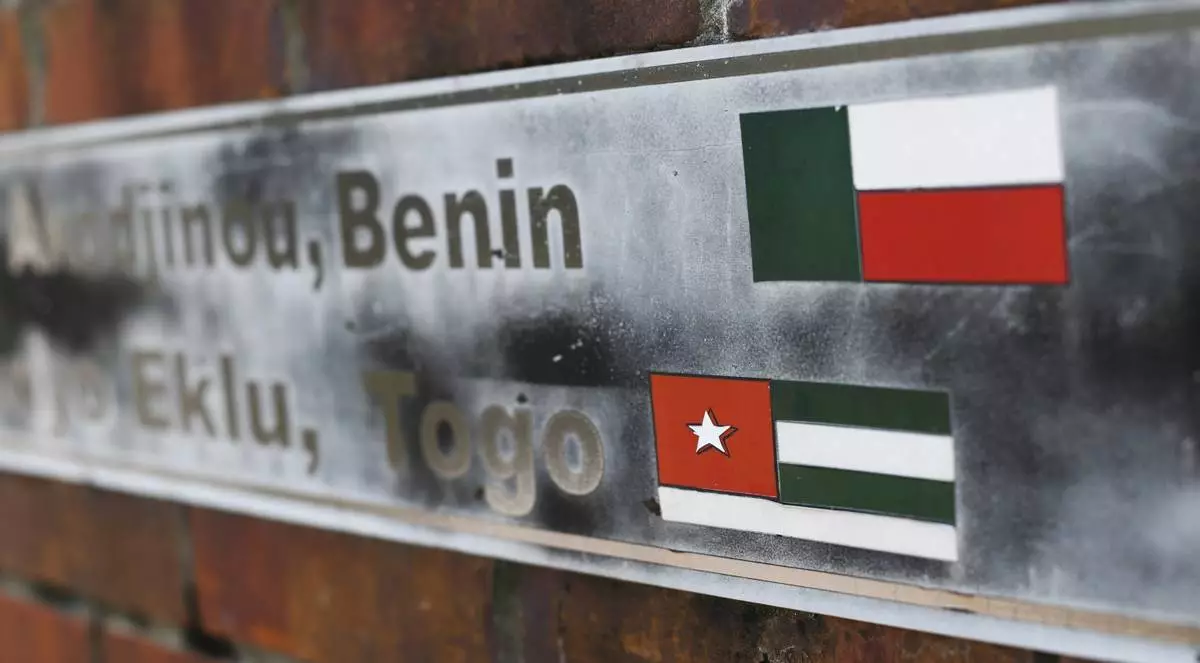
FILE - In this Jan. 29, 2019 file photo, the flags of the nations of Benin and Togo, the west African homes of the survivors of the slave ship Clotilda, remain on display on a monument at what was the Africatown Welcome Center in Mobile, Ala. (AP Photo/Julie Bennett, File)

Nate Debos, known by his stage name NaTRILL Dizaster, left, who said he would apply for Benin citizenship, poses with Ay.Yon Michaels, right, of the rap duo Ayakashi Krewe inside an old school bus in New Orleans, Thursday, Dec. 5, 2024. (AP Photo/Gerald Herbert)

Nate Debos, known by his stage name NaTRILL Dizaster, who said he would apply for Benin citizenship, poses inside an old school bus in New Orleans, Thursday, Dec. 5, 2024. (AP Photo/Gerald Herbert)