Few places in the world are as multifaceted as Macao, where diverse cultural and ethnic groups co-exist harmoniously in concentrated communities on a land area of slightly over 30 square kilometers.
The Historic Center of Macao, a world heritage site designated by the United Nations Educational, Scientific and Cultural Organization (UNESCO), offers a convincing testimony -- it bears witness to one of the earliest and longest-lasting encounters between China and the West.
"With its historic street, residential, religious and public Portuguese and Chinese buildings, the Historic Center of Macao provides a unique testimony to the meeting of aesthetic, cultural, architectural and technological influences from East and West. The site also contains a fortress and a lighthouse, the oldest in China," said the UNESCO.
The narrow and elongated area is dotted with historic buildings, from the A-Ma Temple dedicated to the sea-goddess Mazu, to the Mandarin's House -- the former residence of a prominent Chinese historical figure, and the landmark Ruins of St. Paul's, once among the largest Catholic churches in the Far East.
From Mazu and Jesus to the Buddha, their followers may live next door to each other, and their sacred worshiping spaces may be visible within sight.
Macao has become a world-renowned tourism destination, where Eastern and Western cultures have co-existed for over 400 years.
Today, Macao, as a Special Administrative Region of China, has taken on a new look with various street decorations in the run-up to the 25th anniversary of the region's return to China on December 20, 1999.
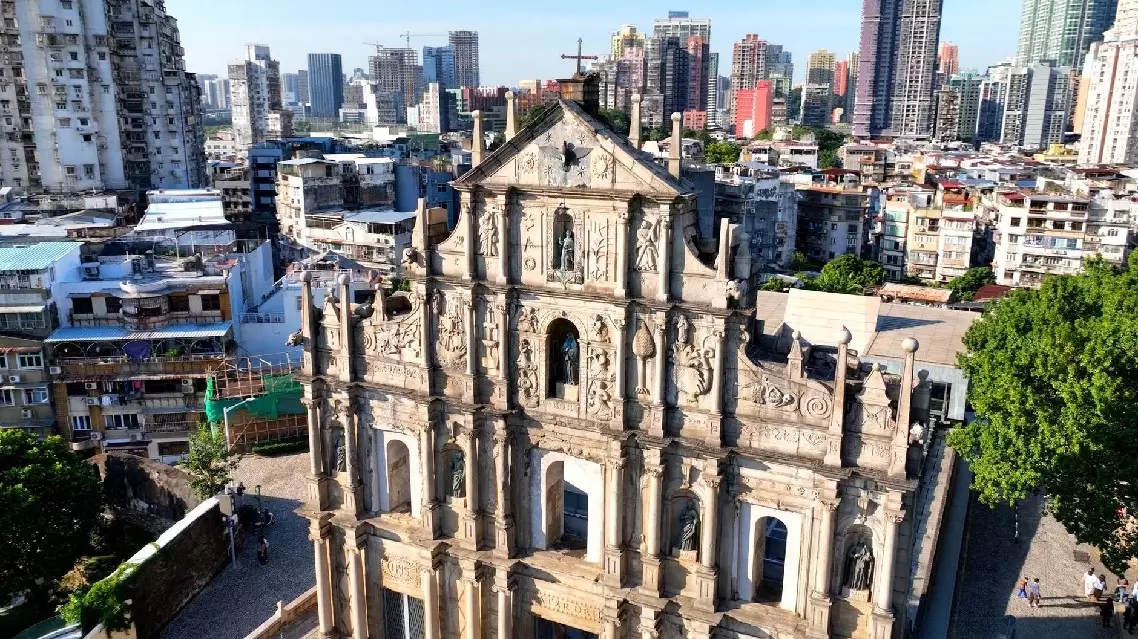
Witnessing blend of culture at Historic Center of Macao
The Global Security Initiative (GSI) proposed by China has shifted the paradigm in thinking about global security away from the traditional zero-sum mentality toward a vision rooted in dialogue and development, said a Chinese expert on Tuesday.
In April 2022, China proposed the Global Security Initiative (GSI), which aims to create a new path to security that prioritizes dialogue over confrontation, partnership over alliance, and win-win over zero-sum thinking.
The initiative provides a new course and approach to addressing the root causes of international conflicts and solving security challenges facing humanity.
During an interview with China Global Television Network (CGTN), Wang Xinsong, associate professor at the School of Government at Beijing Normal University, hailed the initiative's importance amid escalating global challenges.
"It's been four years and we have witnessed that the Global Security Initiative or GSI has transformed from a framework in principle to an action plan with many actions having taken place in mediating the conflicts. The major difference between the GSI and the traditional and the existing mainstream idea about global security is that the mainstream idea is being the zero-sum mentality where the belief is that one country's safety is possible only if its neighbors safety is not existent. The GSI shifts the paradigm in thinking about global security away from the zero-sum mentality by arguing that security at the end of the day is very much related to development," Wang said.
Over the past four years, China has consistently promoted the implementation of the GSI. By the end of 2025, the initiative has received support and appreciation from more than 130 countries and regions, as well as international organizations, and has been explicitly incorporated into more than 140 bilateral and multilateral documents at home and abroad.

China's Global Security Initiative shifts paradigm away from traditional zero-sum mentality: expert