BELLINGHAM, Wash.--(BUSINESS WIRE)--Dec 17, 2024--
SPIE, the international society for optics and photonics, and the IBM-HBCU Quantum Center have selected Patrick Flanigan, a principal investigator at North Carolina Central University (NCCU), as this year’s recipient of the IBM-SPIE HBCU Faculty Accelerator Award in Quantum Optics and Photonics.
This press release features multimedia. View the full release here: https://www.businesswire.com/news/home/20241217039072/en/
The $100,000 annual award, presented jointly by SPIE and the IBM-HBCU Quantum Center, supports and promotes research and education in quantum optics and photonics within IBM-HBCU Quantum Center member institutions, which currently includes 27 historically Black colleges and universities (HBCUs). The first three named faculty-award recipients were Renu Tripathi, a professor of physics and engineering at Delaware State University; Wesley Sims, an assistant professor of physics at Morehouse College; and a group project at Tuskegee University.
Flanigan’s project will explore how to significantly reduce the footprint of future photon-based quantum-computing and quantum-information systems, as well as enable the exploration of new physics that may emerge in the chip-scale system.
“Triple-resonance micro-ring resonators for on-chip entangled photon generation via spontaneous six-wave mixing (SSWM)” has a core quantum optics-and-photonics focus: The SSWM technique is used to produce a trio of quantum entangled photons by simultaneously exciting three energy transitions in a rubidium (Rb) atom. The goal of the project is to design nanophotonic components to miniaturize the platform for SSWM, which so far has been only achieved in free space on an optical table.
The award will also cover Flanigan’s official supervision and mentorship of an NCCU graduate student. In addition, Flanigan will be working with multiple colleagues. At NCCU, Professor Branislav Vlahovic will contribute his expertise on quantum computing and Professor Yongan Tang will share his expertise on electromagnetic simulations. The fabrication and experimentation of the triple-resonance micro-rings will be done by Professor Qing Gu of North Carolina State University. The foundational theory of entangled photon generation by SSWM was developed by Professor Jianming Wen of State University of New York at Binghamton.
“SPIE is particularly proud of our partnership with the IBM-HBCU Quantum Center and our shared support of quantum research programs at HBCUs,” said SPIE CEO Kent Rochford. “The impact of quantum science continues to grow, and we are very excited – especially as the project resulting from this award coincides with the United Nations-declared International Year of Quantum Science and Technology in 2025 – to support Patrick Flanigan in his and his colleagues’ efforts to further enhance the range and application of quantum-related research.”
“The IBM-SPIE HBCU Faculty Accelerator Award plays an important role in the IBM-HBCU Quantum Center’s overall effort to build an ecosystem for traditionally underrepresented students and professionals to be a part of the quantum industry,” said Dr. Kayla Lee, Global Lead, Ecosystem Growth at IBM Quantum. “Dr. Flanigan’s project is a perfect example of the cross-institution collaboration that makes the award and center a success — and pushes the industry forward.”
“Winning this award is a great honor, and I am very thankful to all my collaborators in and outside of NCCU for their help,” said Flanigan. “The physical mechanism underlying this project was experimentally demonstrated only a few months ago, so it is very exciting to be on the cutting-edge of quantum computing and quantum communications research. Winning this award will allow us to continue our work and expand by obtaining new equipment and taking on new students.”
For more on the IBM-SPIE HBCU Faculty Accelerator Award in Quantum Optics and Photonics, please visit our dedicated webpage.
About SPIE
SPIE, the international society for optics and photonics, brings engineers, scientists, students, and business professionals together to advance light-based science and technology. The Society, founded in 1955, connects and engages with our global constituency through industry-leading conferences and exhibitions; publications of conference proceedings, books, and journals in the SPIE Digital Library; and career-building opportunities. Over the past five years, we have invested more than $25 million in the international optics community through our advocacy and support, including scholarships, educational resources, travel grants, endowed gifts, and public-policy development. www.spie.org.

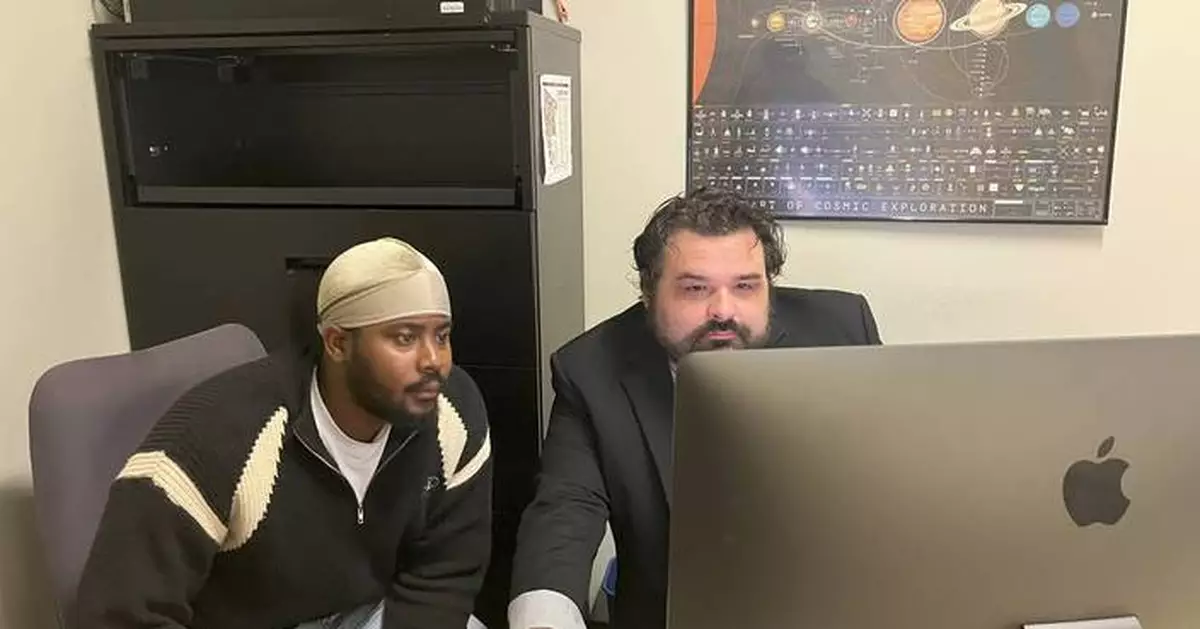
2024 IBM-SPIE HBCU Faculty Accelerator Award in Quantum Optics and Photonics recipient Patrick Flanigan, right, with student Joseph Nduka. (Photo: Business Wire)
NEW YORK (AP) — Reviving a campaign pledge, President Donald Trump wants a one-year, 10% cap on credit card interest rates, a move that could save Americans tens of billions of dollars but drew immediate opposition from an industry that has been in his corner.
Trump was not clear in his social media post Friday night whether a cap might take effect through executive action or legislation, though one Republican senator said he had spoken with the president and would work on a bill with his “full support.” Trump said he hoped it would be in place Jan. 20, one year after he took office.
Strong opposition is certain from Wall Street in addition to the credit card companies, which donated heavily to his 2024 campaign and have supported Trump's second-term agenda. Banks are making the argument that such a plan would most hurt poor people, at a time of economic concern, by curtailing or eliminating credit lines, driving them to high-cost alternatives like payday loans or pawnshops.
“We will no longer let the American Public be ripped off by Credit Card Companies that are charging Interest Rates of 20 to 30%,” Trump wrote on his Truth Social platform.
Researchers who studied Trump’s campaign pledge after it was first announced found that Americans would save roughly $100 billion in interest a year if credit card rates were capped at 10%. The same researchers found that while the credit card industry would take a major hit, it would still be profitable, although credit card rewards and other perks might be scaled back.
About 195 million people in the United States had credit cards in 2024 and were assessed $160 billion in interest charges, the Consumer Financial Protection Bureau says. Americans are now carrying more credit card debt than ever, to the tune of about $1.23 trillion, according to figures from the New York Federal Reserve for the third quarter last year.
Further, Americans are paying, on average, between 19.65% and 21.5% in interest on credit cards according to the Federal Reserve and other industry tracking sources. That has come down in the past year as the central bank lowered benchmark rates, but is near the highs since federal regulators started tracking credit card rates in the mid-1990s. That’s significantly higher than a decade ago, when the average credit card interest rate was roughly 12%.
The Republican administration has proved particularly friendly until now to the credit card industry.
Capital One got little resistance from the White House when it finalized its purchase and merger with Discover Financial in early 2025, a deal that created the nation’s largest credit card company. The Consumer Financial Protection Bureau, which is largely tasked with going after credit card companies for alleged wrongdoing, has been largely nonfunctional since Trump took office.
In a joint statement, the banking industry was opposed to Trump's proposal.
“If enacted, this cap would only drive consumers toward less regulated, more costly alternatives," the American Bankers Association and allied groups said.
Bank lobbyists have long argued that lowering interest rates on their credit card products would require the banks to lend less to high-risk borrowers. When Congress enacted a cap on the fee that stores pay large banks when customers use a debit card, banks responded by removing all rewards and perks from those cards. Debit card rewards only recently have trickled back into consumers' hands. For example, United Airlines now has a debit card that gives miles with purchases.
The U.S. already places interest rate caps on some financial products and for some demographics. The Military Lending Act makes it illegal to charge active-duty service members more than 36% for any financial product. The national regulator for credit unions has capped interest rates on credit union credit cards at 18%.
Credit card companies earn three streams of revenue from their products: fees charged to merchants, fees charged to customers and the interest charged on balances. The argument from some researchers and left-leaning policymakers is that the banks earn enough revenue from merchants to keep them profitable if interest rates were capped.
"A 10% credit card interest cap would save Americans $100 billion a year without causing massive account closures, as banks claim. That’s because the few large banks that dominate the credit card market are making absolutely massive profits on customers at all income levels," said Brian Shearer, director of competition and regulatory policy at the Vanderbilt Policy Accelerator, who wrote the research on the industry's impact of Trump's proposal last year.
There are some historic examples that interest rate caps do cut off the less creditworthy to financial products because banks are not able to price risk correctly. Arkansas has a strictly enforced interest rate cap of 17% and evidence points to the poor and less creditworthy being cut out of consumer credit markets in the state. Shearer's research showed that an interest rate cap of 10% would likely result in banks lending less to those with credit scores below 600.
The White House did not respond to questions about how the president seeks to cap the rate or whether he has spoken with credit card companies about the idea.
Sen. Roger Marshall, R-Kan., who said he talked with Trump on Friday night, said the effort is meant to “lower costs for American families and to reign in greedy credit card companies who have been ripping off hardworking Americans for too long."
Legislation in both the House and the Senate would do what Trump is seeking.
Sens. Bernie Sanders, I-Vt., and Josh Hawley, R-Mo., released a plan in February that would immediately cap interest rates at 10% for five years, hoping to use Trump’s campaign promise to build momentum for their measure.
Hours before Trump's post, Sanders said that the president, rather than working to cap interest rates, had taken steps to deregulate big banks that allowed them to charge much higher credit card fees.
Reps. Alexandria Ocasio-Cortez, D-N.Y., and Anna Paulina Luna, R-Fla., have proposed similar legislation. Ocasio-Cortez is a frequent political target of Trump, while Luna is a close ally of the president.
Seung Min Kim reported from West Palm Beach, Fla.
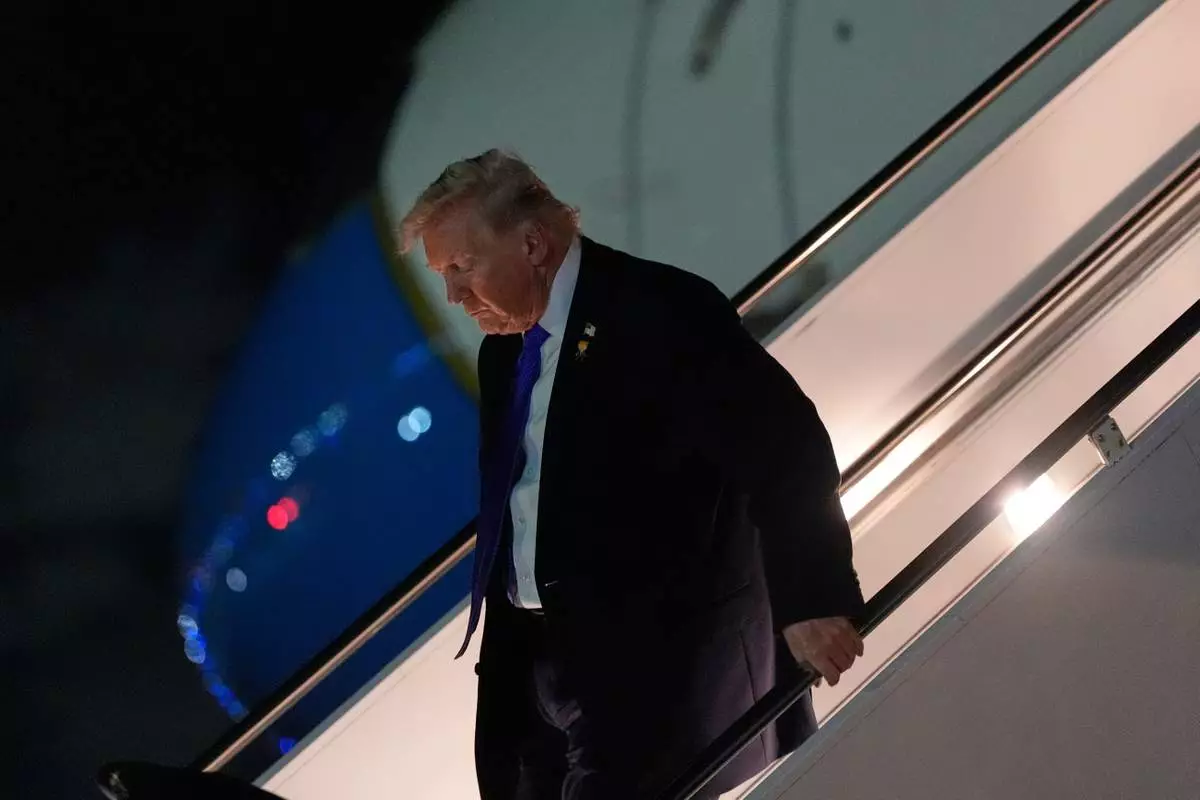
President Donald Trump arrives on Air Force One at Palm Beach International Airport, Friday, Jan. 9, 2025, in West Palm Beach, Fla. (AP Photo/Julia Demaree Nikhinson)
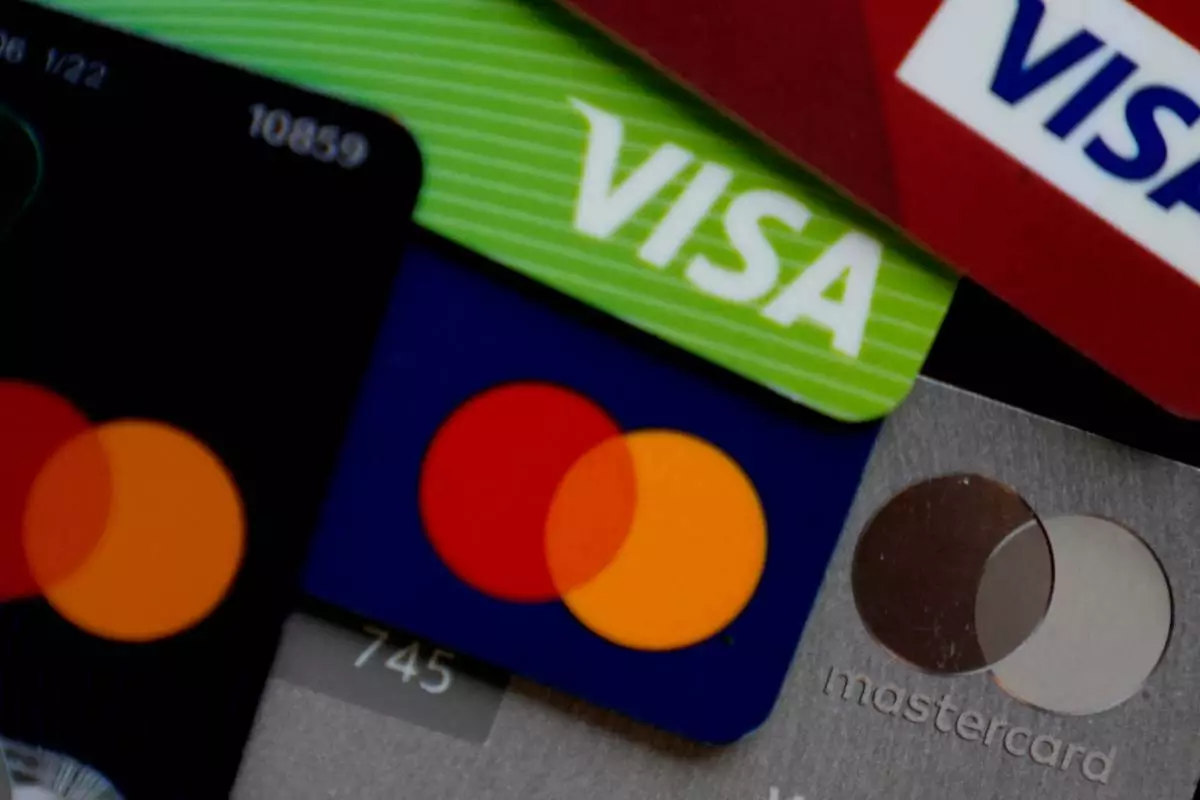
FILE - Visa and Mastercard credit cards are shown in Buffalo Grove, Ill., Feb. 8, 2024. (AP Photo/Nam Y. Huh, File)