ST. MORITZ, Switzerland (AP) — How fast can she go on her titanium knee? And how competitive will she be?
Those are the big questions surrounding Lindsey Vonn’s comeback to World Cup ski racing this weekend at age 40 after nearly six years of retirement.
Click to Gallery
Forerunner Lindsey Vonn skis before a women's World Cup super-G ski race, Sunday, Dec. 15, 2024, in Beaver Creek, Colo. (AP Photo/Robert F. Bukaty)
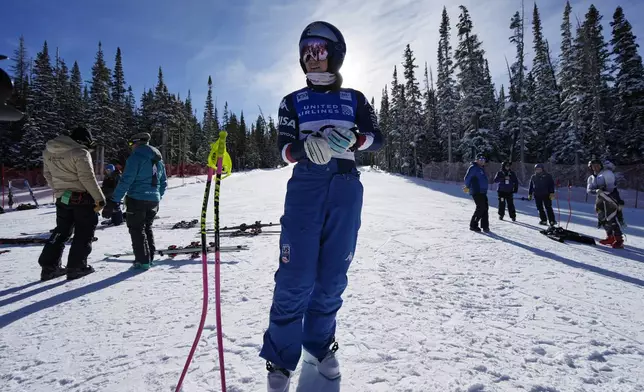
Lindsey Vonn prepares to be a forerunner at a women's World Cup downhill training run, Wednesday, Dec. 11, 2024, in Beaver Creek, Colo. (AP Photo/John Locher)
Lindsey Vonn prepares to be a forerunner at a women's World Cup downhill training run, Wednesday, Dec. 11, 2024, in Beaver Creek. (AP Photo/John Locher)
Lindsey Vonn watches the other racers after her first downhill forerun on the Birds of Prey at the World Cup skiing event, Wednesday, Dec. 11, in Beaver Creek, Colo. (Chris Dillmann/Vail Daily via AP)
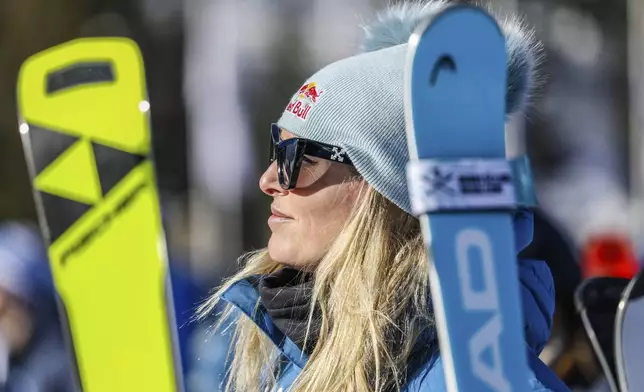
Lindsey Vonn talks with fans after racing at Copper Mountain Ski Resort, Sunday, Dec. 8, 2024, in Copper Mountain, Colo. (AP Photo/Robert F. Bukaty)
Forerunner Lindsey Vonn, of the United States, skis down the course before the training runs at the women's World Cup downhill race, Thursday, Dec. 12, 2024, in Beaver Creek, Colo. (AP Photo/Robert F. Bukaty)
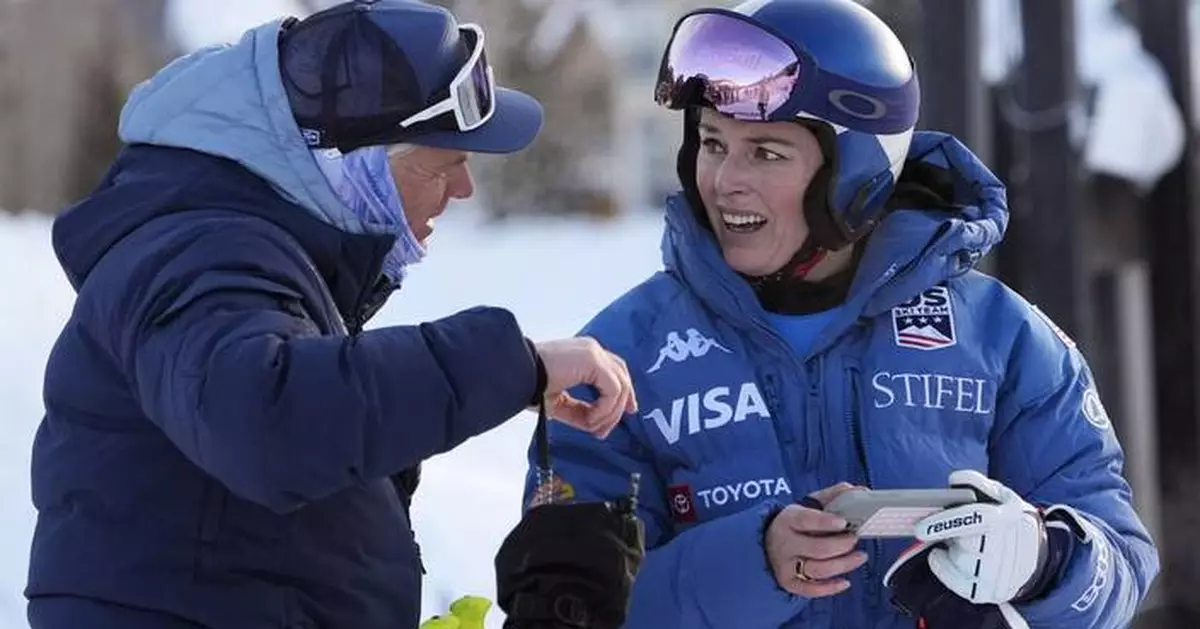
Lindsey Vonn talks with a coach after competing in a Super G skiing race at Copper Mountain Ski Resort, Sunday, Dec. 8, 2024, in Copper Mountain, Colo. (AP Photo/Robert F. Bukaty)
“It’s a question that’s been going through my head a lot over the last week,” said Chris Knight, Vonn’s personal coach. “She’s not far away.”
Vonn is slated to race super-Gs on Saturday and Sunday in St. Moritz.
While Vonn has won a record 28 World Cup super-Gs, including three at the Swiss resort, calculating her current potential is not an exact science.
During two lower-level FIS super-G races in Copper Mountain, Colorado, two weeks ago, she finished 24th and 19th. Although not too much should be read into those results, because Vonn’s main goal was just completing the race with a half-decent time to gain the necessary qualifying points to return to the World Cup — which she accomplished.
A better guide might be last weekend’s World Cup races in Beaver Creek, Colorado, when Vonn was the final forerunner testing the course.
Knight said that Vonn’s forerunning times were 1.2 seconds behind downhill winner Cornelia Huetter and 1.4 behind super-G winner Sofia Goggia — which would have placed her about 12th in both races.
But Vonn said she wasn’t going 100% during her forerunning duties.
“She’s still got a lot left. She can push a lot harder,” Knight told The Associated Press as he arrived in St. Moritz. “Once she gets in the start gate with the bib on, she’s going to go obviously as hard as she can.”
Under a new wild card rule for former champions, Vonn will start after the top 30 ranked racers complete their runs — with No. 31.
The Engiadina course in St. Moritz is entirely above the tree line, which makes it susceptible to strong and sudden gusts of wind.
“Maybe starting No. 31 won’t be so bad with those long flats at the top, to get some of that fresh snow off the track. Speed it up a little bit,” Knight said.
Sun is forecast for Saturday, with overcast conditions and possibly some snow on Sunday.
By the time Vonn comes down, Goggia, Olympic champion Lara Gut-Behrami and the other top racers will have already raced.
Mikaela Shiffrin, who shares the record of five wins in St. Moritz across all disciplines with Vonn, isn’t racing this weekend as she recovers from abdominal surgery to clean out a puncture wound she sustained in a crash last month.
Vonn left the tour with 82 World Cup wins — the record for a woman at the time and within reach of the then all-time Alpine mark of 86 held by Swedish standout Ingemar Stenmark. The women’s record held by Vonn was eclipsed in January 2023 by Shiffrin, who now has an outright record 99 wins.
Vonn’s last big race was the downhill at the world championships in Are, Sweden, in February 2019 when she won bronze on her damaged legs, which had been worn down by a series of crashes and injuries that forced her to retire.
But she underwent replacement surgery on her right knee in April and is feeling better physically now than she has in years.
“She’s in way, way better balance than she was back then,” Knight said. “This knee is in incredible shape now. She has no swelling, no pain. And for the first three camps — July, September and November, I never saw out of balance once, which is pretty impressive.”
Knight, who also coached Vonn within the U.S. Ski Team during various phases of her earlier career, first heard rumblings about her return a year ago. Then in May as Vonn was healing from the surgery, they drew out a comeback plan with Knight in his new role as a Red Bull coach. She first hit the snow on the glacier in Soelden, Austria, in July. Then they went to New Zealand, back to Soelden and ultimately finished the prep period in Colorado.
“She’s a better skier right now. A better balanced skier than I remember at the end of her last season,” Knight said. “You’ll see it when you start watching.”
“The boots are new — it’s a completely different model,” Vonn said. “Those things are the fine details that you need to have dialed in to really be at the top of ski racing. Fundamentally I’m in a great place, and now it’s just fine tuning to be able to be truly competitive.”
Vonn’s longtime ski technician Heinz Haemmerle retired, so her equipment supplier Head assigned her Chris Krause, who formerly worked for Didier Cuche and Bode Miller.
“He’s very, very particular with the equipment,” Knight said. “And Lindsey really likes that.”
AP skiing: https://apnews.com/hub/alpine

Forerunner Lindsey Vonn skis before a women's World Cup super-G ski race, Sunday, Dec. 15, 2024, in Beaver Creek, Colo. (AP Photo/Robert F. Bukaty)
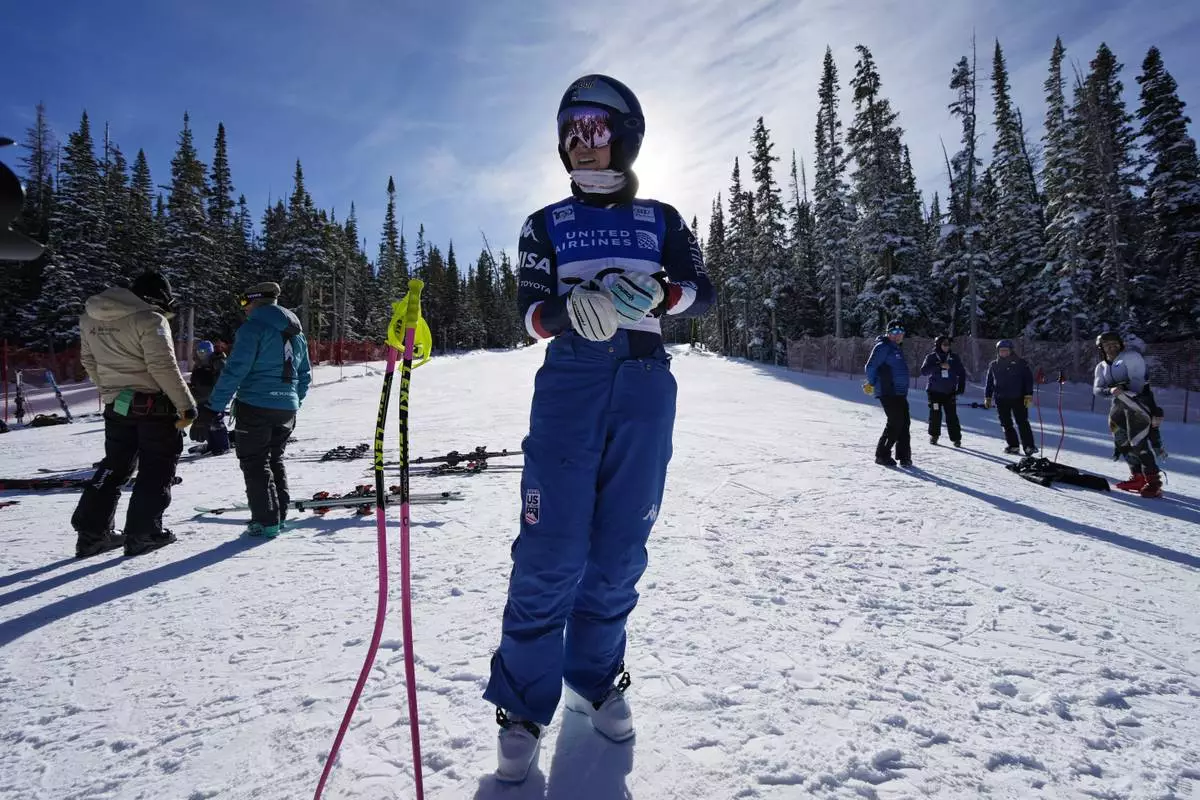
Lindsey Vonn prepares to be a forerunner at a women's World Cup downhill training run, Wednesday, Dec. 11, 2024, in Beaver Creek, Colo. (AP Photo/John Locher)

Lindsey Vonn prepares to be a forerunner at a women's World Cup downhill training run, Wednesday, Dec. 11, 2024, in Beaver Creek. (AP Photo/John Locher)

Lindsey Vonn watches the other racers after her first downhill forerun on the Birds of Prey at the World Cup skiing event, Wednesday, Dec. 11, in Beaver Creek, Colo. (Chris Dillmann/Vail Daily via AP)

Lindsey Vonn talks with fans after racing at Copper Mountain Ski Resort, Sunday, Dec. 8, 2024, in Copper Mountain, Colo. (AP Photo/Robert F. Bukaty)

Forerunner Lindsey Vonn, of the United States, skis down the course before the training runs at the women's World Cup downhill race, Thursday, Dec. 12, 2024, in Beaver Creek, Colo. (AP Photo/Robert F. Bukaty)

Lindsey Vonn talks with a coach after competing in a Super G skiing race at Copper Mountain Ski Resort, Sunday, Dec. 8, 2024, in Copper Mountain, Colo. (AP Photo/Robert F. Bukaty)
CARACAS, Venezuela (AP) — At the White House, President Donald Trump vows American intervention in Venezuela will pour billions of dollars into the country’s infrastructure, revive its once-thriving oil industry and eventually deliver a new age of prosperity to the Latin American nation.
Here at a sprawling street market in the capital, though, utility worker Ana Calderón simply wishes she could afford the ingredients to make a pot of soup.
“Food is incredibly expensive,” says Calderón, noting rapidly rising prices that have celery selling for twice as much as just a few weeks ago and a kilogram (2 pounds) of meat going for more than $10, or 25 times the country’s monthly minimum wage. “Everything is so expensive.”
Venezuelans digesting news of the United States’ brazen capture of former President Nicolás Maduro are hearing grandiose promises of future economic prowess even as they live through the crippling economic realities of today.
“They know that the outlook has significantly changed but they don’t see it yet on the ground. What they’re seeing is repression. They’re seeing a lot of confusion,” says Luisa Palacios, a Venezuelan-born economist and former oil executive who is a research scholar at the Center on Global Energy Policy at Columbia University. “People are hopeful and expecting that things are going to change but that doesn’t mean that things are going to change right now.”
Whatever hope exists over the possibility of U.S. involvement improving Venezuela’s economy is paired with the crushing daily truths most here live. People typically work two, three or more jobs just to survive, and still cupboards and refrigerators are nearly bare. Children go to bed early to avoid the pang of hunger; parents choose between filling a prescription and buying groceries. An estimated eight in 10 people live in poverty.
It has led millions to flee the country for elsewhere.
Those who remain are concentrated in Venezuela’s cities, including its capital, Caracas, where the street market in the Catia neighborhood once was so busy that shoppers bumped into one another and dodged oncoming traffic. But as prices have climbed in recent days, locals have increasingly stayed away from the market stalls, reducing the chaos to a relative hush.
Neila Roa, carrying her 5-month-old baby, sells packs of cigarettes to passersby, having to monitor daily fluctuations in currency to adjust the price.
“Inflation and more inflation and devaluation,” Roa says. “It’s out of control.”
Roa could not believe the news of Maduro’s capture. Now, she wonders what will come of it. She thinks it would take “a miracle” to fix Venezuela’s economy.
“What we don’t know is whether the change is for better or for worse,” she says. “We’re in a state of uncertainty. We have to see how good it can be, and how much it can contribute to our lives.”
Trump has said the U.S. will distribute some of the proceeds from the sale of Venezuelan oil back to its population. But that commitment so far largely appears to be focused on America’s interests in extracting more oil from Venezuela, selling more U.S.-made goods to the country and repairing the electricity grid.
The White House is hosting a meeting Friday with U.S. oil company executives to discuss Venezuela, which the Trump administration has been pressuring to open its vast-but-struggling oil industry more widely to American investment and know-how. In an interview with The New York Times, Trump acknowledged that reviving the country’s oil industry would take years.
“The oil will take a while,” he said.
Venezuela has the world's largest proven oil reserves. The country's economy depends on them.
Maduro's predecessor, the fiery Hugo Chávez, elected in 1998, expanded social services, including housing and education, thanks to the country’s oil bonanza, which generated revenues estimated at some $981 billion between 1999 and 2011 as crude prices soared. But corruption, a decline in oil production and economic policies led to a crisis that became evident in 2012.
Chávez appointed Maduro as his successor before dying of cancer in 2013. The country’s political, social and economic crisis, entangled with plummeting oil production and prices, marked the entirety of Maduro's presidency. Millions were pushed into poverty. The middle class virtually disappeared. And more than 7.7 million people left their homeland.
Albert Williams, an economist at Nova Southeastern University, says returning the energy sector to its heyday would have a dramatic spillover effect in a country in which oil is the dominant industry, sparking the opening of restaurants, stores and other businesses. What's unknown, he says, is whether such a revitalization happens, how long it would take and how a government built by Maduro will adjust to the change in power.
“That’s the billion-dollar question,” Williams says. “But if you improve the oil industry, you improve the country.”
The International Monetary Fund estimates Venezuela’s inflation rate is a staggering 682%, the highest of any country for which it has data. That has sent the cost of food beyond what many can afford. Venezuela’s monthly minimum wage of 130 bolivars, or $0.40, has not increased since 2022, putting it well below the United Nations’ measure of extreme poverty of $2.15 a day.
The currency crisis led Maduro to declare an “economic emergency” in April.
Usha Haley, a Wichita State University economist who studies emerging markets, says for those hurting the most, there is no immediate sign of change.
“Short-term, most Venezuelans will probably not feel any economic relief,” she says. “A single oil sale will not fix the country’s rampant inflation and currency collapse. Jobs, prices, and exchange rates will probably not shift quickly.”
In a country that has seen as much strife as Venezuela has in recent years, locals are accustomed to doing what they have to in order to get through the day, so much so that many utter the same expression
“Resolver,” they say in Spanish, or “figure it out," shorthand for the jury-rigged nature of life here, in which every transaction, from boarding a bus to buying a child's medicine, involves a delicate calculation.
Here at the market, the smell of fish, fresh onions and car exhaust combine. Calderon, making her way through, faces freshly skyrocketing prices, saying “the difference is huge,” as the country’s official currency has rapidly declined against its unofficial one, the U.S. dollar.
Unable to afford all the ingredients for her soup, she left with a bunch of celery but no meat.
Sedensky reported from New York. Associated Press writer Josh Boak in Washington contributed to this report.
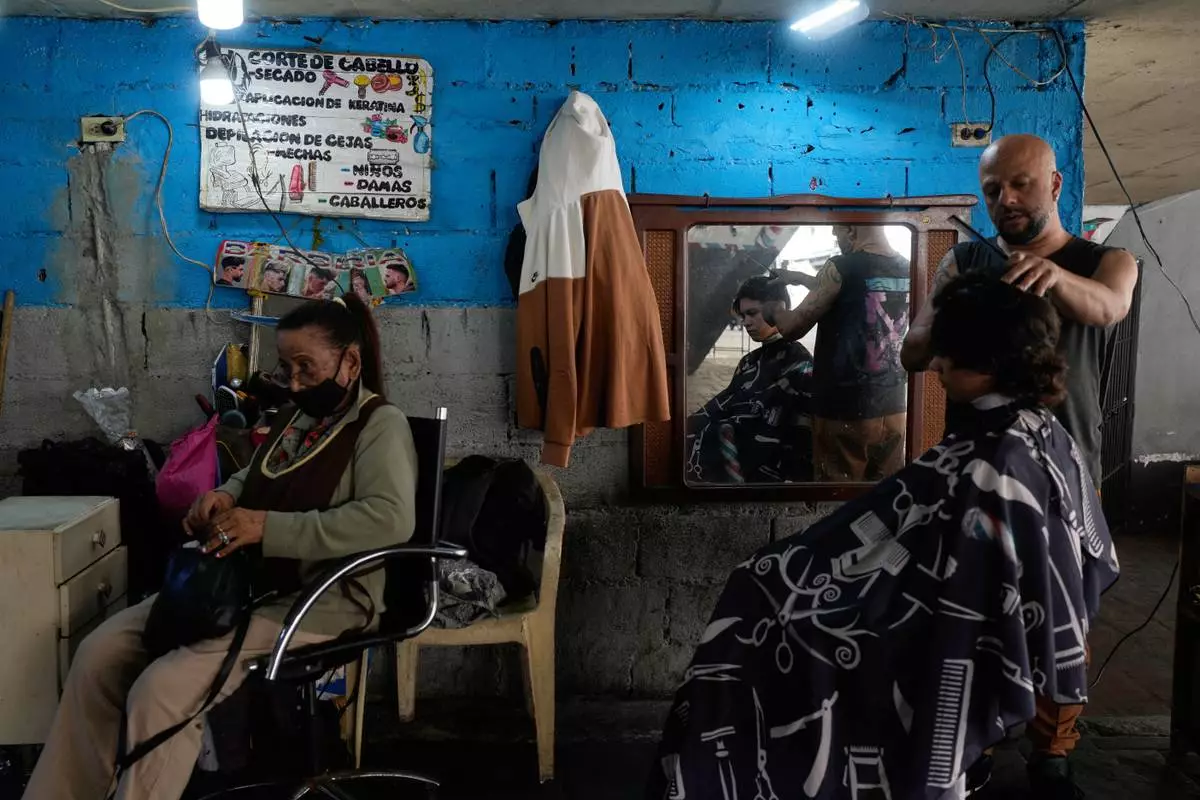
A barber cuts hair at a barbershop in Caracas, Venezuela, Tuesday, Jan. 6, 2026. (AP Photo/Matias Delacroix)
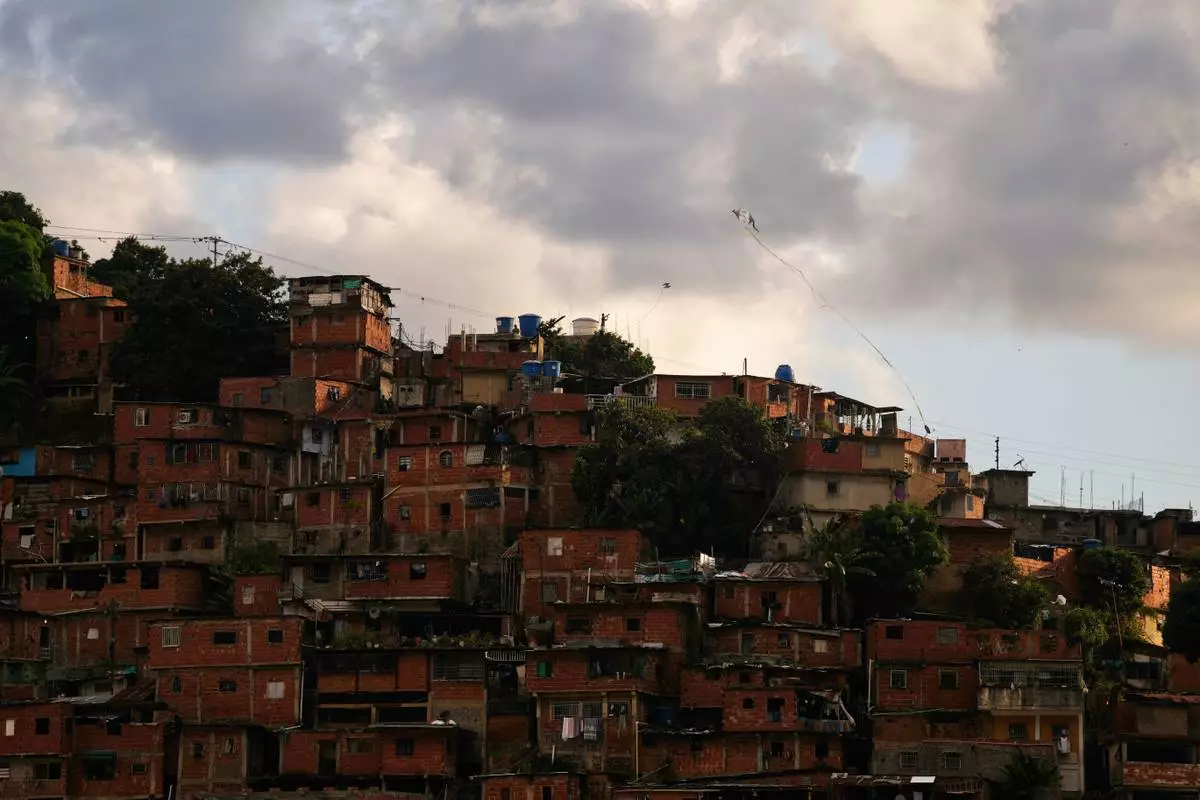
A kite flies over the Petare neighborhood of Caracas, Venezuela, Wednesday, Jan. 7, 2026. (AP Photo/Matias Delacroix)
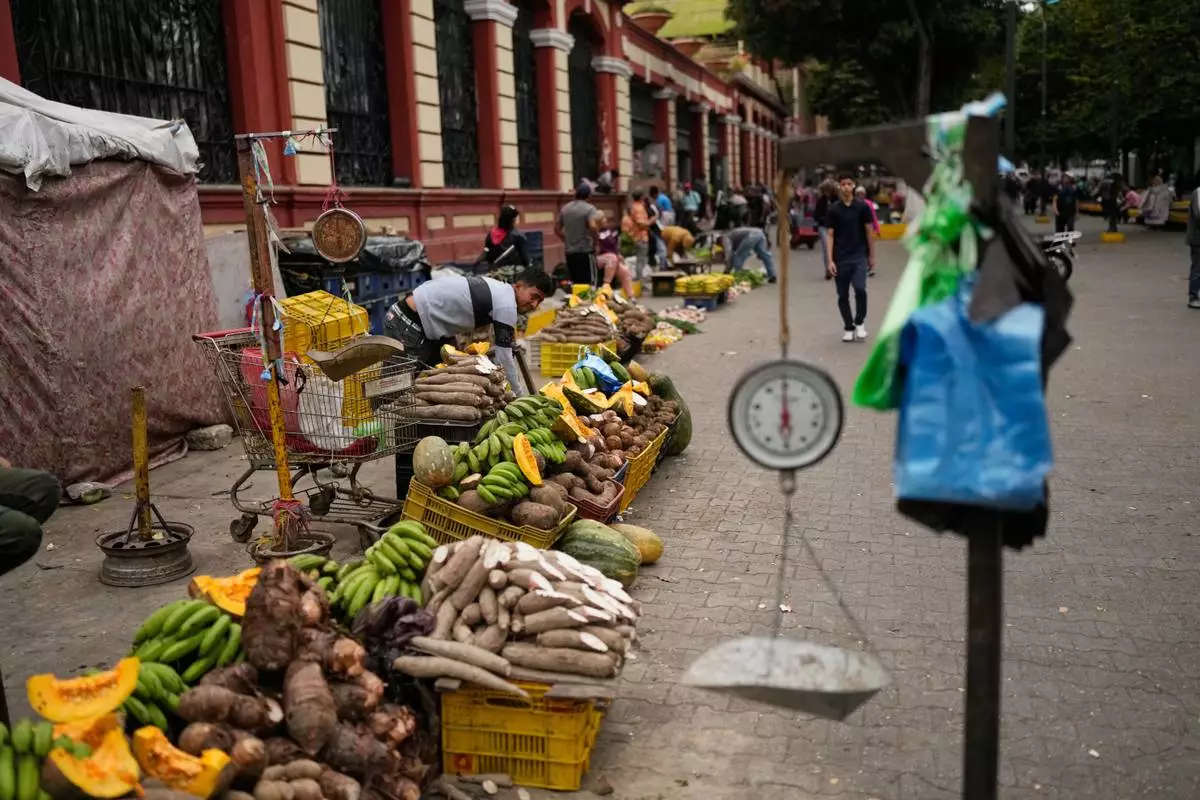
Vendors display vegetables at a street market in Caracas, Venezuela, Thursday, Jan. 8, 2026. (AP Photo/Matias Delacroix)
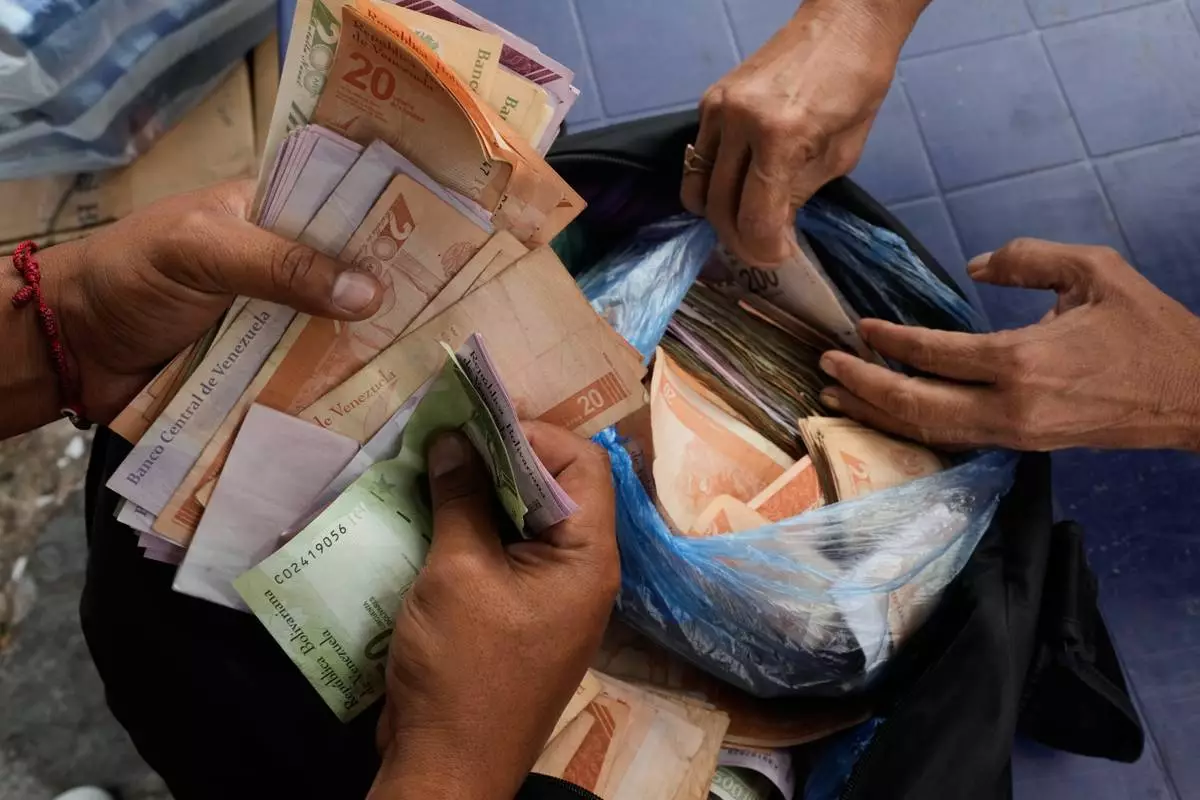
People exchange U.S. dollars for Venezuelan bolivars at a street market in Caracas, Venezuela, Thursday, Jan. 8, 2026. (AP Photo/Matias Delacroix)
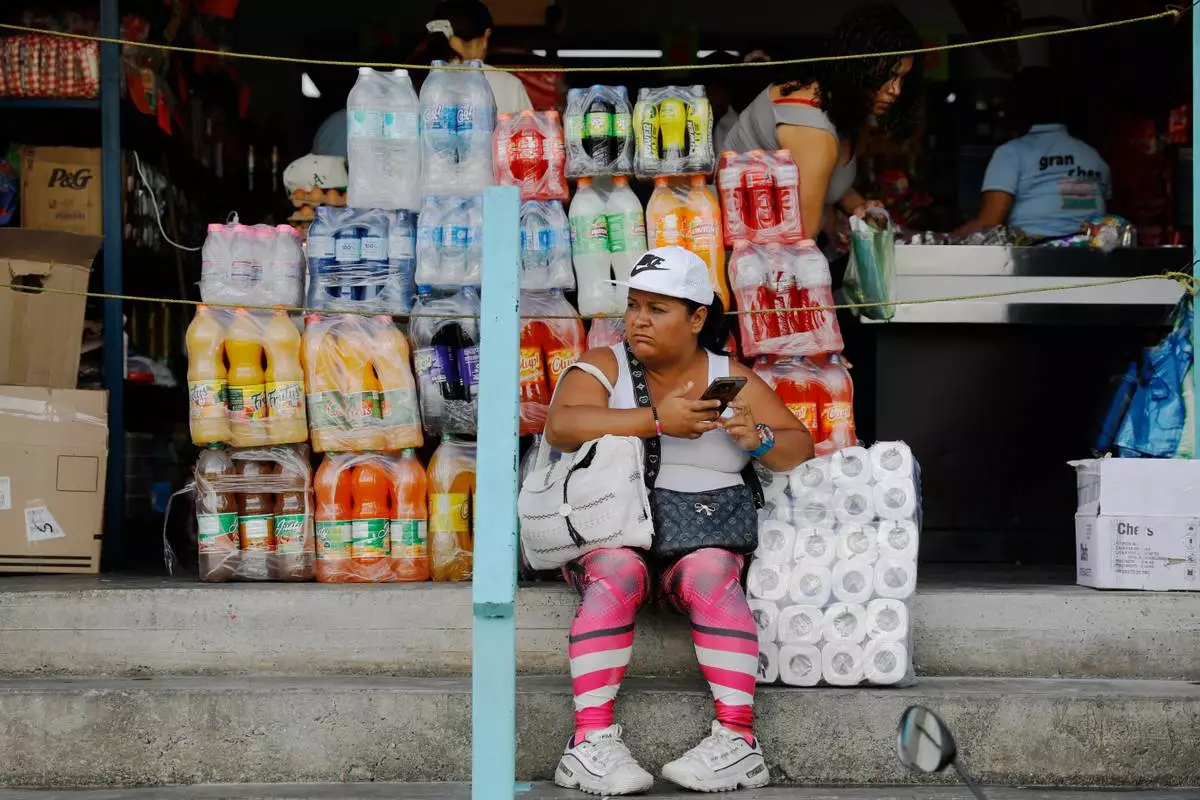
A woman sits in front of a store in the Petare neighborhood of Caracas, Venezuela, Wednesday, Jan. 7, 2026. (AP Photo/Cristian Hernandez)