A young attendant from the Dai ethnic group on the China-Laos Railway has witnessed firsthand how the railway has transformed the daily lives of people in surrounding areas, offering greater convenience and fostering deeper connections.
The China-Laos Railway, which connects Kunming, the capital of southwest China's Yunnan Province, with the Lao capital Vientiane, started operation on Dec 3, 2021.
Stretching 1,035 kilometers, this railway is a flagship project within the framework of the China-proposed Belt and Road Initiative (BRI).
Yu Hanlun, the young attendant, was born in Menghai County of Xishuangbanna Dai Autonomous Prefecture, a region renowned for its tropical rainforests in Yunnan.
When she was in high school, news spread that a railway would be reaching her hometown.
"Everyone was excited, and so was I, because it would make going home so much more convenient. I am from the Dai ethnic group. I've learned some basic Lao, and when I go shopping, I can communicate in the Lao language," she said.
Now, Yu lives in Kunming, over 500 kilometers away from her parents.
"In the past, when my mom visited me in Kunming, or when I went home, the journey would take around 10 hours by bus. But since the China-Laos Railway opened, traveling back home has become much more convenient. The time it takes from work to home has been greatly shortened, making the visit much more convenient," she said.
This railway not only marks a change in Yu's life but also stimulates the economic development of the surrounding areas, bringing more commercial activity and cultural exchanges.
For example, near the Mengla station on the China-Laos Railway, a lively village fair has sprung up, offering a variety of products from Laos as well as local specialties, creating a bustling scene of trade and interaction.
The railway also opens up new possibilities for people living in small mountainous villages in southwest China, allowing them to reach distant places they could never visit before, and experience the joys of traveling abroad.
"Since the China-Laos Railway was built and put into operation, it has served as a bridge, connecting us with the outside world and broadening our horizons. Our villages can now organize group tours from time to time. In the past, we wouldn't go to distant places. With the railway now open, villagers will apply for passports for group trips to Laos. It's truly convenient," she said.
Ye Handi, Yu's sister, observing this transformation, noted not only the changes the China-Laos Railway has brought to the region but also how Yu herself has grown.
"Before she started working on the railway, Yu was quite reserved, but since she has to interact with different people during her work on the railway, she has become much more open and outgoing," her sister remarked.
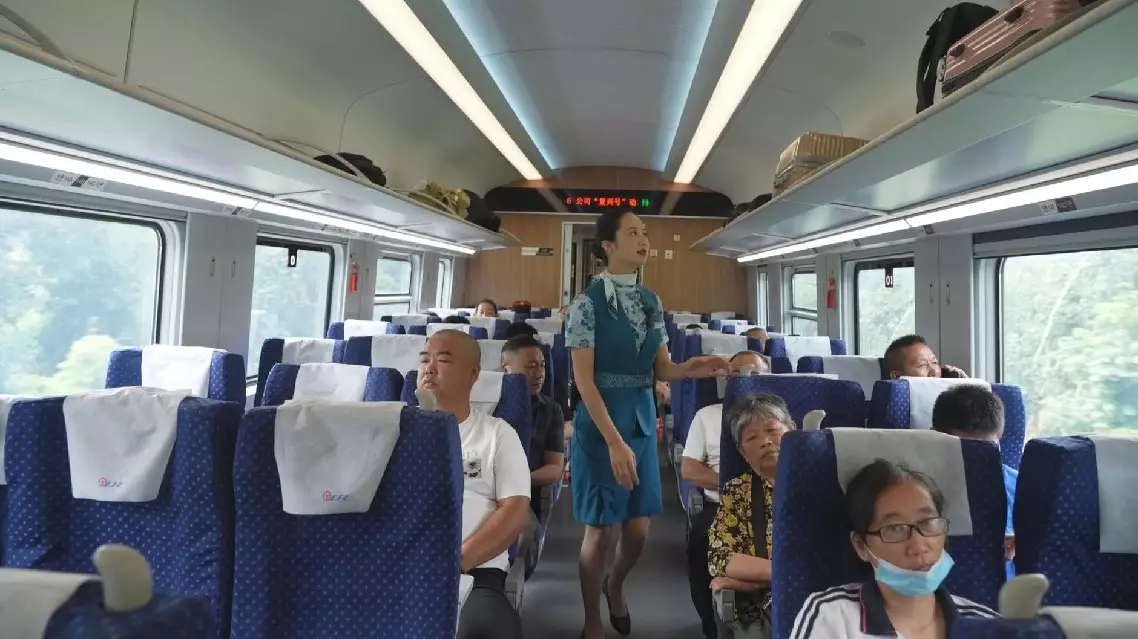
China-Laos railway transforms life, community of young ethnic Dai attendant