Northeast China's Heilongjiang Province, known for its harsh winters, is turning winter into a breeding ground for innovation in key industries. From cutting-edge ice equipment in Qiqihar to smart winter fashion in Harbin, technology and creativity are fostering new opportunities.
With average winter temperatures around -10 degrees Celsius, Qiqihar has earned its reputation as one of China's hubs for ice sports. At the factory of a 70-year-old ice equipment brand, machines are working tirelessly around the clock to grind blades.
These one-millimeter-thick ice-skating blades, designed for speed skating, feature numerous technological innovations for which the company has secured patents.
"We've integrated titanium alloy into the design of our blades for the first time. We've also innovated with a T-shaped structure, replacing the traditional round tube design. This has reduced the overall cross-sectional area by more than 50 percent, while also making the blades lighter - over 10 percent lighter than foreign competitve products of the same level," said Zheng Xiaojie, head of the Technical Department at Qiqihar's Black Dragon Company.
In high-stakes speed skating competitions, where gold and silver can be determined by fractions of a second, that 10-percent weight reduction can make all the difference. Thanks to advanced, intelligent production methods, this heritage brand is now expanding its reach internationally, with growing presence in the Netherlandish and South Korea markets.
"(Our ice-skating blades) can now compete with top-tier international products, with the performance gap being narrowed to minimal," said Zheng.
Meanwhile, a leading brand in China's down jacket market has aslo seized an opportunity for innovation, teaming up with Harbin, the city that attracted a record-breaking three million tourists during last year's three-day New Year holiday.
"Harbin is a city that showcases its full beauty in winter, just as our brand has its maximum splendor in winter. So, it is a perfect marriage," said Pietro Ferragina, creative director of Bosideng.
In the brand's state-of-the-art Harbin factory, all 158 steps involved in creating a down jacket - cutting, sewing, sorting, and packaging - are fully automated.
"Our jackets are lighter yet provide more warmth in temperatures as low as -50 degrees Celsius. This is achieved through experiments combining heat air circulation with our goose down and sewing system," Ferragina said.
The fusion of technology and design culminated in a stunning fashion show held against the backdrop of the landmark St. Sophia Cathedral in downtown Harbin earlier this month.

Northeastern Heilongjiang Province leverages technology to boost winter sports, fashion
U.S. President Donald Trump said on Friday that he estimates a deal with Iran will be signed "in the next day or two."
Trump said in an interview with Israel's Channel 12 News that the United States and Iran will probably meet over the weekend to finalize a deal to end the war. "The Iranians want to meet and make a deal," he said.
He said "the naval blockade on Iran is helping to make a deal. I will not lift it until we make a deal," adding that "the biggest part of this deal is that it will make Israel safer. This deal is good for Israel."
According to the channel, one component of the deal under discussion is that the United States will release 20 billion U.S. dollars in frozen Iranian funds.
In exchange, Iran would give up its stockpile of enriched uranium, and would be only allowed to have nuclear research reactors to produce medical isotopes, all above ground.
Trump also stressed that Israel must stop the strikes on Lebanon, saying, "They can't keep blowing up buildings. I'm not going to allow that."
Also on Friday, Trump said in a phone interview with Bloomberg that a deal to end the U.S.-Israeli war with Iran is mostly complete as talks over a lasting peace deal will "probably" be held this weekend in Pakistan.
Trump said in the phone interview that Iran agreed to suspend its nuclear program indefinitely, and will not receive any frozen funds from the United States.
"Most of the main points are finalized. It'll go pretty quickly," Trump said.
Asked if he would travel to Pakistan to sign the potential deal, Trump said: "I may."
Trump again denied that the moratorium on Iran's nuclear program would expire after 20 years. "No years, unlimited," Trump said.
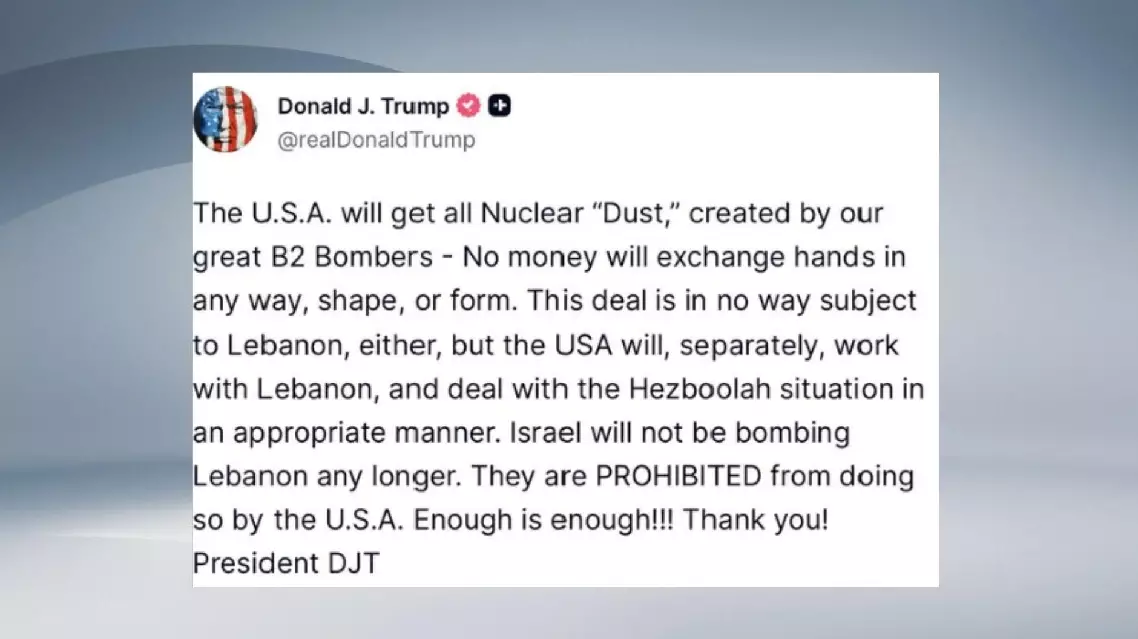
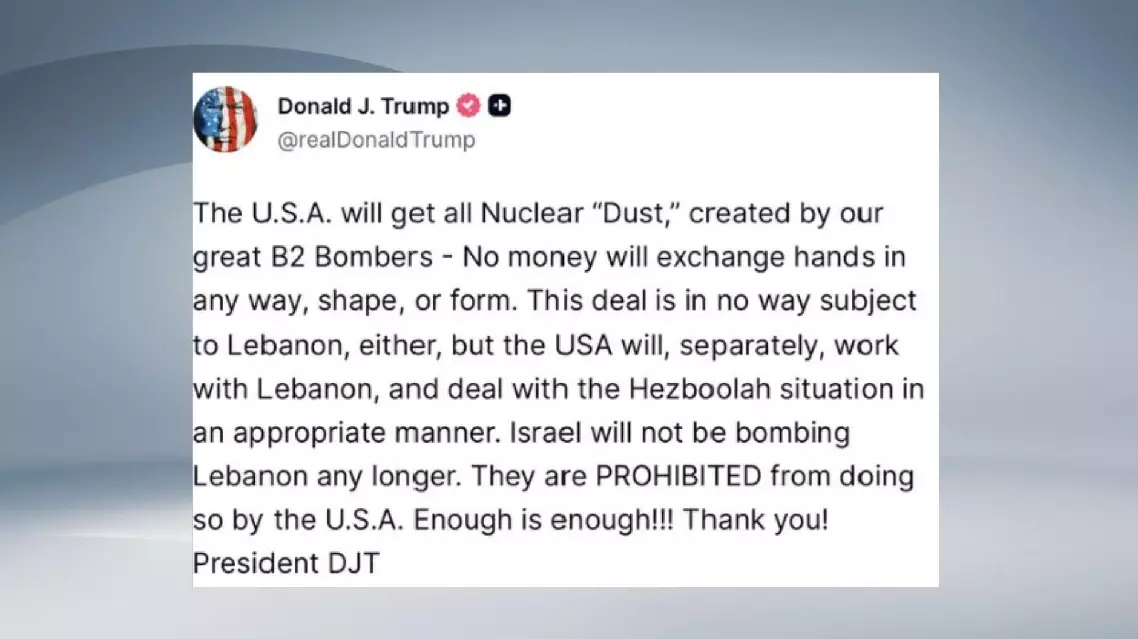
The United States will get all of Iran's nuclear "dust" with no money having exchanged hands "in any way, shape, or form," Trump wrote on social media earlier on Friday. Multiple Western media outlets have interpreted Trump's reference to nuclear "dust" as meaning Iran's stockpile of enriched uranium.
Iran has yet to comment on any deal beyond the reopening of the Strait of Hormuz, nor on claims made by Trump that Tehran had offered concessions, including over the key issue of its nuclear program.
If the United States continues its naval blockade of the Strait of Hormuz, Iran will consider it a violation of the ceasefire between the two countries and will close the waterway, the semi-official Tasnim news agency reported Friday, citing an informed source close to the Supreme National Security Council.
The Iranian side has yet to respond to the media report on the enriched uranium issue.
The United States and Iran had their first round of negotiations in Pakistan's Islamabad last weekend to ease tension in the Middle East. The talks, which failed to produce an agreement, took place after a ceasefire was announced on April 8 between Iran, the United States, and Israel, following 40 days of fighting.
Iran tightened control over the Strait of Hormuz after the United States and Israel launched joint attacks on the country on Feb. 28. The United States also imposed a naval blockade on the strait following the failed negotiations in Islamabad.
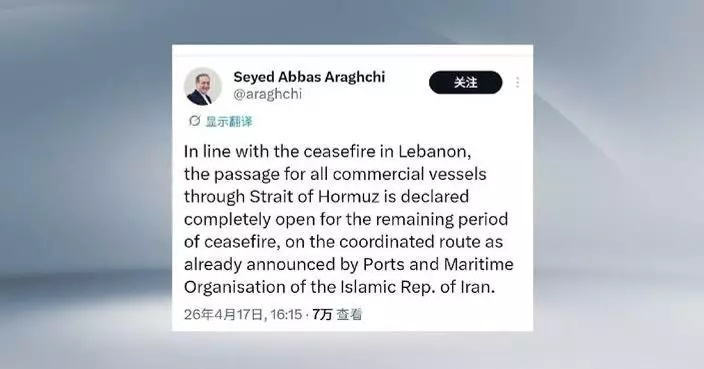
Earlier on Friday, both Washington and Tehran confirmed that the strait had been completely open for all commercial vessels. However, Trump said on Truth Social that the U.S. naval blockade would "remain in full force." In response, Iran warned of closing the waterway again if the U.S. blockade continues.
Trump says may sign deal with Iran "in the next day or two": Israeli media
Trump claims peace deal with Iran mostly complete: report