China's National Cultural Heritage Administration on Thursday released some key archeological findings of the several ancient capital ruins dating back to the earliest China dynasties over 4,000 years ago, shedding lights on how the ancient Chinese people used their urban spaces.
The findings were yielded from the significant progresses made by some of the country's most important archeological programs and Wednesday's release focused on the relic sites of some of China's most ancient capital cities originally built in China's first recorded dynasties of Xia Dynasty (2070-1600 BC) and Shang Dynasty (1600-1046 BC), and Zhou Dynasty (1046-256 BC).
Covering an area of three million square meters, the Erlitou relics site in Luoyang city of central China's Henan Province was thought to be the capital of Xia Dynasty.
Remains of the capital showed that the ancient city had crisscross roads and walls that divided it into four regular grids.
Archeologists believe Erlitou's layout was a manifestation of developed zoning ideas and a mature ruling system, which is considered the defining features of a "dynastic state".
In Anyang City of central China's Henan Province, further unearthing of another archaeological site of Yinxu, or the Yin Ruins, capital of the Shang Dynasty, gave insights into its urban layout, which were largely made up by road networks and ditches.
The relics of the Zhongcun Tomb was found in Xiyang County in north China's Shanxi Province. Built between the Xia Dynasty and the Shang Dynasty, it was the largest and the highest-ranking among its kind ever excavated in the eastern part of the Loess Plateau.
Historical ruins showed the burial customs of the people living in the building era of the tomb had strong local characteristics but were also influenced by the cultures of Erlitou and Xiaqiyuan, thus standing as a prime example of cultural integration.
The Sanxingdui ruins found in the Guanghan City of southwest China's Sichuan Province represents one of the most glorious periods of the ancient Shu Kingdom that suddenly disappeared about 2,000 years ago.
Shu civilization spanned the periods across the late Neolithic Age to the end of the Shang Dynasty and the beginning of the Zhou Dynasty.
Archeologists have found out the age of the ruins' jade "workshop" and have identified the types of the unearthed jades. Further findings also helped clarify when the two water gates of the ruins were formed, marking an achievement in the discovery of the urban water networks of Sanxingdui.
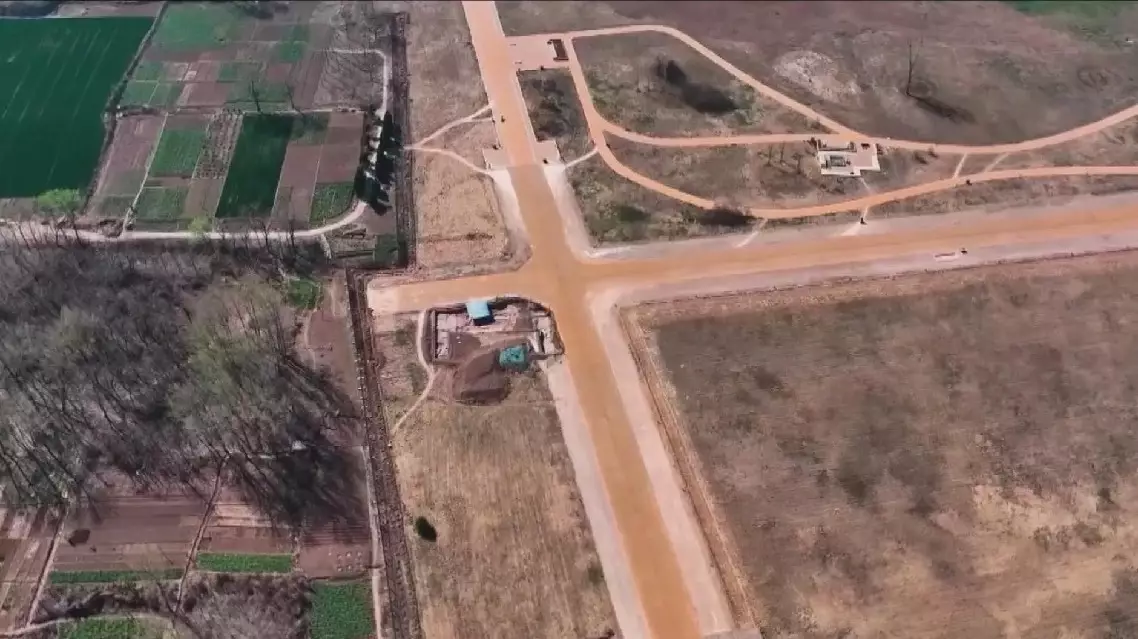
China releases key archeological findings of its ancient capitals
More than 20 students from Ivy League universities in the United States visited China's Southwest Jiaotong University in on Tuesday, where they got a first-hand look at a fast-moving technological innovation that could power future transportation.
The students paid a visit to a special demonstration lab in Chengdu, the capital of southwest China's Sichuan Province, where they explored the world’s first high-temperature superconducting magnetic levitation prototype and test line, taking part in some fun hands-on experiments and even enjoying a brief trial ride.
Experts say the system could exceed speeds of 600 kilometers per hour, helping to further narrow the gap between high-speed rail and air travel.
The students' visit came as part of a week-long language and cultural exchange program, giving the young participants the chance to experience daily life in Chengdu while learning more about China.
The exchange event comes at a momentous time for China-U.S. relations, with U.S. President Donald Trump on Friday wrapping up a three-day state visit to China at the invitation of Chinese President Xi Jinping, which marked the first such trip by a U.S. president in nine years.
The students taking part in the Chengdu activity said exchanges like the one they have embarked on can help deepen trust and expand cooperation between the U.S. and China.
"The positive signals I am hoping to see is that right now I see China and the United States as two powerful and very important countries in this world. But they also both have a lot of potential, and I think that if they work together, they can make some tremendous change across the world," said Alex Davenport, a student from Mount Holyoke College.
"America and China are two of the largest superpowers in the world right now, and I think politically and culturally it’s really great to communicate with one another," said Caroline Ewald, a student at the University of Pittsburgh.
Others are hoping that Trump's landmark visit will also help improve ties.
"That's probably the biggest thing I am look for is try to cool down the trade stuff that's going on in the U.S.," said McKenna Lundy, a student from the University of Michigan.
China is seen as a world leader in maglev technology. Last December, the country's Hubei East Lake Laboratory announced a groundbreaking achievement, with its test line accelerating a 1.1-tonne model train to an astonishing 800 kilometers per hour in just 5.3 seconds -- a milestone in electromagnetic propulsion research.
The technology is also proving its worth at more manageable speeds, with a restaurant in the southern Chinese tech hub of Shenzhen going viral earlier this year after it used magnetic levitation to serve food, with plates seen floating along tracks to arrive smoothly in front of each diner.
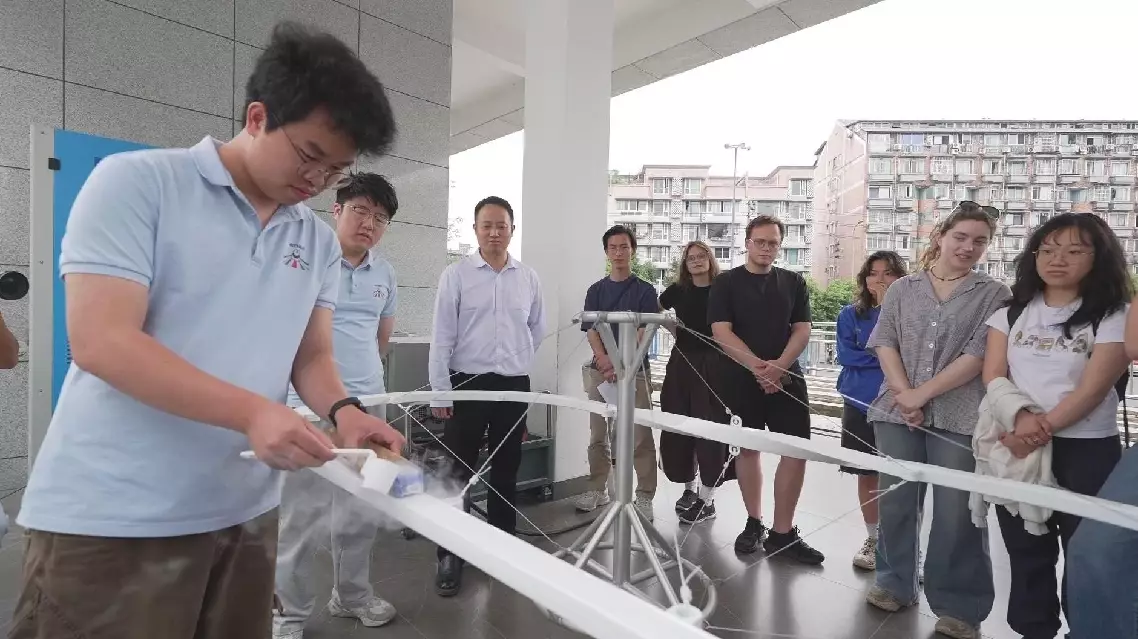
US students get taste of high-speed technology with visit to top maglev lab in Sichuan