China has made significant progress in economic transformation toward emerging and future industries as well new business models by developing new quality productive forces.
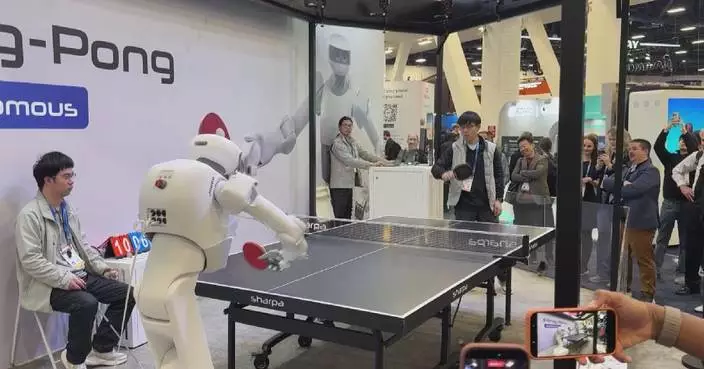
A key driver for the development of new quality productive forces is sci-tech innovation. In the first 10 months of 2024, investment in high-tech industries in China increased by 9.4 percent year on year, significantly boosting the development of emerging industries, particularly in the humanoid robot sector.
"Walker X, launched in 2021, is our fourth-generation robot, which added enhanced artificial intelligence interaction capabilities, enabling it to perform tasks such as picking up a bottle, playing chess, and giving massages," said Gao Weifeng, a senior technical engineer of UBTech Robotics, a robot manufacturer based in Shenzhen City of south China's Guangdong Province.
"I believe that intelligent manufacturing, particularly in the automotive sector, may emerge as the first significant application area for humanoid robots. To support this, we launched the Walk S series in 2023, focusing on applications in industrial manufacturing," said Qin Wenlong, another senior engineer of UBTech.
The advancement of AI technology has created huge opportunities for advanced manufacturing.
In Ningde City of east China's Fujian Province, CATL, the world's largest power battery manufacturer, has established the first "lighthouse factory" in the lithium-ion battery industry.
The facility features a highly intelligent and automated production line, laying a solid foundation for leading innovation in green energy sectors.
"Our cell-to-pack technology eliminates the module structure by directly assembling the battery with the cell. This innovation improves the energy density of the battery. In recent years, we have seen notable acceleration in our development of energy storage industry. Like now, we see these energy storage cabinets which currently represent the cutting edge technology in the field. These cabinets have the capability to replace fixed fossil energy sources," said Ma Lin, deputy director of the Intelligent Manufacturing Department of CATL.
The rapid development of science and technology has revitalized traditional industries. As the world's largest logistics market, with over 70 percent of freight transport occurring on roads, China is leveraging technological innovations like autonomous driving to enhance line-haul logistics. The progress is also contributing to the formation of new supply chain patterns.
"As the average age of drivers increases, autonomous driving can help car companies solve part of the driver shortage. This is helpful to the sustainable development of the logistics industry, which requires a combination of extensive technology and data. We get rich data from China's complex logistics environment and diverse operational scenarios, and from simulation as well. In this perspective, China is at a relatively leading position in terms of intelligent driving technology," said Liu Yuhang, director of the China Logistics Information Center.
Intelligent technologies have been applied in agriculture to help farmers monitor field conditions, reduce costs of fertilizers and pesticides, and increase yields.
"Now, with this smart basement, we can monitor the disease, insect and pests and growth situation remotely," said Wang Jun, a farmer in Lishu County of northeast China's Jilin Province.
"This part of the base station is to monitor the insect situation, and there are parts to monitor the wind, humidity and so on. On the monitoring platform you can see the situation of any parts of the land. You can click on whose land this belongs to, what situation is convenient for us to operate," said Han Fengxiang, head of the Fenghuangshan Rural Cooperative.
With high technology, efficiency and quality, future industries are flourishing in China. According to official data, the scale of China's commercial space market is projected to exceed 2.3 trillion yuan (about 315 billion U.S. dollars) in 2024.
In 2023, the low-altitude economy in China reached over 505 billion yuan (about 69.19 billion U.S. dollars), marking a growth rate of 34 percent. The market is expected to expand to 1.5 trillion yuan (about 206 billion U.S. dollars) by 2025.
"About four years ago, we started thinking about adjacency for Aviage. What if we can make that avionics suite smaller, cheaper, lighter and even better? And sure enough, now, the Chinese government is really promoting this thing called the low-altitude economy. And it's a perfect fit for our eVTOL market," said George Chang, president and CEO of Aviage Systems, a joint venture between General Electric Company (GE) and Aviation Industry Corporation of China (AVIC).

New quality productive forces reshaping China's economic landscape