Chinese lawmakers on Dec 25 voted to adopt a law on value-added tax (VAT), the largest tax category in China, marking major progress in enforcing the principle of law-based taxation.
The law, passed at a session of the Standing Committee of the National People's Congress, the national legislature, will take effect on Jan 1, 2026.
Currently, 14 out of the 18 tax categories in effect in China have already been legislated, covering the majority of tax revenue.
The VAT law specifies tax rates and taxable amounts, maintaining the three current rates of 13 percent, 9 percent, and 6 percent, with a zero tax rate applied to certain goods and services exports.
"The VAT legislation maintains the current statutory tax rates: 13 percent for goods, 9 percent for sectors like transportation, postal, communication, real estate, and construction, and 6 percent for services," said Shi Zhengwen, director of the Fiscal and Taxation Law Research Center of China University of Political Science and Law.
In terms of tax collection management, the VAT law clarifies that VAT will be collected by tax authorities, while customs will handle VAT for imported goods.
Additionally, for the first time, the law specifically outlines an invoicing management system, emphasizing the promotion of electronic invoices and strengthening data-driven tax administration.
"Electronic VAT invoices aim to provide timely access to tax-related information from business operations. The goal is to establish a tax information-sharing mechanism and coordination system. Under the 'data-driven tax administration' model, VAT collection will ultimately support high-quality development, social fairness, and market unity," said Shi.

VAT law to take effect in 2026, with current rates unchanged
Hong Kong's first astronaut lifted off into space on Sunday, sparking a wave of enthusiasm for space exploration in the special administrative region, while inspiring a new generation to look to the stars.
The Shenzhou-23 crewed spaceship, atop a Long March-2F carrier rocket, blasted off from the Jiuquan Satellite Launch Center in northwest China at 23:08 (Beijing Time) on Sunday. The crew members include Lai Ka-ying, the first astronaut and payload specialist from Hong Kong to join a national space mission, whose achievements have motivated many Hong Kong residents.
"I feel so happy and thrilled. This is the first time a Hong Kong astronaut has gone to space, and to see a true Hong Konger, who is also a mother of three, just really touches my heart," said Chow, a local resident.
The successful spaceflight of Lai has especially captivated the younger generation to dream bigger about the future.
"I want to be an astronaut, because I want to discover more things about space," said a young student surnamed Chow.
"I have seen things related to spaceflights of astronauts. I hope when I grow up, I could receive training and go to space myself," said another student surnamed Koo.
To meet public expectations, the Hong Kong Space Museum has updated its space-themed exhibition with the latest development of the Shenzhou-23 mission, extending the display until July 6. Parents are seizing the moment to enrich their children's knowledge.
"At his age, I want him to be exposed to a wide range of information. With all the recent astronaut news, I brought him here specially to see for himself. We will also check out a film about space knowledge at the planetarium. I hope he can get more out of this from an early age," said Cheung, a father.
"We just watched the Shenzhou-23 launch at home with my son last night, and decided to take him to the Space Museum," a mother surnamed Chun shared.
"I saw on TV that so many people were cheering for the launch. When the rocket was launched, fire burst out from its body. I was really happy they succeeded," said Chun's son.
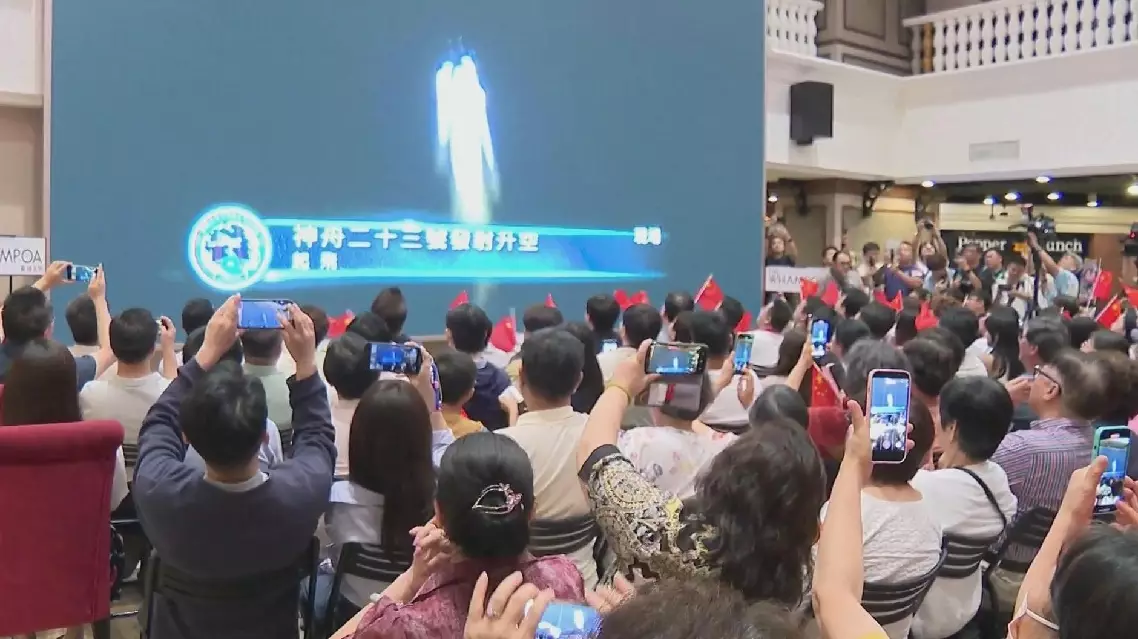
Hong Kong's first astronaut ignites citywide enthusiasm over space exploration