Art enthusiasts in San Francisco are getting their first glimpse of the masterpieces by one of China's most renowned painters, Qi Baishi (1864-1957), through a special exhibition at the Asian Art Museum.
The exhibition titled "Qi Baishi: Inspiration In Ink" opened in the city in mid-December 2024, to mark the 160th anniversary of the artist's birth, and will stay open until April 7, 2025.
"Qi Baishi is one of the most important Chinese artists in the 20th century, and his artworks actually created lots of auction records. Qi Baishi, actually in the 1940s, 50s, was regarded as one of the avant garde artists and very contemporary, and also [he] refashioned, revitalized Chinese traditional ink painting," said Zhang Fan, curator of Chinese Art at the Asian Art Museum.
His work is being viewed as a bridge between Chinese ink painting and Western audiences. The exhibition marks the first time the 40 works of Qi Baishi are being shown in the U.S.
Enjoying the exhibition are art enthusiasts and artists, too, like painter Gary Bukovnik.
"It makes it look like, oh, I could do that, except it takes a lifetime to know how to just make it look like it doesn't take any effort whatsoever," Bukovnik said.
Qi's ink paintings depict ordinary moments and scenes, capturing the essence of nature's beauty and the delight found in life's simplest pleasures.
Among the works on display is a painting that depicts an everyday scene of an old man sending a tearful child to school.
"I was looking at this because I was a teacher. And so I thought a youngster going to school with a parent or grandparent. It's just like so typical of the family taking the children to school and then, okay, be good and learn all you can and all that. So, education and all that is so critical," said Betty Meissner, one of the visitors.
"I like the story that he told, how he came to paint the abacus, pursuing wealth without harming others," said Sally Whitehead, another visitor, observing the painting titled "Abacus".
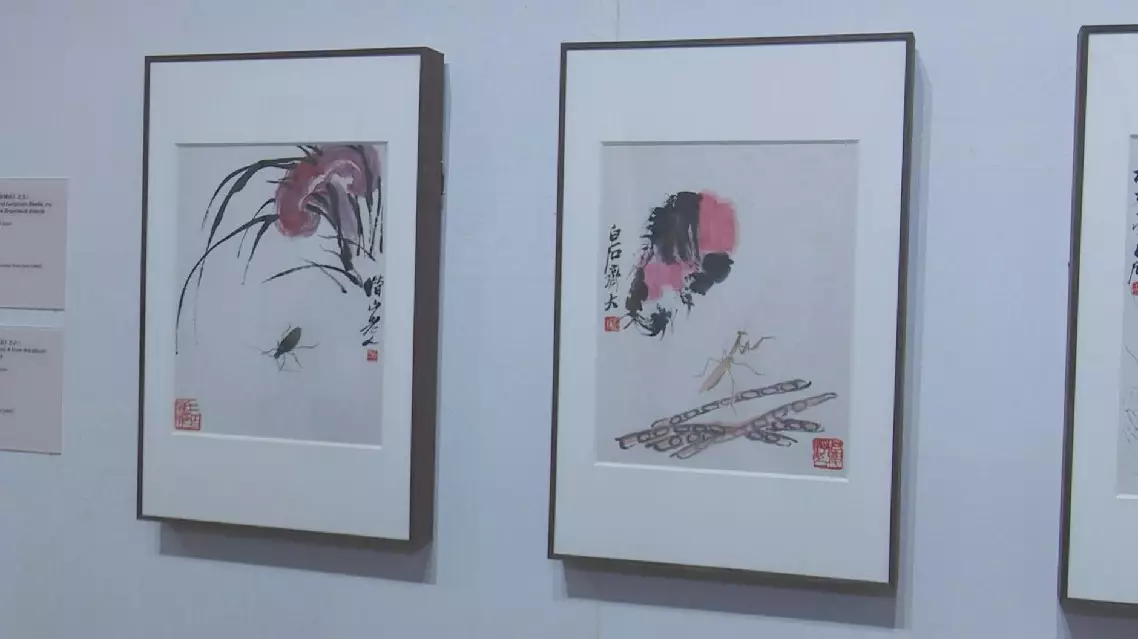
Artworks of Chinese painter Qi Baishi now on display in San Francisco
China's first 500-kV cross-border alternating-current power interconnection project entered service Monday, creating the highest voltage grid tie between the two countries and advancing Belt and Road energy cooperation.
The project raises two-way power transfer capacity between the two countries from 50,000 kW to 1.5 million kW, enabling the annual transmission of about 3 billion kWh of clean electricity, roughly 30 times the capacity of previous lines, according to China Southern Power Grid.
As the largest cross-border grid project and the highest-voltage power link between China and Laos, it connects southwest China's Yunnan Province with Oudomxay and Luang Namtha provinces in northern Laos.
Cross-border electricity trading began as the project entered operation. About 4.81 million kWh of power from clean energy bases in northern Laos was transmitted to Yunnan through the new line, marking a more regular and institutionalized phase of power connectivity between the two countries.
It is also the first time an overseas new energy project has participated in China's electricity market, the company said. The power involved in the transaction came from a large mountain photovoltaic project in Laos, one of the core supporting power sources for the interconnection line.
"This project is the cross-border power grid project with the highest voltage level between China and Laos. Leveraging the China-Laos power grid interconnection and the power markets in southern China, surplus hydropower from Laos can be transmitted to China during the rainy season, while China can supply supplemental power to northern Laos during the dry season. This project represents yet another landmark achievement between China and Laos in deepening power cooperation and jointly advancing the high-quality development of the Belt and Road Initiative," said Li Jingru, general manager of Electricite du Laos Transmission Company Limited (EDL-T), a joint venture of China Southern Power Grid and Lao state-run Electricite du Laos.
The solar project has an average annual power generation capacity of about 1.65 billion kWh. In 2026, it is expected to transmit about 1.1 billion kWh of solar power across the border, supporting energy complementarity between the two countries.
"In the future, efforts will be made to further promote normalized cross-border electricity trading, meet the trading needs such as electricity transmission from Laos to China's Yunnan, from China's Yunnan to Laos, and from Laos to China's Guangdong, and facilitate the optimal allocation of energy resources in the Lancang-Mekong region," said Li Minhong, marketing director of China Southern Power Grid.
Construction of the interconnection project began in late February last year. Spanning a total length of 177.5 km, the transmission line includes a 145-km Chinese section and a 32.5-km Lao section.
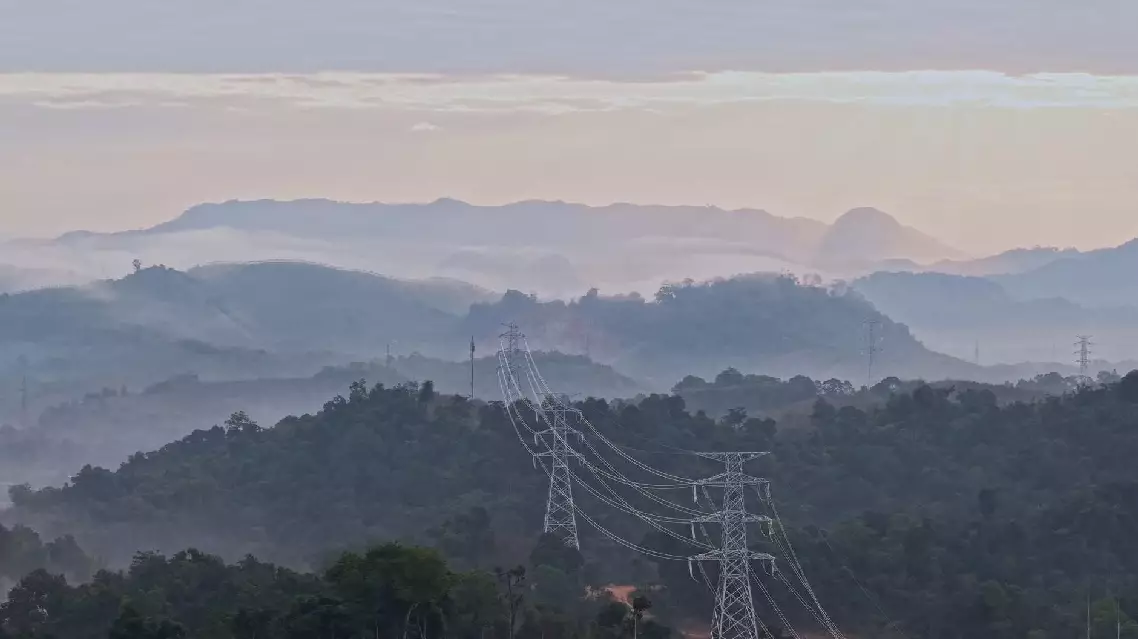
New China-Laos power link expands transfer capacity 30-fold, boosts electricity trading