The rapid growth of the low-altitude economy is fueling demand for skilled professionals like pilots, flight controllers, and drone operators as industries embrace innovative flight technologies, creating new jobs while highlighting a significant talent gap.
Low-altitude economy refers to the economic activities and industries centered around manned and unmanned aerial vehicles operating in the airspace usually within 1,000 meters above the ground.
This booming industry is revolutionizing the aviation sector, with professionals in piloting, flight control, and aircraft development playing a pivotal role in addressing its evolving challenges.
Luo Hanqing, a helicopter pilot based in south China's tech hub of Shenzhen, has logged over 7,000 flying hours over his 12-year career. Previously focused on flights to offshore drilling platforms, he now spends a significant portion of his time flying low-altitude routes between cities.
"Our company currently employs around 130 to 140 pilots. Since the launch of the low-altitude economy, we've seen a noticeable increase in flight volumes. To keep up, we're adding more staff and expanding training to equip them with the necessary skills," Luo explained.
Before every flight, Luo and his colleagues meticulously review flight details and conduct thorough checks on their helicopters. As low-altitude pilots, they not only master flying techniques but also learn vital skills such as flight route design.
"You have to plan your flight route according to the map, which helps you determine your total flight distance, safety altitude, and fuel requirements, " Luo said. "For each aircraft model, you need to accumulate adequate flying hours on that model and pass a theoretical exam before it can be officially endorsed on your license."
Reflecting on his own training, Luo said it took him about eight months to become a certified pilot, accumulating 200 flight hours. However, with the advent of electric Vertical Takeoff and Landing (eVTOL) aircraft, industry experts believe the training process for future pilots will be streamlined.
"The design of eVTOLs offers a more intuitive experience compared to traditional helicopters, where complex buttons are replaced by simpler controls. We've already teamed up with top flight schools in China to design the initial courses for this new technology," said Huang Xiaofei, vice president for Strategy at Shanghai Volant Aerospace.
Meanwhile, some companies are focusing on the development of unmanned aerial vehicles (UAVs), which will eliminate the need for onboard pilots. Instead, ground-based staff can monitor the aircraft in real time.
Liu Ye, a 20-year-old UAV operator working in Shenzhen, holds a drone pilot's license certified by the civil aviation department.
"Aerial photography, power line inspections, and mapping are just a few areas where UAVs are used," Liu explained. "There are many job opportunities available in this field."
The expansion of the low-altitude economy has created a considerable talent gap, with industry estimates suggesting a shortage of 1 million UAV operators alone.
"The demand for drone operators in agriculture, forestry, inspection, surveying, meteorology, environmental protection, and emergency response is immense," said Yang Jincai, president of the Shenzhen UAV Industry Association. "In the future, the demand for eVTOL operators will also be very high."
The Civil Aviation Administration of China estimates that the country's low-altitude market will soar from 500 billion yuan in 2023 to 1.5 trillion yuan in 2025 and as much as 3.5 trillion yuan in 2035.
This year, for the first time, the term "low-altitude economy" was included in the Chinese government's work report, signifying an official endorsement that has emboldened numerous cities.
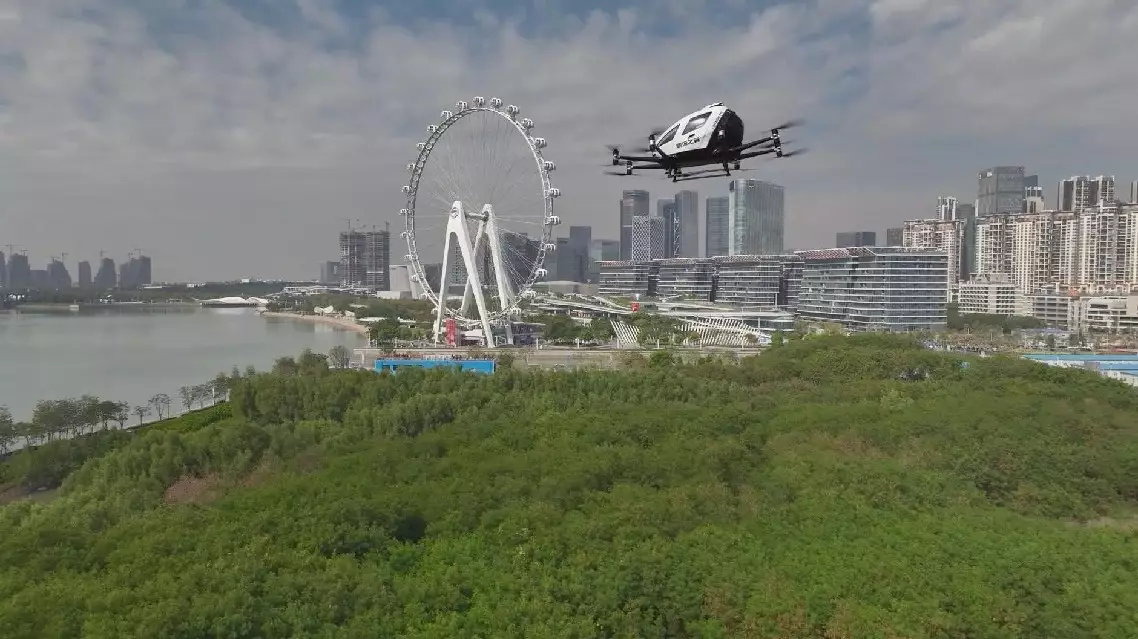
Rapidly expanding low-altitude economy gives rise to new job opportunities