SANTA FE, N.M. (AP) — The New Mexico Supreme Court on Thursday struck down abortion restrictions by conservative cities and counties, helping to ensure the state remains a go-to destination for people from other states with bans.
The unanimous opinion, in response to a request from state Attorney General Raúl Torrez, reinforces the state’s position as having some of the most liberal abortion laws in the country.
Attorneys representing the cities of Hobbs and Clovis and Lea and Roosevelt counties had argued that provisions of a federal “anti-vice” law known as the Comstock Act block courts from striking down local abortion ordinances.
But Justice C. Shannon Bacon, writing for the majority opinion, said state law precludes cities and counties from restricting abortion or regulating abortion clinics.
“The ordinances violate this core precept and invade the Legislature’s authority to regulate access to and provision of reproductive healthcare,” she wrote. “We hold the ordinances are preempted in their entirety.”
New Mexico Attorney General Raúl Torrez praised the court’s ruling Thursday, saying that the core of the argument was that state laws preempted any action by local governments to engage in activities that would infringe on the constitutional rights of citizens.
“The bottom line is simply this: Abortion access is safe and secure in New Mexico," he said. "It’s enshrined in law by the recent ruling by the New Mexico Supreme Court and thanks to the work of the New Mexico Legislature.”
New Mexico House Speaker Javier Martínez called access to health care a basic fundamental right in New Mexico.
“It doesn’t take a genius to understand the statutory framework that we have. Local governments don’t regulate health care in New Mexico. It is up to the state,” the Albuquerque Democrat said.
Opposition to abortion runs deep in New Mexico communities along the border with Texas, which has one of the most restrictive bans in the U.S.
But Democrats, who control every statewide elected office in New Mexico and hold majorities in the state House and Senate, have moved to shore up access to abortion — before and after the U.S. Supreme Court overturned Roe v. Wade in 2022, eliminating the nationwide right to abortion.
In 2021, the New Mexico Legislature repealed a dormant 1969 statute that outlawed most abortion procedures as felonies, ensuring access to abortion even after the Roe v. Wade reversal.
And in 2023, Democratic New Mexico Gov. Michelle Lujan Grisham signed a bill that overrides local ordinances aimed at limiting abortion access and enacted a shield law that protects abortion providers from investigations by other states.
In September, construction began on a state-funded reproductive health and abortion clinic in southern New Mexico that will cater to local residents and people who travel from neighboring states.
The new clinic is scheduled for completion by early 2026 to provide services ranging from medical and procedural abortions to contraception, cervical cancer screenings and education about adoptions.
In Thursday's opinion, justices said they "strongly admonish” Roosevelt County, in particular, for an ordinance that would have allowed individuals to file lawsuits demanding damages of more than $100,000 for violations of the county's abortion ordinance.
The provision would have created "a private right of action and damages award that is clearly intended to punish protected conduct,” the court said in its opinion.
Erin Hawley, a vice president at Alliance Defending Freedom, an Arizona-based Christian legal advocacy group, is an attorney who argued on behalf of Roosevelt County in the case. On Thursday, she criticized the court's decision and emphasized its limitations.
“Roosevelt County and other New Mexico localities should be able to enforce ordinances that comply with federal law and protect the lives of their citizens,” said Hawley, the wife of U.S. Sen. Josh Hawley of Missouri. “We're grateful that the New Mexico Supreme Court did not abandon common sense and find a so-called right to abortion in the state constitution.”
It was not immediately clear whether the ruling can be appealed in federal court or influence broader efforts to apply Comstock Act restrictions on abortion. The New Mexico Supreme Court opinion explicitly declined to address conflicts with federal law, basing its decision solely on state provisions.
Austin, Texas-based attorney Jonathan Mitchell, a former Texas solicitor general and architect of that state's strict abortion ban, said he looked forward "to litigating these issues in other states and bringing the meaning of the federal Comstock Act to the Supreme Court of the United States.”
__
Associated Press writer Susan Montoya Bryan in Albuquerque contributed to this report.

FILE - The New Mexico Supreme Court Building is seen, Jan. 9, 2023, in Santa Fe, N.M. (AP Photo/Morgan Lee, File)
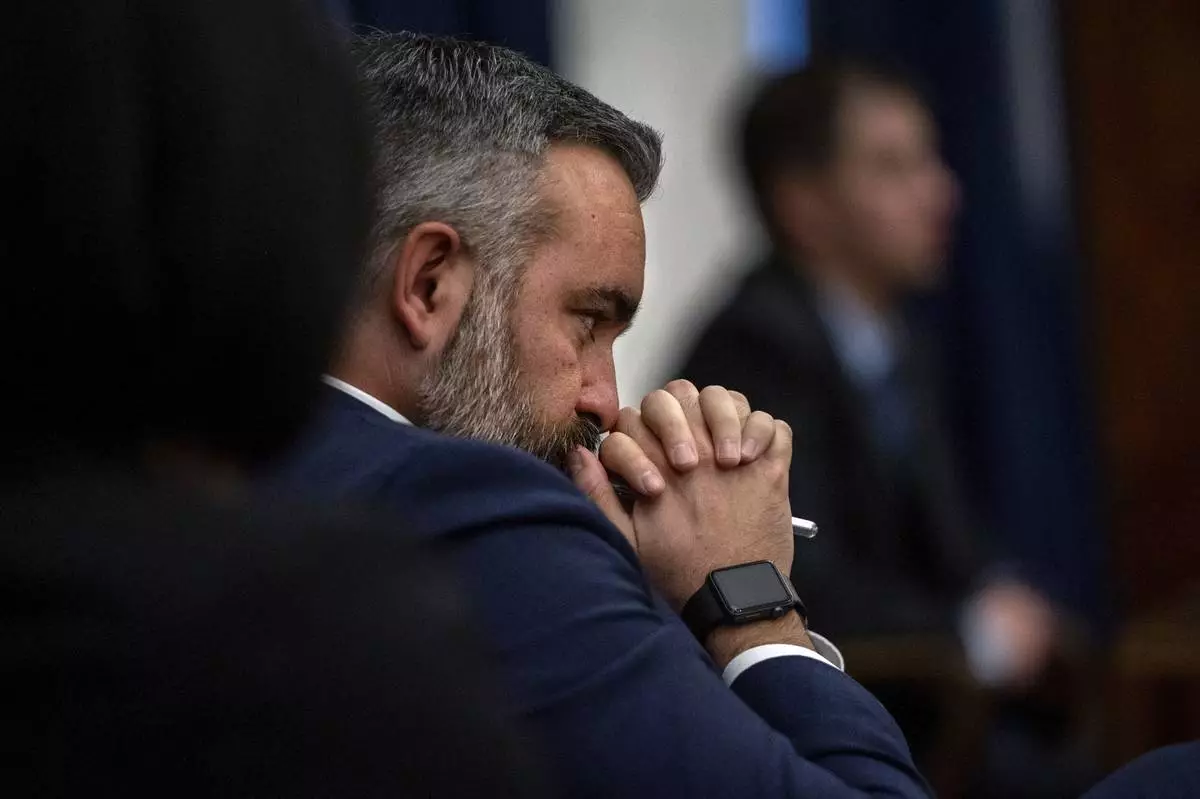
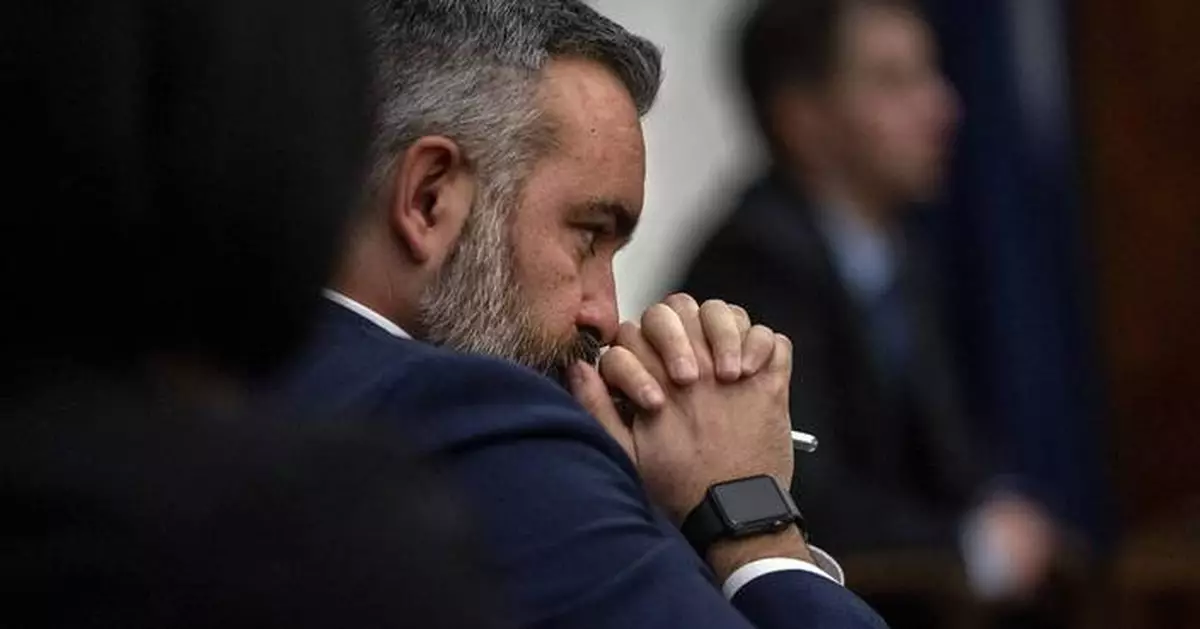
FILE - New Mexico Attorney General Raul Torrez listens to oral arguments dealing with local municipalities implementing ordinances restricting abortion, Dec. 13, 2023 in Santa Fe, N.M. . (Eddie Moore/The Albuquerque Journal via AP, file)
KAMPALA, Uganda (AP) — One figure looms large ahead of Uganda's elections Thursday, although he is not on the ballot: the president's son and military commander, Muhoozi Kainerugaba.
Kainerugaba, long believed to be the eventual successor, stood down for his father, President Yoweri Museveni, who is seeking a seventh term that would bring him closer to five decades in power.
Yet Kainerugaba, a four-star general, remains a key figure in Ugandan politics as the chief enforcer of his father’s rule in this east African country. He is the top military commander, appointed by his father nearly two years ago after Kainerugaba told a political rally he was ready to lead.
Kainerugaba’s appointment as army chief put his political campaign on hold — a least, critics say, for as long as Museveni still wants to stay.
Many Ugandans are now resigned to the prospect of hereditary rule, once vehemently denied by government officials who said claims of a secret “Muhoozi Project” for leadership were false and malicious.
Kainerugaba himself has been honest about his presidential hopes since at least 2023 and openly says he expects to succeed his father.
“I will be President of Uganda after my father,” he said in 2023, writing on social platform X. “Those fighting the truth will be very disappointed.”
The president’s son is more powerful than ever, his allies strategically deployed in command positions across the security services. As the presumed heir to the presidency, he is the recipient of loyalty pledges from candidates seeking minor political offices.
Kainerugaba joined the army in the late 1990s, and his fast rise to the top of the armed forces proved controversial.
In February 2024, a month before Kainerugaba was named army chief, the president officially delegated some of his authority as commander-in-chief to the head of the military.
Exercising authority previously reserved for the president, including promoting army officers of high rank and creating new army departments, Kainerugaba is more powerful than any army chief before him, said Mwambutsya Ndebesa, a political historian at Uganda’s Makerere University, adding that family rule appears inevitable.
“Honestly, I don’t see a way out through constitutional means,” he said.
Elections, he said, “is just wasting time, legitimizing authority but not intended as a democratic goal... Any change from Museveni will be determined by the military high command.”
With Museveni not saying when he would retire, a personality cult around Kainerugaba has emerged. Some Ugandans stage public celebrations of his birthday. Campaign posters of many seeking parliamentary seats often feature the emblem of Kainerugaba’s political group, the Patriotic League of Uganda. Speaker of Parliament Anita Among last year called Kainerugaba “God the Son."
The speaker's comments underscored the political rise of Kainerugaba in a country where the military is the most powerful institution and Museveni has no recognizable successors in the upper ranks of his party, the National Resistance Movement.
Some believe Kainerugaba is poised to take over in the event of a disorderly transition from Museveni, who is 81. One critic, ruminating on Kainerugaba’s military rank, has been urging the son to depose his father.
“I have endlessly appealed to Muhoozi Kainerugaba to, at least, pretend to coup his dad, become the opposition hero, and accuse the old man of all the crimes the general Kampala public accuses him of,” Yusuf Serunkuma, an academic and independent analyst, wrote in the local Observer newspaper last year.
“Sadly, Kainerugaba hasn’t heeded my calls thus far. That he is being pampered by his father to the presidency doesn’t look good at all.”
Kainerugaba’s supporters say he is humble in private and critical of the corruption that has plagued the Museveni government. They also say he offers Uganda the opportunity of a peaceful transfer of political power in a country that has not had one since independence from British colonial rule in 1962.
In addition to opposing family rule, his critics point out that Kainerugaba has behaved badly in recent years as the author of often-offensive tweets.
He has threatened to behead Bobi Wine, a presidential candidate who is the most prominent opposition figure in Uganda. He has said the opposition figure Kizza Besigye, jailed over alleged treason charges, should be hanged "in broad daylight” for allegedly plotting to kill Museveni. And he has appeared to confound even his father, who briefly removed him from his military duties in 2022 when Kainerugaba threatened on X to capture the Kenyan capital of Nairobi in two weeks.
Wine said in a recent interview with The Associated Press that Kainerugaba's army "has largely taken over the election.” Wine said his supporters are the victims of violence, including beatings, perpetrated by soldiers.
In its most recent dispatch ahead of voting, Amnesty International said the security forces were engaging in a “brutal campaign of repression.” It cited one event at a rally by Wine’s party, the National Unity Platform, in eastern Uganda on Nov. 28, when one man died after the military blocked an exit and open fired on the crowd.
It was not possible to get a comment from Kainerugaba, who rarely gives interviews.
Frank Gashumba, a Kainerugaba ally and vice chairman of the Patriotic League of Uganda, said Wine was exaggerating the threat against him. “Nobody is touching him,” he said. “He’s lacking the limelight.”
Only one senior member of the president’s party has publicly pushed back against hereditary rule.
Kahinda Otafiire, a retired major general who is among those who were by Museveni’s side when he first took power by force after a guerrilla war in 1986, has urged Kainerugaba to seek leadership on his own merits rather than as his father’s son.
“If you say so-and-so’s son should take over from the father, his son will also want to take over from his grandfather. Then there will be Sultan No. 1, Sultan No. 2, and then the whole essence of democracy, for which we fought, will be lost," Otafiire, who serves as Uganda's interior minister, told local broadcaster NBS last year.
"Let there be fair competition, including Gen. Muhoozi. Let him prove to Ugandans that he is capable, not as Museveni’s son but as he, Muhoozi, who is competent to manage the country.”
Follow AP’s Africa coverage at: https://apnews.com/hub/africa
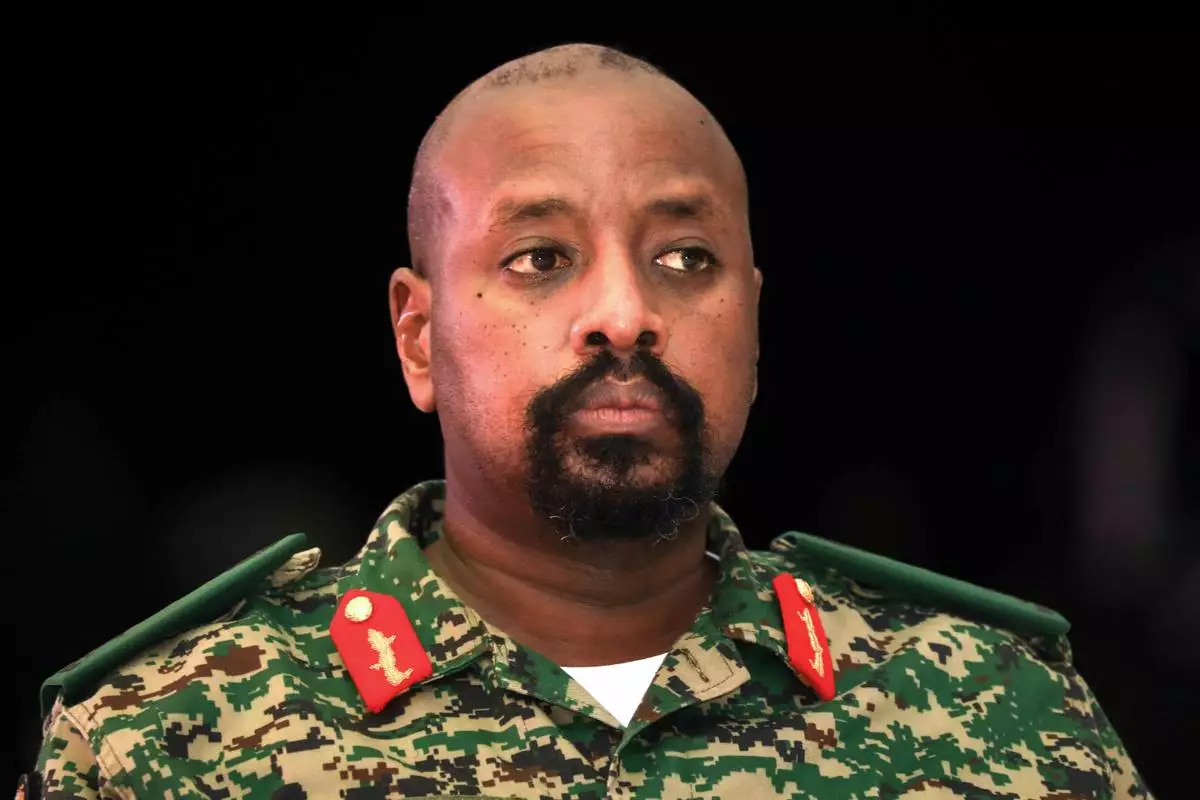
FILE - Lt. Gen. Muhoozi Kainerugaba, son of Uganda's President Yoweri Museveni, attends a "thanksgiving" ceremony in Entebbe, Uganda, May 7, 2022. (AP Photo/Hajarah Nalwadda, File)