DOHA, Qatar--(BUSINESS WIRE)--Jan 16, 2025--
Power International Holding (PIH), a globally recognized Qatari-based conglomerate, has officially completed the acquisition of a 100% participatory interest in Mobile Telecom-Service LLP (MTS) from Kazakhtelecom JSC.
This press release features multimedia. View the full release here: https://www.businesswire.com/news/home/20250116739731/en/
This acquisition follows the initial agreement signed on February 14, 2024, in Doha between PIH, Kazakhtelecom, and the sovereign wealth fund Samruk-Kazyna as well as the signing of the definitive sale and purchase agreement on June 4, 2024.
MTS, known for its prominent brands Altel and Tele2, is the country's leading provider of ultrafast 5G connectivity. Established in 2004, MTS employs around 2,000 staff and operates over 140 retail stores. The company offers a comprehensive range of telecommunications and digital services, making it a cornerstone of Kazakhstan's telecommunications landscape.
With Kazakhstan’s population of 20.2 million and high penetration rates of mobile and internet usage, the telecom industry is experiencing robust growth, driven by increasing consumer demand for enhanced connectivity and digital services.
Read the whole story: https://powerholding-intl.com/2025/01/14/power-international-holding-pih-completes-the-acquisition-of-mobile-telecom-service-llp-mts-from-kazakhtelecom-jsc/
*Source:AETOSWire

Power International Holding (PIH) completes the acquisition of Mobile Telecom – Service LLP (MTS) from Kazakhtelecom JSC (Photo: AETOSWire)
WASHINGTON (AP) — Secretary of State Marco Rubio suggested Sunday that the United States would not govern Venezuela day-to-day other than enforcing an existing “oil quarantine” on the country, a turnaround after President Donald Trump has insisted that the U.S. would be running Venezuela following its ouster of leader Nicolás Maduro.
Rubio’s statements seemed designed to temper concerns that the assertive action to achieve regime change in Venezuela might lead the U.S. into another prolonged foreign intervention or failed attempt at nation-building.
They stood in contrast to Trump’s broad but vague claims that the U.S. would at least temporarily “run” the oil-rich nation, comments that suggested some sort of governing structure under which Caracas would be controlled by Washington.
Rubio offered a more nuanced take, saying the U.S. would continue to enforce an oil quarantine that was already in place on sanctioned tankers before Maduro was removed from power early Saturday and use that leverage as a means to press policy changes in Venezuela.
“And so that’s the sort of control the president is pointing to when he says that," Rubio said on CBS’ “Face the Nation.” "We continue with that quarantine, and we expect to see that there will be changes, not just in the way the oil industry is run for the benefit of the people, but also so that they stop the drug trafficking.”
The blockade on sanctioned oil tankers — some of which have been seized by the U.S. — “remains in place, and that’s a tremendous amount of leverage that will continue to be in place until we see changes that not just further the national interest of the United States, which is number one, but also that lead to a better future for the people of Venezuela,” he added.
Hours later, interim Venezuelan leader Delcy Rodríguez invited Trump “to collaborate” and said she seeks “respectful relations,” striking a notably more conciliatory tone than in her previous positions.
“We invite the US government to collaborate with us on an agenda of cooperation oriented towards shared development within the framework of international law to strengthen lasting community coexistence,” Rodriguez wrote in an online post.
She had delivered speeches projecting fierce defiance to the Trump administration earlier in the weekend and called for the U.S. to release Maduro. But her statement in English on her Instagram account marked a dramatic shift in tone.
Even before the operation that nabbed Maduro, experts questioned the legality of aspects of the Trump administration’s pressure campaign on Maduro, including the deadly bombing of boats accused of trafficking drugs that some scholars said stretched the boundaries of international law.
Cuba on Sunday night announced that 32 Cuban security officers were killed in the U.S. operation in Venezuela, which Trump acknowledged: “You know, a lot of Cubans were killed yesterday.”
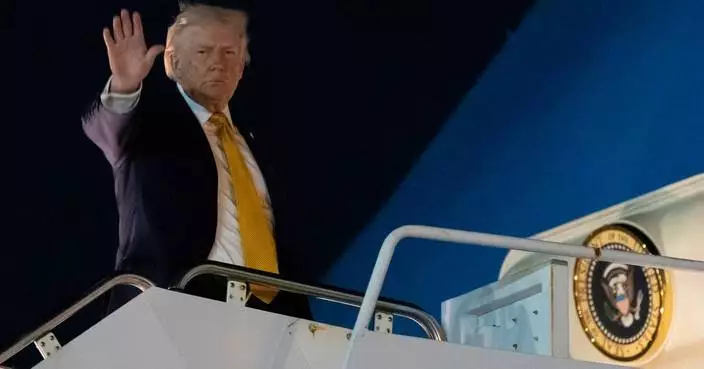
“There was a lot of death on the other side," Trump said aboard Air Force One as he flew back to Washington from his Mar-a-Lago estate in Florida. "No death on our side.”
The president's vow, repeated more than half a dozen times at a Florida news conference on Saturday, sparked concerns among some Democrats. It also drew unease from parts of his own Republican coalition, including an “America First” base that is opposed to foreign interventions, and from observers who recalled past nation-building efforts in Iraq and Afghanistan.
Rubio dismissed such criticism, saying Trump’s intent had been misunderstood.
“The whole foreign policy apparatus thinks everything is Libya, everything is Iraq, everything is Afghanistan,” Rubio said. "This is not the Middle East. And our mission here is very different. This is the Western Hemisphere.”
He also suggested the U.S. would give Maduro’s subordinates now in charge time to govern, saying, “We’re going to judge everything by what they do.” Though he did not rule out boots on the ground in Venezuela, Rubio said the U.S., which has built up its presence in the region, was already capable of stopping alleged drug boats and sanctioned tankers.
A day earlier, Trump had told reporters, “We’re going to run the country until such time as we can do a safe, proper and judicious transition.” He later pointed to his national security team with him, including Rubio and Defense Secretary Pete Hegseth, and said it would be done for a period of time by “the people that are standing right behind me. We’re gonna be running it, we’re gonna be bringing it back."
Despite Rubio's seeking to tamp down that notion, Trump reiterated Sunday that the U.S. would control Venezuela, saying, “We’re going to run everything."
“We’re going to run it, fix it,” he said Sunday. He added, "We’ll have elections at the right time” but didn't say when that might be.
A middle-of-the-night operation extracted Maduro and his wife, Cilia Flores, from their home in a military base in the capital city of Caracas — an act Maduro’s government called “imperialist.” The couple faces U.S. charges of participating in a narco-terrorism conspiracy.
The dramatic seizure capped an intensive Trump administration pressure campaign on Venezuela’s autocratic leader and months of secret planning, resulting in the most assertive American action to achieve regime change since the 2003 invasion of Iraq. Legal experts raised questions about the lawfulness of the operation, which was done without congressional approval.
Rodrígue z has called Maduro the country’s rightful leader, even as her nation’s high court named her interim president. So did Defense Minister Vladimir Padrino López, who sai the country's armed forces “categorically reject the cowardly kidnapping" and will “maintain internal order and peace.”
Asked about Rodríguez comments in which she stands by Maduro, Trump said, “I don’t think it’s pushback" and suggested her calling what occurred a kidnapping of Maduro wasn't "a bad term.”
Maduro is due to make his first appearance Monday in Manhattan's federal court.
He and other Venezuelan officials were indicted in 2020 on narco-terrorism conspiracy charges, and the Justice Department released a new indictment Saturday of Maduro and his wife that painted his administration as a “corrupt, illegitimate government” fueled by a drug-trafficking operation that flooded the U.S with cocaine. The U.S. government does not recognize Maduro as the country’s leader.
Venezuela’s government kept operating as usual over the weekend as ministers remained in their posts.
The capital was unusually quiet Sunday with few vehicles moving around and convenience stores, gas stations and other businesses closed.
Maduro’s son, lawmaker Nicolás Ernesto Guerra, has not appeared in public since the attack. On Saturday, he posted on Instagram a government statement repudiating the capture of his father and stepmother.
The country’s incoming National Assembly is set to be sworn in at the legislative palace in Caracas. The unicameral assembly will remain under control of the ruling party.
Under Venezuelan law, Rodríguez would take over from Maduro. Rodriguez stressed during a Saturday appearance on state television that she did not plan to assume power, before Venezuela’s high court ordered that she assume the interim role.
Trump told The Atlantic in an interview Sunday that Rodríguez could “pay a very big price” if she doesn’t do what he thinks is right for Venezuela. Speaking to reporters later, Trump said Rodríguez is “cooperating” but reiterated the threat. He said he wanted her to provide “total access,” from major oil operations to basic infrastructure like roads, so all can be rebuilt.
His warning contrasted with his comments about Rodríguez on Saturday when he said Rubio had spoken with her and she was willing to do what the U.S. thinks is needed to improve the standard of living in Venezuela.
Garcia Cano reported from Caracas, Venezuela. Associated Press writers Darlene Superville aboard Air Force One and Jorge Rueda in Caracas, Venezuela, contributed to this report.
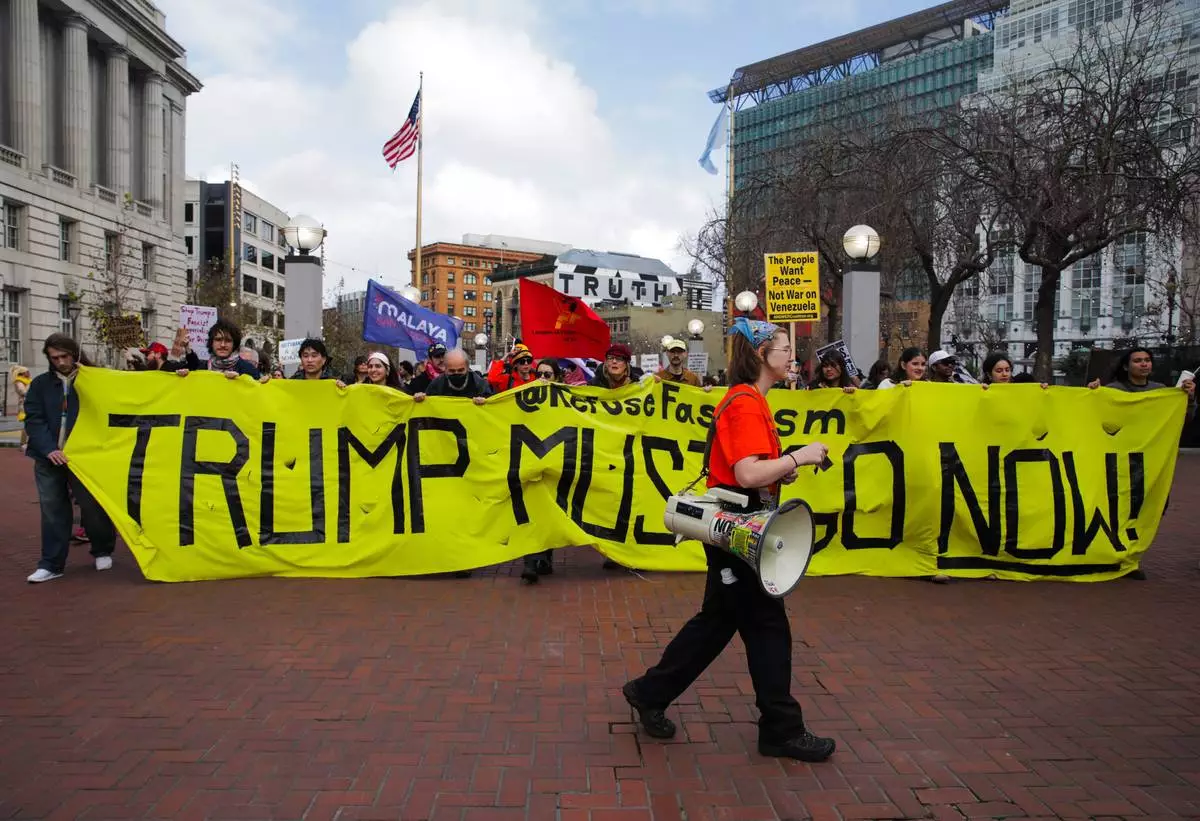
Protestors hold a banner stating "Trump Must Go Now" as they gather outside the UN Plaza during a demonstration against the U.S. bombing of Venezuela and seizure of Venezuelan President Nicolás Maduro, in San Francisco on Saturday, Jan. 3, 2026. (Yalonda M. James/San Francisco Chronicle via AP)
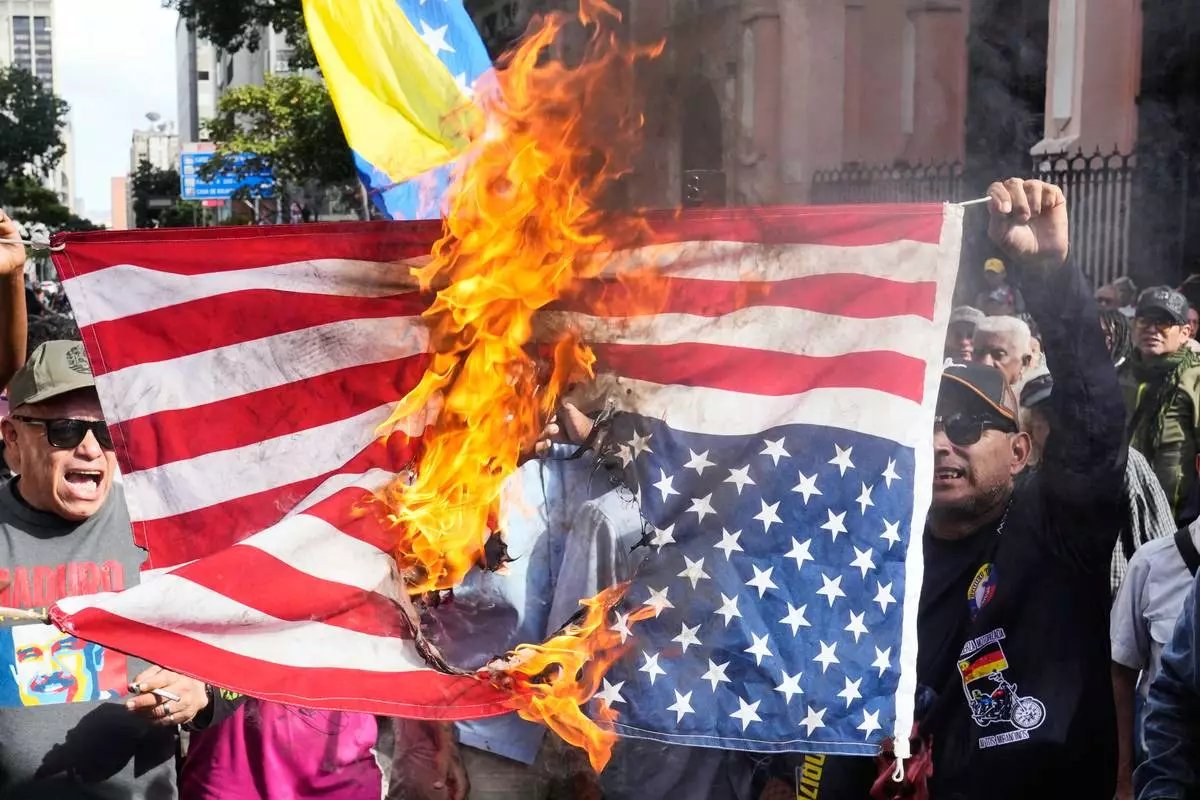
Government supporters burn a U.S. flag in Caracas, Venezuela, Saturday, Jan. 3, 2026, after U.S. President Donald Trump announced that U.S. forces had captured Venezuelan President Nicolás Maduro and his wife. (AP Photo/Ariana Cubillos)
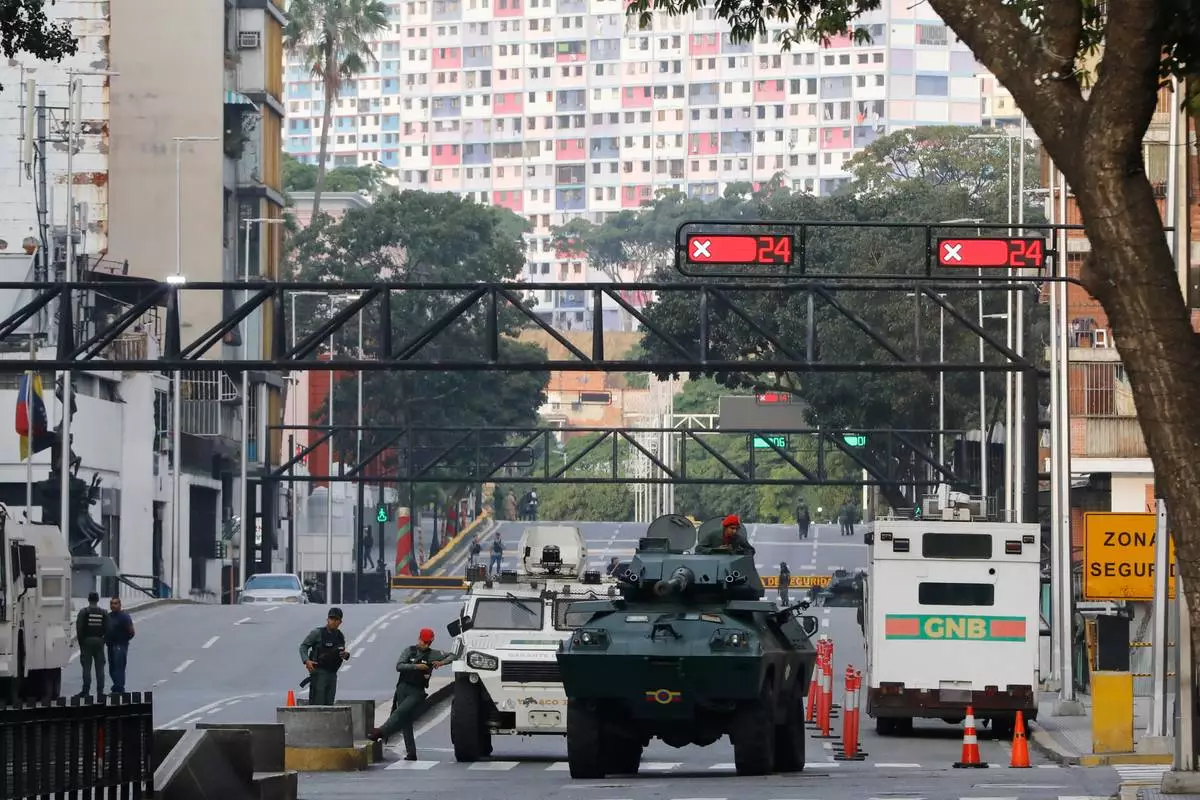
National Guard armored vehicles block an avenue leading to Miraflores presidential palace in Caracas, Venezuela, Saturday, Jan. 3, 2026. (AP Photo/Cristian Hernandez)
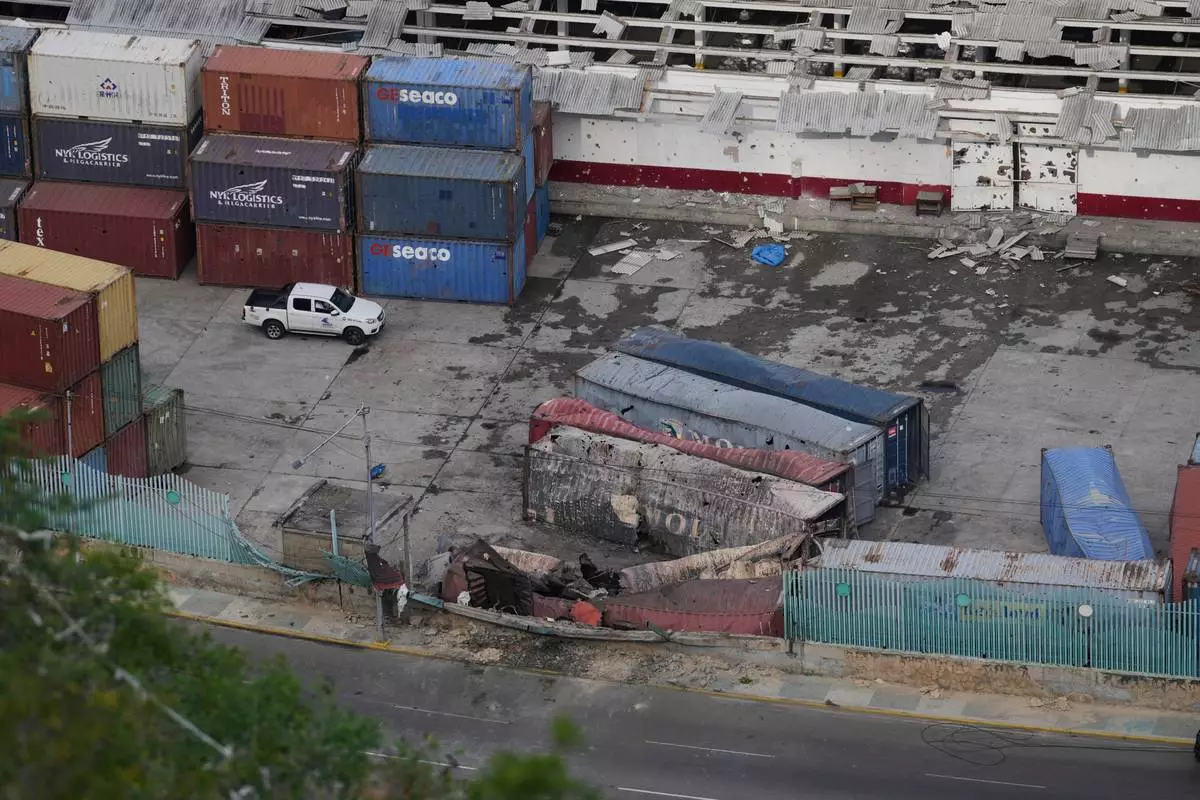
Destroyed containers lay at La Guaira port after explosions were heard in Venezuela, Saturday, Jan. 3, 2026. (AP Photo/Matias Delacroix)
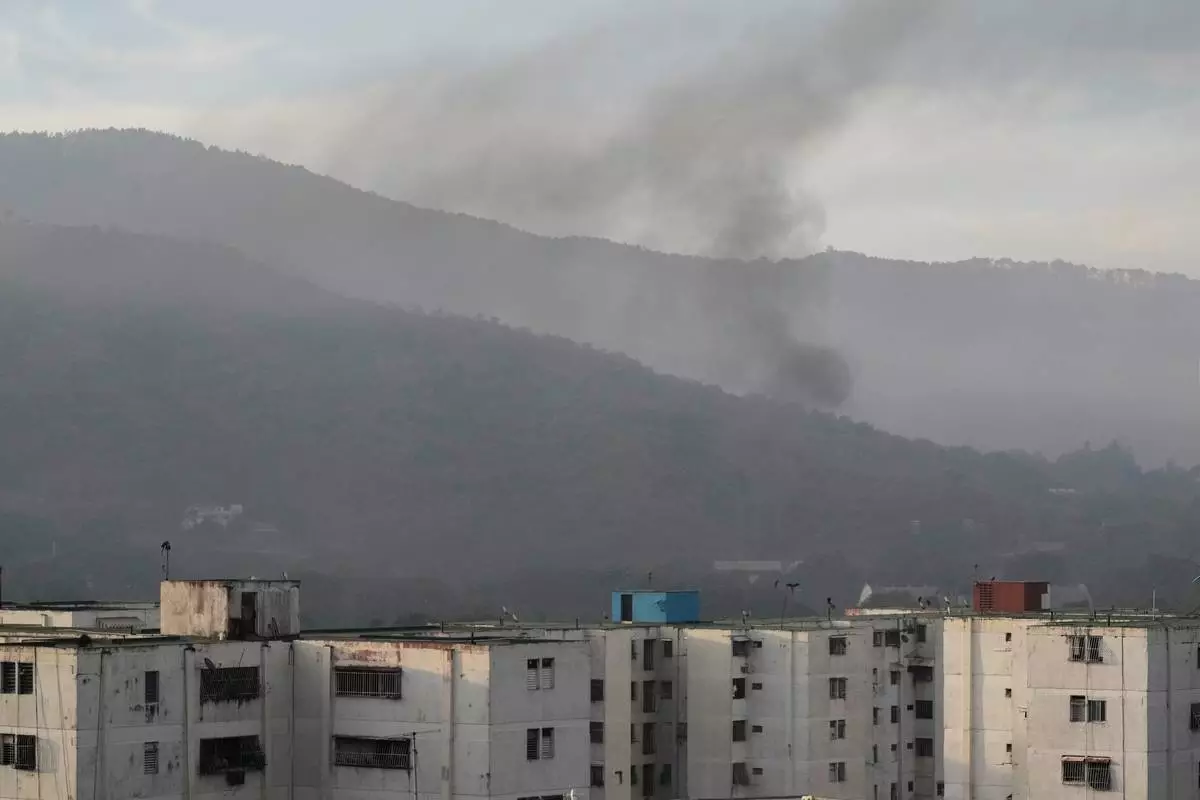
Smoke rises from Fort Tiuna, the main military garrison in Caracas, Venezuela, after multiple explosions were heard and aircraft swept through the area, Saturday, Jan. 3, 2026. (AP Photo/Matias Delacroix)
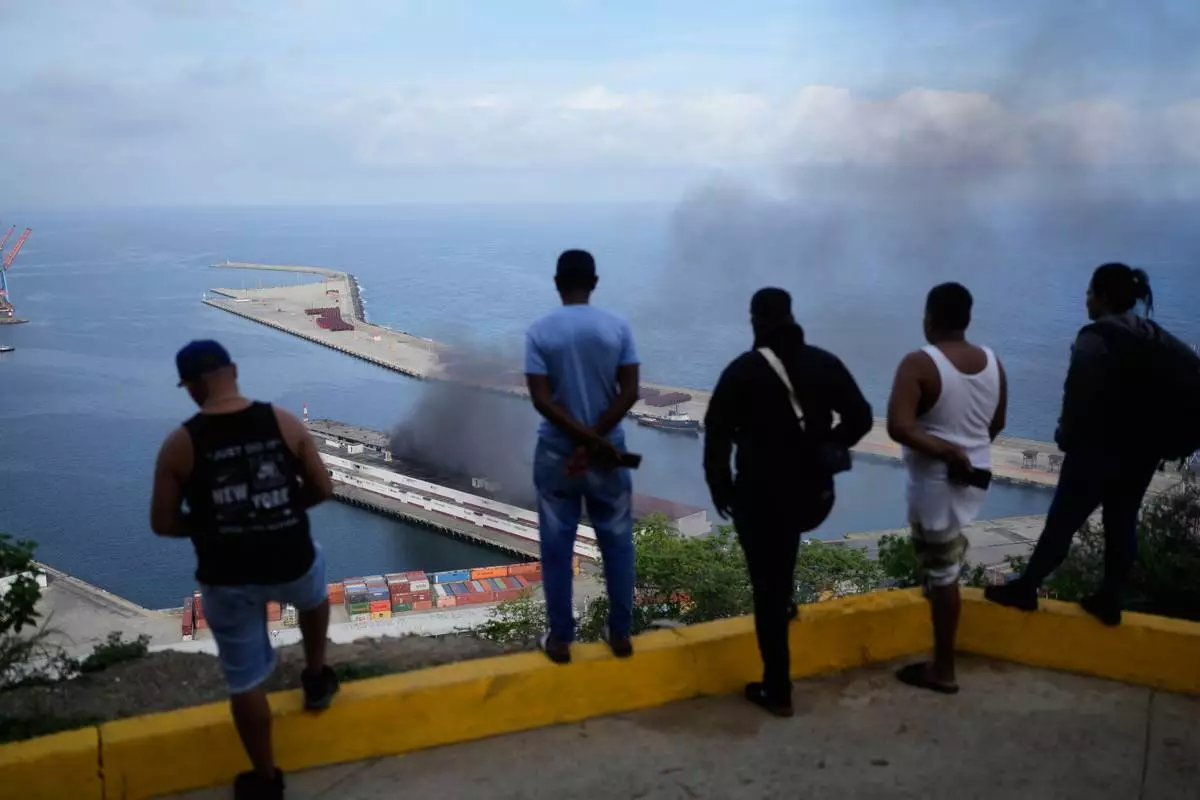
Men watch smoke rising from a dock after explosions were heard at La Guaira port, Venezuela, Saturday, Jan. 3, 2026. (AP Photo/Matias Delacroix)
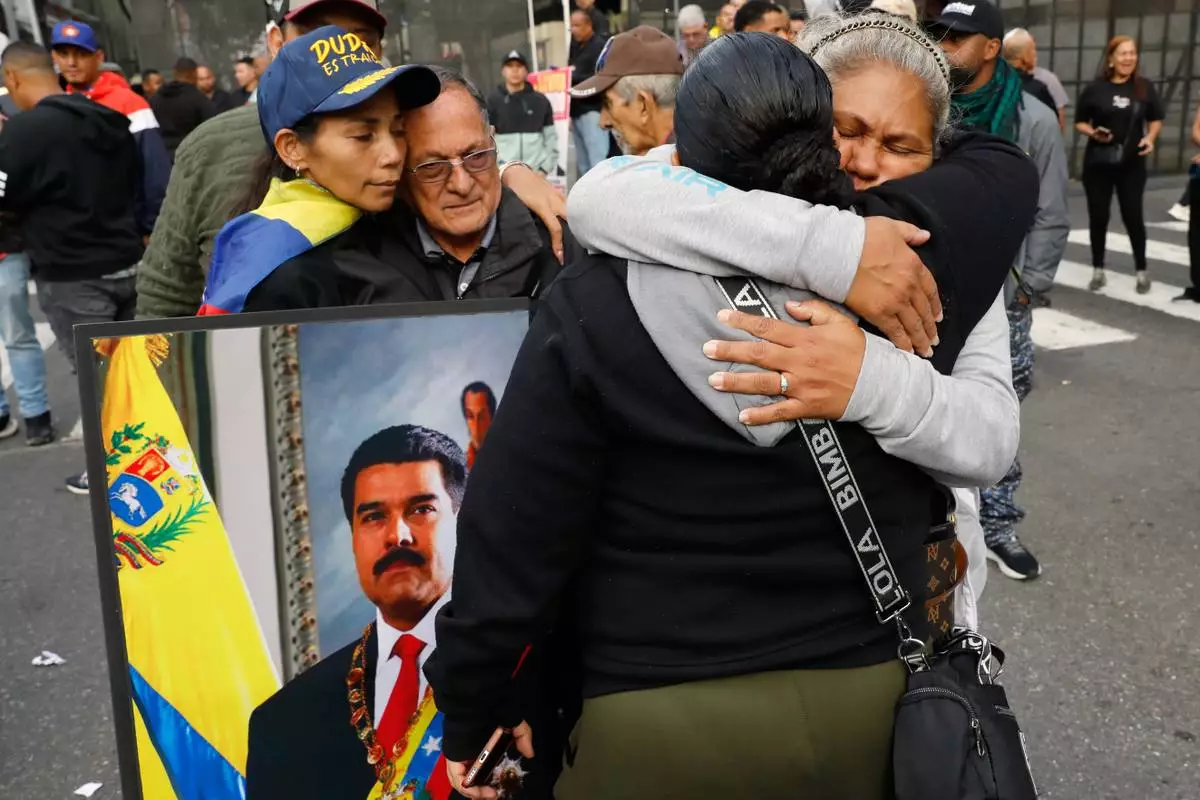
Supporters of Venezuelan President Nicolás Maduro embrace in downtown Caracas, Venezuela, Saturday, Jan. 3, 2026, after U.S. President Donald Trump announced that Maduro had been captured and flown out of the country. (AP Photo/Cristian Hernandez)