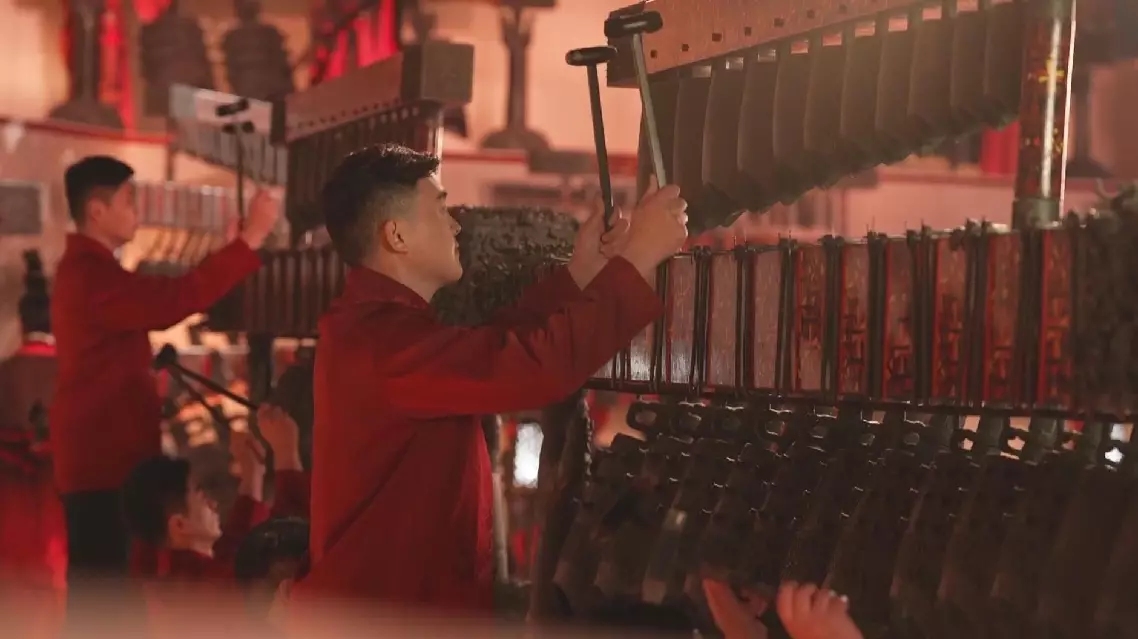
A music performance featuring an iconic ancient Chinese instrument, Bianzhong, will hit the stage of the Spring Festival Gala from the show's sub-venue in Wuhan, Hubei Province.
Bianzhong, or chime bells, is an instrument with over 3,000 years of history and one of the earliest instruments found throughout Chinese history.
This year's Spring Festival Gala will feature an instrumental performance linking its four sub-venues. For its part, Hubei, where the earliest Bianzhong were discovered, is putting the ancient instrument on the center stage, with performance rehearsals in full swing.
Production is underway, led by a mysterious musician whose identity remains a secret until the big night.
On set, over 30 sets of Bianzhong were used, each set contains 58 single bell.
"There are main bells, or 'Yong' bell, and 'Niu' bell. The person playing the large bells stands in the front, while those playing the Niu Bell are positioned behind,"said Jiang Jun, member of the Hubei Provincial Opera and Dance Drama Theater.
Striking each bell may seem simple, but achieving harmonious sound is no way an easy task.
The sub-venues of the Spring Festival Gala have always been a celebration of local culture and history.
Leading the charge is director Zhang Min. Last year, she also helmed the Xi'an sub-venue, captivating audiences with a stunning display of rich cultural history.
"Both cities are rich in cultural heritage, but Wuhan's distinct characteristics can be found in its concept of 'metropolis of grand rivers and lakes'. This gives it a unique grandeur and sets it apart from the Xi'an sub-venue in terms of presentation style. We aim to deliver a powerful, emotional, and story-driven narrative," Zhang said.
The annual Spring Festival Gala produced by China Media Group (CMG), also known as "Chunwan" in Chinese, has been seen as a major cultural symbol for the traditional Lunar New Year celebrations in China since its debut in 1983. This year's event will be aired on Jan 28, the eve of the Chinese Lunar New Year.
Wuhan, along with Wuxi, Chongqing and Lhasa were selected as this year's sub-venues to complement the main venue in Beijing.
Ancient Bianzhong sound from Hubei to ring on Spring Festival Gala stage
Marking China's 11th Space Day, the China National Space Administration (CNSA) introduced major space projects in the 15th Five-Year Plan period on Friday in Chengdu, the provincial capital of Sichuan in the southwest, the main venue of a series of events marking this day.
Jointly sponsored by the CNSA and the provincial government, the event revealed major sci-tech achievements and space industry updates, with Shan Zhongde, head of the CNSA, introducing China's major space projects to be implemented in the next five years.
"In the areas of entering space, utilizing space, exploring space, and governing space, we will intensify the efforts to carry out key projects including manned spaceflight, lunar probe, planetary probe, and the national satellite internet. We will pace up the demonstration and launch of a new generation of space-power initiatives such as heavy-lift rockets, reusable launch vehicles, and next-generation national space infrastructure. In the fields of lunar and planetary probe, asteroid defense, on-orbit service, and space debris mitigation, we will deepen international collaboration, build the International Lunar Research Station, have in-depth engagement in global space governance, and create an open and cooperative landscape for China's space industry to build a community with a shared future for mankind," Shan said.
The CNSA also released a series of updates marking the Space Day, including the latest lunar discoveries from the Chang'e-5 mission, two new minerals named magnesiochangesite-(Y) and changesite-(Ce), selected international partners for the Tianwen-3 Mars mission, announcement of international cooperation opportunities for the Xihe-2 mission, and the Version 1.0 of the Commercial Space Standards System.
On the same occasion, Xie Jun, deputy chief designer of the BeiDou system, Zhang Bing, member of the Chinese Academy of Sciences, and veteran astronaut Ye Guangfu, were appointed as the 2026 China Space Public Welfare Ambassadors.
More than 30 side events will take place across Chengdu during the Space Day period. Highlights include a space science exhibition at the Chengdu New International Convention and Exhibition Center, a VR sci-fi drama aimed at extending space knowledge, and the Space Wish Initiative launched by the China Media Group (CMG), inviting the public to share their stories related to space.
"We plan to put up over 30 activities in various forms with rich content for the Space Day to give people a feeling for the evolution and dynamism of China's space program. Aside from offering academic exchange platforms for professionals, we place more emphasis on engaging the public, particularly young people, in carrying forward the spirit and culture of space exploration," said Wang Cheng, secretary-general of the China Space Foundation.
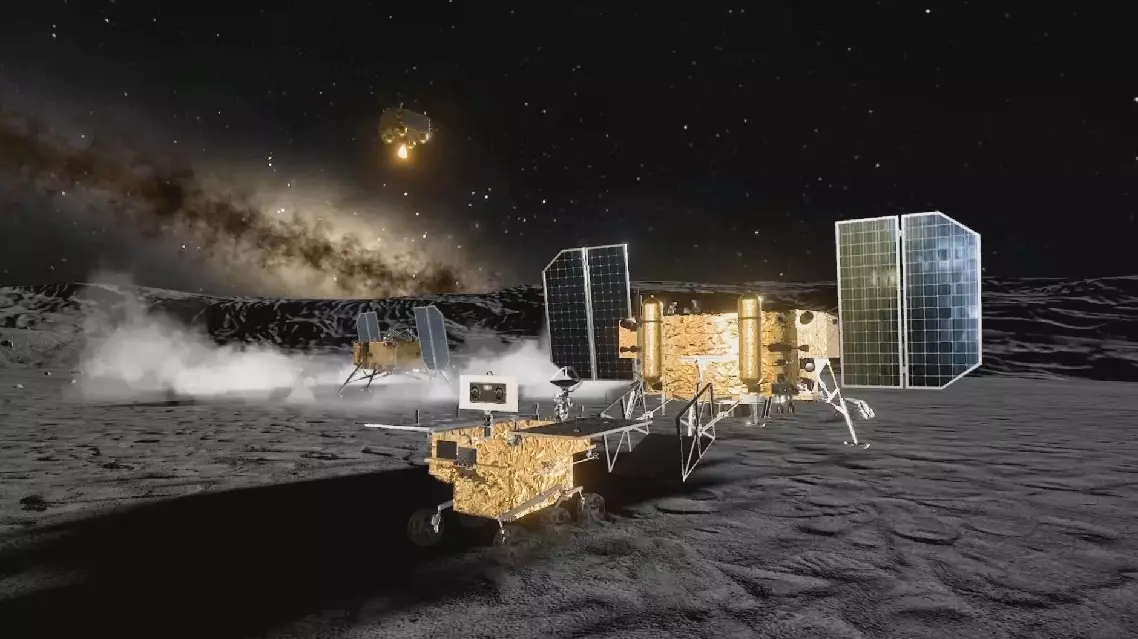
Officials introduces space projects in 15th 5-Year Plan period