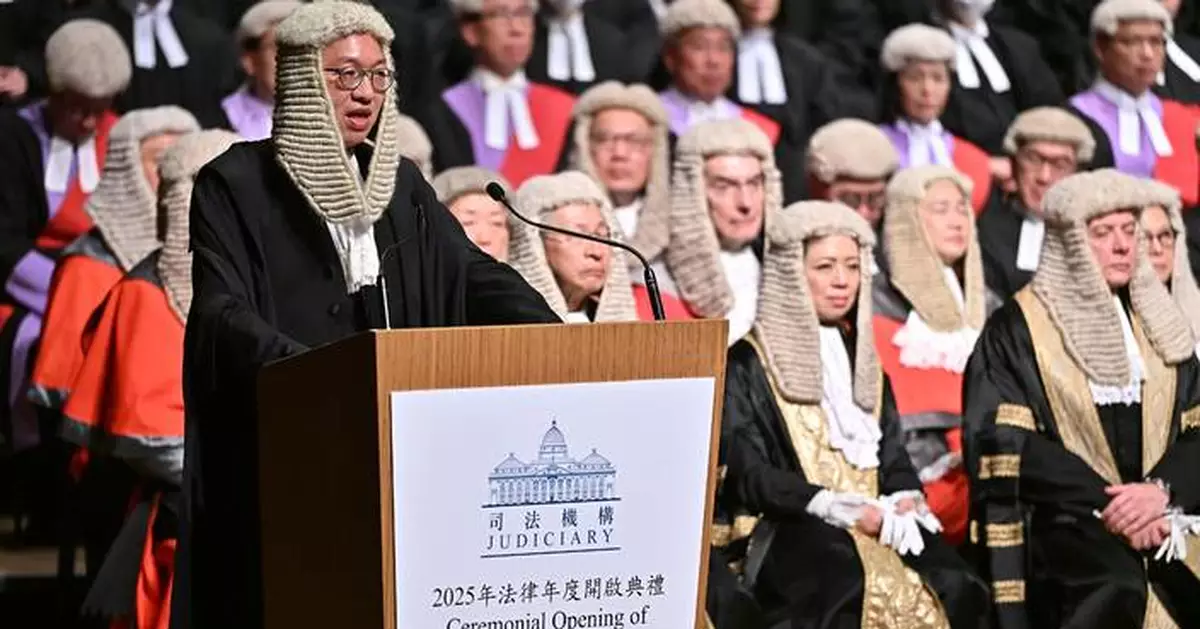
SJ's speech at Ceremonial Opening of Legal Year 2025
Following is the speech by the Secretary for Justice, Mr Paul Lam, SC, at the Ceremonial Opening of the Legal Year 2025 today (January 20):
Chief Justice, members of the Judiciary, Chairman of the Bar Association, President of the Law Society, distinguished guests, ladies and gentlemen,
The common law system of Hong Kong is undoubtedly one of the most important and distinctive institutional strengths of Hong Kong under the principle of "one country, two systems".
Adherence to the principle of "one country, two systems"
In President Xi Jinping's speech delivered on December 20, 2024, at the celebration of the 25th anniversary of Macao's return to the motherland and the inaugural ceremony of the sixth-term Government of the Macao Special Administrative Region, he stated that "one country, two systems" is a good system that sustains the long-term prosperity and stability of Hong Kong and Macao; it is a good system that facilitates endeavours to build China into a great country and achieve national rejuvenation; it is a good system for ensuring peaceful coexistence and mutual benefit between different social systems; and, therefore, it must be adhered to in the long run.
As an important legal measure proving that the principle of "one country, two systems" will not change, on July 5, 2024, the Extension of Government Leases Ordinance (Cap. 648) has come into operation. Under that Ordinance, subject to a few exceptions, Government leases which would expire on or after July 5, 2024, without any right of renewal may be renewed by operation of law for 50 years without any additional premium, which means that the term of these leases can be extended beyond 2047. The new mechanism has removed doubts with regard to the so-called "2047 deadline" and brought peace of mind to property owners, investors and financial institutions.
In the same speech delivered in Macao, President Xi also pointed out that four crucial values are embodied in the principle of "one country, two systems", namely, peace, inclusiveness, openness and sharing - they are relevant to not only China but also the whole world. These important values are indeed manifested by the common law system of Hong Kong, which serve not only the interests of the HKSAR (Hong Kong Special Administrative Region) and China but also the international community.
Peace
Let me start with peace. Events taking place in other parts of the world at this very moment remind us that peace and security cannot be taken for granted. Peace and security are indeed essential elements of the rule of law. The enactment of the Safeguarding National Security Ordinance in March 2024 discharged Hong Kong's constitutional duty under Article 23 of the Basic law, which had remained unfulfilled for over 26 years. The Ordinance aims to ensure that the hard-won peace and stability that we enjoy today can and will be preserved so that we can focus on social and economic development. Unless security is first safeguarded, it will be impossible for Hong Kong to utilise its unique strengths at full strength under the principle of "one country, two systems", and serve as an international financial, shipping and trade centre.
Section 2 of the Ordinance expressly states that one of the principles on which the Ordinance is based is that human rights are to be respected and protected, the rights and freedoms enjoyed under the Basic Law, the provisions of the International Covenant on Civil and Political Rights and the International Covenant on Economic, Social and Cultural Rights as applied to Hong Kong are to be protected in accordance with the law. Detailed provisions, which aim at giving effect to this principle, have been put into the Ordinance after consulting the relevant jurisprudence in other leading common law jurisdictions.
It is vital to bear in mind that the enforcement of the national security law is subject to the supervision of the Hong Kong court exercising its independent judicial power. While the concept of judicial deference to the executive's assessment on national security is well established under common law, the Court of Appeal in an important judgment decided in May 2024 that there are at least three areas where the court has been held to be qualified to make its own judgment while giving the executive deference: first, where a fundamental right of the person affected by the measure is engaged; second, where the requirement of a fair trial is in issue; and third, where the question of open justice is raised. Having regard to the important function of the Hong Kong Judiciary in this respect, anyone who intimidates judges handling national security cases or interferes with the relevant judicial proceedings in whatsoever manner cannot be genuinely concerned about the rule of law in Hong Kong.
Peace entails resolving disputes by peaceful means, which is yet another essential ingredient of the rule of law. Hong Kong is keen on promoting and facilitating the resolution of not only domestic but also international disputes by peaceful means. Negotiations on the Convention on the Establishment of The International Organization for Mediation were concluded in Hong Kong in October last year, and the signing ceremony for the Convention will be held in Hong Kong this year. The International Organization for Mediation (IOMed) will be the world's first intergovernmental international legal organisation dedicated to resolving international disputes of different natures through mediation. Most importantly, the state parties to the negotiation have agreed that the headquarters of IoMed shall be established in Hong Kong. The conversion of the old Wan Chai Police Station into the headquarters of the IoMed will be completed in mid-2025 in anticipation that it may start operation by the end of this year.
Inclusiveness and openness
Moving on to inclusiveness and openness, one of the most distinctive characteristics of Hong Kong's judicial system is that, as provided by the Basic Law, judges may be recruited from other common law jurisdictions. The departure of some foreign Non-Permanent Judges (NPJs) of the Court of Final Appeal (CFA) on different grounds in 2024 has attracted public attention. But one must not overlook that Lord Neuberger, the former President of the Supreme Court of the United Kingdom, has agreed to extend his term for three years from March 1, 2024; and Justice Allsop, the former Chief Justice of the Federal Court of Australia, was appointed for a term of three years from May 24, 2024. And most recently, Lord Hoffmann, the longest serving foreign NPJ first appointed back in 1998, has agreed to be reappointed for another three years from January 12 this year.
The participation of eminent foreign judges in the work of the CFA does not only benefit Hong Kong, but also the common law world as a whole. Let me give a most recent example. On December 23, 2024, the CFA delivered a landmark judgment written by Lord Hoffmann, with whom other judges agreed, which resolved an extremely important and difficult legal question of whether a claim to recover property obtained by an agent breaching his fiduciary duty is subject to a six-year limitation period by a provision in the Trustee Ordinance (Cap. 29). This statutory provision was based on a provision in the United Kingdom Limitation Act, and many other common law jurisdictions have the same provision. The judgment of the CFA has now become the most authoritative statement of the law in this respect, which will undoubtedly be relevant to and applied in other common law jurisdictions.
It is most regrettable that there were attempts mainly from overseas to exert improper pressures on foreign judges to dissociate themselves from the Hong Kong court. These attempts pose a threat to not only the rule of law in Hong Kong but also the development of common law in general. The Government is in full support of the Judiciary in its continuous efforts to appoint and retain foreign NPJs in future.
Sharing
Turning to sharing, Hong Kong has always been an international centre of capacity building and experience sharing among legal professionals from different jurisdictions. Again, let me give one example. The 26th Congress of the International Council for Commercial Arbitration (ICCA), known as the "Olympics of international commercial arbitration", was held between May 5 and 8, 2024, in Hong Kong. The Congress had attracted more than 1 400 delegates from over 70 jurisdictions, making it the best attended ICCA Congress ever.
To strengthen our efforts in this respect, the Department of Justice established the Hong Kong International Legal Talents Training Academy in November 2024. The Academy is advised by an expert committee, which consists of international legal experts such as the Secretary General of the Hague Conference on Private International Law (HCCH), and the Secretary-General of the International Institute for the Unification of Private Law (UNIDROIT).
Let me give one example of our plan for this year in this respect. Climate change is one of the biggest challenges that mankind is facing. In March 2025, the Department of Justice and the United Nations Commission on International Trade Law (UNCITRAL) will co-organise a conference on international trade law and climate change.
Conclusion
The Hong Kong Government will continue to do its best to utilise Hong Kong's common law system to uphold and promote the important values of peace, inclusiveness, openness and sharing both locally and internationally. But the Government cannot, and is not, doing it alone. The Judiciary, the Department of Justice and the two independent legal professional bodies represent the four main pillars supporting Hong Kong's legal system. While we perform different roles and functions, we share the same strong sense of mission, and the same high degree of determination to maintain and enhance the rule of law in Hong Kong. I am confident that our solidarity would enable us to overcome whatever challenges that may lie ahead.
I wish to conclude by wishing you and your families a happy new year and, as the Chinese New Year is approaching, also a happy Chinese New Year of the Snake.
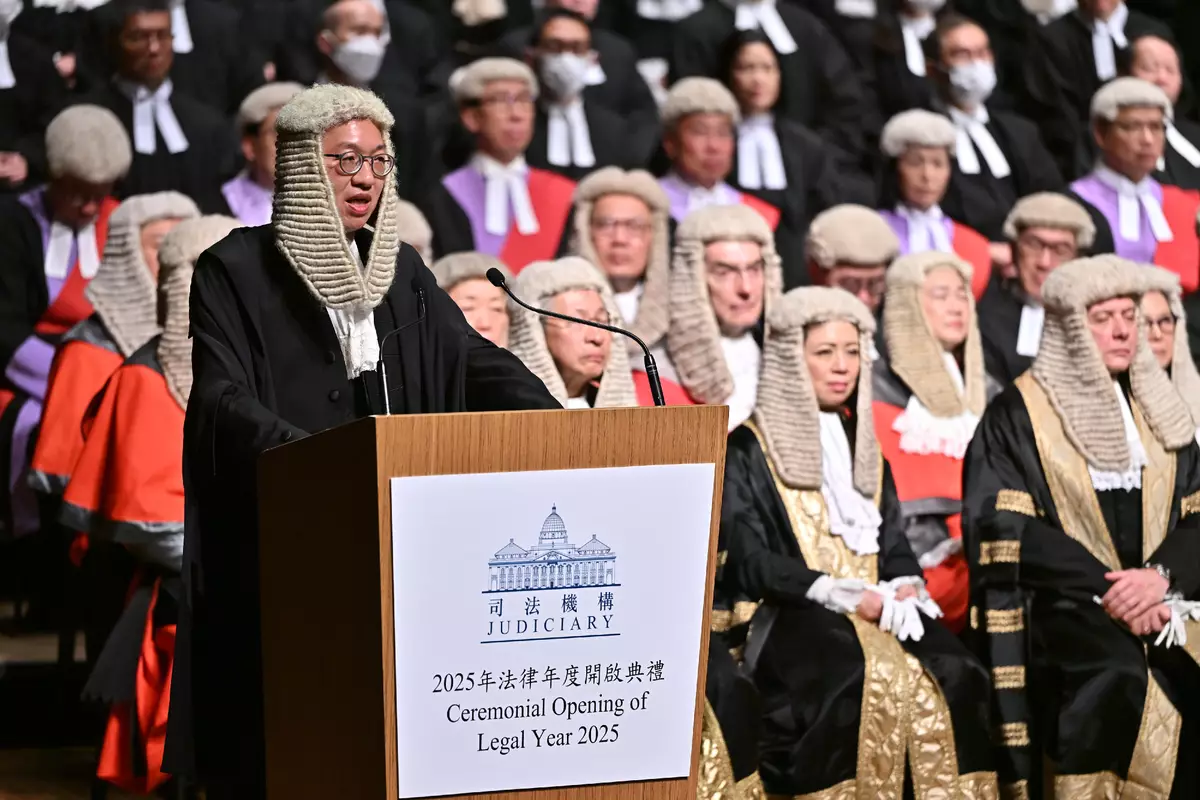
SJ's speech at Ceremonial Opening of Legal Year 2025 Source: HKSAR Government Press Releases