A remarkable collection of carefully selected 258 pieces of jade artifacts from the storerooms of the emperors is being exhibited at Beijing's Palace Museum, demonstrating the versatility of Hetian Jade.
As a cornerstone of Chinese jade culture, Hetian Jade, one of the world's finest jades produced in present-day Xinjiang Uygur Autonomous Region's Hotan area, has been integral to Chinese rituals and traditions, symbolizing social status and cultural values.
Titled "Jade from the Kunlun Mountains: Special Exhibition on Hetian Jade Culture in the Qing Court," the event has showcased exquisite cultural relics ranging from royal seals and ritual artifacts to carvings and miscellaneous articles of daily use during the Qing Dynasty (1644-1911). Among them 130 precious cultural relics made their debuts.
According to Huang Ying, curator of the jade exhibition, the highlights of the exhibition include a white jade statue of bixie -- a mythical lion-like creature believed to ward off evil spirits -- and an heirloom seal of the Qing Dynasty.
"The jade figure of bixie is from the Western Han Dynasty (202 BC-25 AD). Crafted from top-tier Hetian Jade, it is the earliest known jade artifact in the collection of the Palace Museum. The second key exhibit is a seal of the Qing Dynasty (1644-1911), which is also the first of the 25 cardinal seals of the Qing Dynasty (1644-1911). It symbolizes the legitimate status of Qing emperors as divinely chosen rulers. Crafted from Hetian Jade, the rare treasure is the most significant one among the seals of the Qing Empire. It's prominently displayed in the center of the showcase. So, this exhibit is a must-see for all visitors," Huang said.
Hetian Jade artifacts of daily use, including accessories and vessels also added a touch of class and elegance to the court. Huang also recommends seeing a set of jade ornaments with ingenious designs that can be disassembled and recombined.
"A group of white jade pendants is made from a single piece of Hetian Jade. When separated, it consists of twelve petal-shaped pendants and a circular stamen-shaped decoration. But when combined, it forms a large floral design. Each of the 12 petal-shaped pendants represents one of the 12 months, showcasing an ingenious design concept. In terms of craftsmanship, the center of the stamen features intricate hollow-carving work that allows for rotation. This hollow-carving technique was exceptionally refined at that time and was also a unique art, which is extremely rare," Huang said.
Launched on Jan 7, 2025, the exhibition will run till Jan 4, 2026.
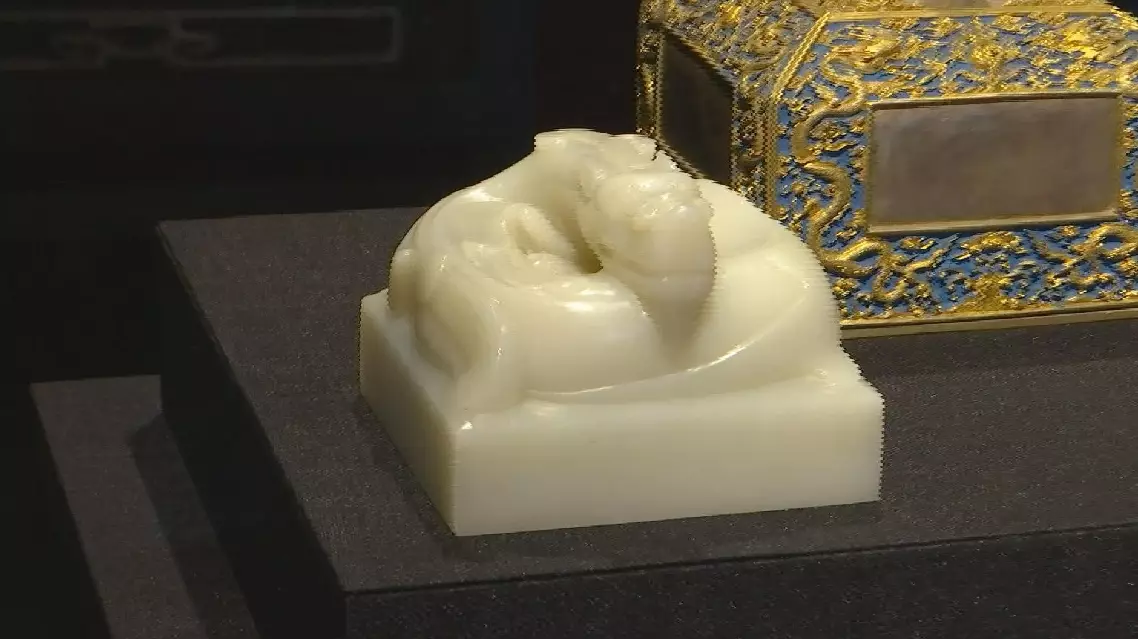
Exhibition on Hetian jade culture held at Palace Museum in Beijing