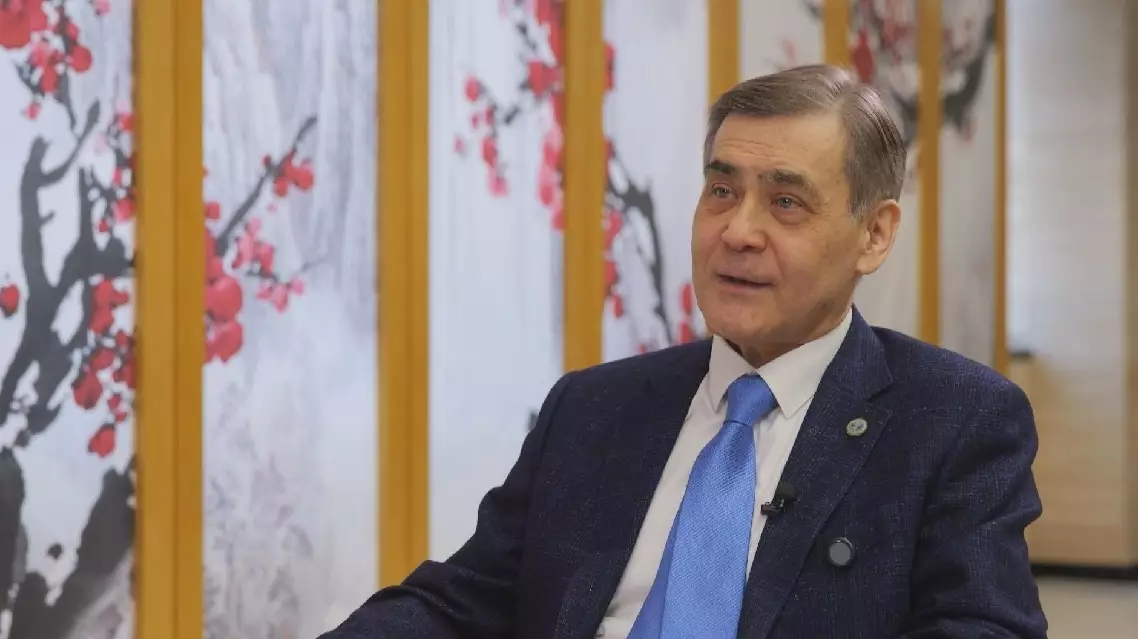
Nurlan Yermekbayev, the newly appointed secretary-general of the Shanghai Cooperation Organization (SCO), has laid out the priorities for the work of the organization this year, as it faces both new opportunities and challenges.
Yermekbayev, a veteran diplomat and former defense minister of Kazakhstan, officially took office as the SCO chief on Jan 1 for a three-year term.
The SCO, the world's largest and most populous regional cooperation organization, plays a significant role in global diplomacy. Since the SCO Summit in Astana last July, China has officially assumed the rotating presidency for 2024-2025.
Speaking in an exclusive interview with China Central Television (CCTV) in Beijing, Yermekbayev emphasized the growing influence of the SCO, stressing the need to transform the increasing number of meetings and events into practical outcomes that benefit member states.
"An increasing number of countries seek to join the Shanghai Cooperation Organization or upgrade their position within it. We are actively collaborating with these countries. At present, our top priority is to translate the quantity of meetings and events into meaningful outcomes. In other words, achieving tangible, practical results that benefit the peoples of our nations," Yermekbayev said.
Discussing the secretariat's priorities for the year, Yermekbayev underscored that supporting China's presidency would be central to the organization's work in 2025.
"During China's tenure as the rotating president, the theme of 'SCO Year of Sustainable Development' has been introduced, which is of great practical significance. Sustainable development encompasses a wide range of issues, from ecology and green energy to food security, education, and healthcare. China is organizing a variety of forums, conferences, and other events focused on these areas," said Yermekbayev.
With China taking the rotating presidency for 2024-2025, much attention is on how it will guide the SCO to capitalize on these opportunities while addressing the challenges that lie ahead.
"With the expansion of membership, the first challenge the Shanghai Cooperation Organization faces is how to strengthen unity among the members. The external environment for the SCO may become even more challenging. However, the SCO is an organization built on openness and cooperation, not confrontation. Creating a favorable external environment remains a shared issue for all SCO member states. Amid a rapidly evolving and complex regional security landscape, where traditional and non-traditional security threats abound, enhancing security cooperation among member states presents a significant challenge," said Ding Xiaoxing, Deputy Secretary-General of the Academic Committee at the China Institute of Contemporary International Relations.
Since China assumed the presidency, a number of key projects have advanced, including the launch of the first international road transport system connecting the China-SCO Local Economic and Trade Cooperation Demonstration Zone to Uzbekistan.
More products from fellow SCO members are also entering the Chinese market, signaling the organization's increasing practical impact.
Just this month, China unveiled the official emblem for the SCO rotating chair, further underscoring the momentum behind its leadership.
"A key development during China's presidency is the ongoing improvement and enhancement of the SCO's operations. China has already begun actively preparing for the SCO Heads of State Council meeting, this year's most important event, to be held here. A number of key resolutions and documents will be adopted during the meeting, including the SCO Declaration, a significant political document. Moreover, the 'SCO Development Strategy until 2035,' another crucial document, will also be approved at the meeting," Yermekbayev concluded.
The SCO is a permanent intergovernmental international organization established on June 15, 2001 in Shanghai by China, Kazakhstan, Kyrgyzstan, Russia, Tajikistan and Uzbekistan. Its membership has since expanded to include India, Pakistan, Iran and Belarus.
Shanghai Cooperation Organization's new chief lays out priorities for 2025 work